Atlantic Ocean
Eight arms, one mind, and every shelf the Atlantic tide will reach.

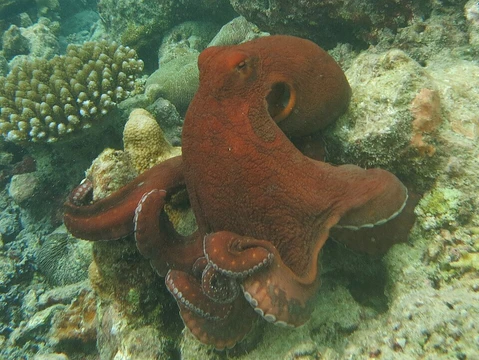
The common octopus (Octopus vulgaris) is a highly adaptable cephalopod whose range spans the Atlantic Ocean from the temperate North Atlantic to the subtropical waters bordering West Africa, the Caribbean, and the southeastern United States. As a benthic predator, it occupies rocky outcrops, coral rubble, seagrass meadows, and artificial structures at a wide range of depths, serving as both a keystone mid-level predator and a prey item for larger fish and marine mammals.
Within the broader Atlantic ecosystem, the species functions as a mobile forager that links benthic invertebrate communities to pelagic energy flows. Its capacity to alter skin chromaticity, texture, and body shape in real time makes it one of the most visually conspicuous yet cryptic animals on Atlantic coastal shelves.
- Class
- Cephalopoda
- Order
- Octopoda
- Family
- Octopodidae
- Primary distribution
- Atlantic Ocean and adjacent marginal seas
- Habitat type
- Benthic, shallow to mid-shelf
- Substrate preference
- Rocky, coral rubble, seagrass, artificial structures
Lore & Background
In the Atlantic, the common octopus is a generalist par excellence. Along the Iberian and French coasts it shelters in crevices of granite boulders and the broken coral of the Mediterranean-Atlantic interface; along the Gulf of Guinea it exploits the dense seagrass and mangrove-root tangles of the inner shelf; and off the Carolinas it is frequently encountered on the sunken hulls and pilings of the historic shipping lanes that scar the seabed. This breadth of microhabitat use is underpinned by a nervous system in which roughly half of the neurons reside in the arms, granting each limb a degree of semi-autonomous foraging behaviour.
Reproductively, the Atlantic population is characterized by a semelparous life cycle: the male transfers spermatophores via the hectocotylus (a specialized eighth arm), after which both sexes decline and die within weeks to months. Females guard a single clutch of eggs, fanning them with their arms and refusing to feed, a behaviour that has been documented in both wild Atlantic populations and laboratory settings. This single reproductive event means that each cohort is a discrete pulse of recruitment into the local benthic community.
The species' ecological significance in the Atlantic is amplified by its role as a predator of bivalves, crabs, and small fish, and as prey for groupers, moray eels, and, in deeper waters, sharks and large jacks. Its presence or absence is therefore a useful indicator of benthic community health along Atlantic coastlines, and its sensitivity to hypoxia and temperature shifts has made it a sentinel species in several regional monitoring programmes.
Reader's Guide
North Atlantic (Iberian, French, British coasts): The species favours rocky intertidal to subtidal zones, typically from the low-tide line down to roughly 50–100 m. Substrate is dominated by granite boulders, shell gravel, and the broken coral of the Alboran Sea. Seasonal upwelling along the Portuguese and Breton coasts drives the octopus into deeper crevices in summer and toward shallower foraging grounds in autumn. The ecological significance here is the high density of bivalve beds (mussels, oysters) that form the primary prey base.
Tropical and subtropical West Africa (Gulf of Guinea, Senegambia): Habitat shifts to seagrass meadows, mangrove root systems, and coral rubble on the inner shelf, generally 2–30 m. The warm, low-salinity plumes of major rivers create patchy zones where the octopus exploits the dense invertebrate fauna. Recruitment pulses follow the rainy-season runoff.
Western Atlantic (Caribbean, Gulf of Mexico, southeastern U.S. shelf): The species is common on artificial substrates—sunken vessels, pilings, reef blocks—as well as natural coral and seagrass. Depths range from the intertidal to approximately 100 m. The ecological role here is pronounced: the octopus is a top benthic predator in many of these habitats, and its predation pressure on crabs and bivalves shapes the local community structure. Seasonal movement is minimal; the animal is largely sedentary, shifting microhabitat only in response to spawning or thermal stress.
Did You Know?
- Roughly half of a common octopus's neurons are distributed in its arms rather than its brain, giving each limb a degree of independent sensory and motor control.
- The species is semelparous: after a single reproductive event, both the male and the female die, making each cohort a discrete pulse of benthic recruitment.
- In the Atlantic, the octopus is frequently found on artificial structures—sunken ships, pilings, and reef blocks—sometimes at densities exceeding those on natural substrate.
- The specialised eighth arm (hectocotylus) used for spermatophore transfer in males is a derived trait within the order Octopoda and is not present in all cephalopod lineages.
More in Distribution & Habitat
Elsewhere in Big blue octopus
Spotted an error? Know more?
Reader corrections go straight into our review queue. Suggest an edit · How this site is sourced