Hemocyanin
The blue blood of the sea, carried not in cells but in open, copper-laden plasma.

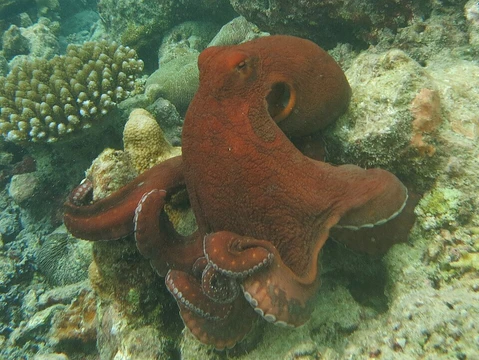
Hemocyanin is a copper-based respiratory metalloprotein dissolved in the hemolymph of many molluscs (octopuses, squids, snails) and arthropods (crabs, lobsters, centipedes). It functions as the primary oxygen-transport molecule in these invertebrates, binding O₂ at a binuclear copper center and releasing it to metabolizing tissues. Unlike vertebrate hemoglobin, hemocyanin is not enclosed in red blood cells; it circulates freely in the open circulatory fluid, and its oxygenated form imparts the characteristic blue coloration seen in the blood of octopuses and crustaceans.
The protein is among the largest known biological molecules. In molluscs it typically assembles as a hexamer of six subunits, each subunit carrying a pair of copper ions that together form the oxygen-binding site. The enormous size, the copper (rather than iron) coordination chemistry, and the open-system solubility distinguish hemocyanin from any vertebrate respiratory protein and make it a central subject in comparative physiology and marine biochemistry.
- Type
- Copper-based respiratory metalloprotein
- Phyla in which found
- Mollusca and Arthropoda
- Oxygenated appearance
- Blue (Cu(II)–O₂ complex)
- Deoxygenated appearance
- Colorless to pale yellow (Cu(I))
- Metal center per subunit
- Binuclear copper (2 Cu atoms)
- Circulatory context
- Dissolved in hemolymph; open circulatory system
- Molluscan oligomeric state
- Hexamer (6 subunits)
Lore & Background
In the open circulatory system of a cuttlefish or a blue crab, hemocyanin drifts freely through the hemolymph rather than riding inside erythrocytes. Each subunit presents a binuclear copper site: two Cu atoms held in a defined geometry by histidine and methionine ligands. When O₂ diffuses in, both coppers are oxidized from Cu(I) to Cu(II), the O₂ molecule bridges the two metals in a side-on fashion, and the resulting Cu(II)–O₂–Cu(II) unit absorbs strongly in the red-orange region of the visible spectrum, scattering blue light back to the observer. The reverse reaction, O₂ release at a tissue, returns the coppers to Cu(I) and the local hemolymph fades to nearly colorless.
The evolutionary origin of hemocyanin is distinct from that of hemoglobin. The two proteins share no significant sequence homology; they are convergent solutions to the same problem of oxygen transport. Hemocyanin's copper center is thought to have been recruited from a pre-existing detoxification or peroxidase-type enzyme, whereas hemoglobin's heme-iron center traces back to a different ancestral metalloprotein. This independent origin is one reason the two systems differ so markedly in molecular architecture, oligomeric state, and the thermodynamics of O₂ binding.
In marine settings, hemocyanin's O₂ affinity is tuned to the cooler, higher-pressure waters in which many of its host species live. The hexameric molluscan form, for example, exhibits a relatively steep oxygen-dissociation curve, allowing efficient loading in the gill blood and unloading in the mantle or muscle tissue. The protein's sheer size—on the order of several megadaltons for the full hexamer—also means it is retained in the vascular space by size exclusion at capillary-scale pores, reducing the need for a closed circulatory system.
Reader's Guide
Binuclear copper center: The functional heart of hemocyanin. Two copper ions sit in a defined pocket of the protein, held by histidine and methionine side chains. In the deoxygenated state both are Cu(I); upon O₂ binding both shift to Cu(II) and the O₂ molecule bridges them. This single site is all that is needed to bind one O₂ molecule, and it is the source of the protein's blue color. Scale: the two Cu atoms occupy a volume roughly 0.5 nm across, a tiny fraction of the full subunit.
Subunit (monomer): In molluscs each subunit is a single polypeptide of roughly 1,000+ amino-acid residues, giving a monomer mass on the order of 1 MDa. The subunit contains the copper-binding pocket near its N-terminus and a large, mostly β-sheet structural scaffold that positions the copper ligands precisely. Scale: one subunit is about one-sixth of the full hexameric particle.
Hexamer (molluscan oligomer): Six subunits assemble into a roughly disc-shaped particle approximately 10–12 nm in diameter. This is the form that circulates in the hemolymph of octopus, squid, and many gastropods. Its size is roughly 100× the diameter of a hemoglobin tetramer, making it one of the largest soluble proteins in nature.
Hemolymph / open vascular space: Hemocyanin is not caged in a cell. It is dissolved directly in the plasma-like fluid that bathes the organs in the open circulatory system. This means the protein is exposed to the full ionic environment of the body cavity, and its O₂ affinity is modulated by pH, Mg²⁺, and osmotic pressure rather than by the intracellular milieu of a red blood cell. Scale: the hemolymph volume in a medium-sized octopus is on the order of a few millilitres, yet it carries the full oxygen load for the animal.
Remarkable comparison: No vertebrate respiratory protein matches hemocyanin's combination of copper chemistry, cell-free solubility, and megadalton-scale oligomerization. The protein is a unique solution to oxygen transport, evolved independently of the iron-heme system that dominates the vertebrate world.
Did You Know?
- Hemocyanin's blue color is not a pigment in the usual sense; it is the visible-light absorption of the Cu(II)–O₂–Cu(II) complex, which absorbs strongly around 600–650 nm and reflects blue.
- The molluscan hemocyanin hexamer (roughly 6.5 MDa) is approximately 100 times larger by mass than a human hemoglobin tetramer (~64 kDa), yet both carry the same essential function of shuttling O₂.
- Hemocyanin and hemoglobin are not homologous proteins; they are convergent, independently evolved solutions to oxygen transport, with no shared ancestral sequence.
- In the deoxygenated state the copper ions are Cu(I) and the protein is essentially colorless, so a crab's blood appears pale or clear until it is exposed to air and oxidized.
More in Anatomy & Physiology
Elsewhere in Big blue octopus
Spotted an error? Know more?
Reader corrections go straight into our review queue. Suggest an edit · How this site is sourced