Where Big blue octopus has been recorded
GBIF occurrence records for Octopus cyanea, mapped and tabulated by country.

4,354 georeferenced occurrence records with coordinates are published for Octopus cyanea through GBIF, from 60 countries or marine areas. This page maps those records and lists where they come from. Occurrence records reflect where people have looked as well as where the species lives, so well-surveyed coastlines are over-represented.
- Georeferenced records
- 4,354
- Countries / areas
- 60
- Mapped locations
- 335
- Records sampled for the map
- 3,000
- Inland records omitted
- 45
- Gbif taxonkey
- 2289535
Physical Form and Locomotion
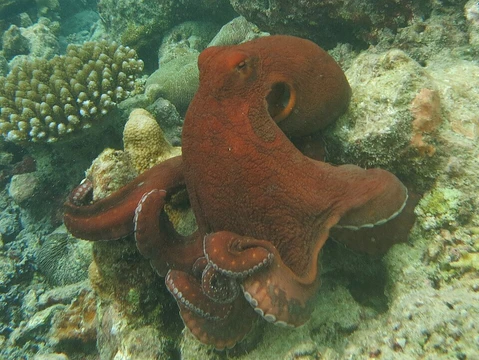
The octopus presents a striking paradox of form: a creature entirely without bones or rigid internal structure, yet capable of extraordinary physical feats. Its elongated body is bilaterally symmetric, with a beaked mouth positioned at the center where eight flexible limbs radiate outward. These arms function as muscular hydrostats, packed with longitudinal, transverse, and circular muscle fibers around a central nerve, allowing them to coil, squash, stretch, or stiffen in virtually any direction. The absence of skeletal support means the animal can compress its entire body through openings barely wider than 2.5 centimeters, a flexibility that even the largest species retain. Locomotion is equally versatile: the octopus propels itself through water via a muscular siphon that expels jets of fluid, often swimming backwards while trailing its appendages behind. The interior surfaces of each arm are lined with circular, adhesive suckers—bowl-like structures composed of an outer infundibulum and inner acetabulum—that enable the animal to grip surfaces, manipulate objects, and anchor itself in currents.
Habitat Range and Life Cycle
Octopuses occupy an astonishing breadth of marine environments, from sunlit coral reefs and open pelagic waters to the crushing pressures of the abyssal seabed. Some species thrive in the intertidal zone, while others dwell at the deepest ocean floors, making their recorded range one of the widest among invertebrates. Their life cycles are remarkably compressed: most species grow rapidly, reach maturity early, and live only briefly. Reproduction follows a stark pattern—males transfer sperm through a specially adapted arm directly into the female's mantle cavity, after which the male enters senescence and dies. The female then guards her fertilized eggs in a den until they hatch, only to perish herself shortly afterward. As active predators, octopuses prey on crustaceans, bivalves, gastropods, and small fish. To survive their own predators, they deploy a toolkit of defenses: expelling clouds of ink, shifting skin coloration for camouflage, performing threat displays, jetting rapidly through the water to escape, concealing themselves, and even employing deceit. Every octopus species carries venom, though only the blue-ringed variants pose a lethal threat to humans.
Cultural Footprint and Mythological Presence
Long before modern science catalogued their biology, octopuses captured the human imagination as fearsome sea creatures. In Norse tradition, the legendary kraken embodies the terror of a colossal cephalopod lurking in Norwegian waters, while the Ainu people of Japan knew the Akkorokamui as a similarly monstrous marine entity. Some scholars even draw a speculative line to the Gorgons of ancient Greek myth. In literature, Victor Hugo devoted a dramatic passage in Toilers of the Sea to a man's desperate struggle against an octopus, cementing the animal's role as a symbol of primal oceanic danger. In Japanese artistic tradition, octopuses appear in shunga erotic prints, reflecting a very different cultural relationship with the creature. On the culinary side, octopus is regarded as a delicacy across the Mediterranean and much of Asia, where it is prepared and enjoyed as a prized food. This wide spectrum of cultural treatment—from monstrous adversary to artistic subject to table fare—underscores how deeply the octopus has embedded itself in human storytelling and daily life.
Linguistic Identity and the Plural Debate
The very name octopus carries a rich etymological history. The scientific Latin term derives from the Ancient Greek compound oktōpous, blending oktō (meaning eight) with pous (meaning foot), a form attested in the writings of Alexander of Tralles around the sixth century. The question of how to pluralize the word in English has generated persistent disagreement among linguists and dictionaries. The standard English plural, octopuses, emerged in the latter half of the nineteenth century. The Latinate form octopi, which appeared earlier in English sources during the early 1800s, is widely regarded as etymologically flawed because it incorrectly treats the word as a second-declension Latin noun when it is actually third-declension. The Greek plural octopodes, though the rarest in modern usage, has been acknowledged by reference works such as Merriam-Webster. H. W. Fowler's Dictionary of Modern English Usage declared octopuses the sole acceptable form, dismissing octopi as misconceived and octopodes as pedantic. The Oxford English Dictionary lists all three in order of frequency, while the New Oxford American Dictionary, third edition, 2010, endorses only octopuses as correct.
More in Distribution & Habitat
Related in Big blue octopus
Links follow this subject's own source article.
Elsewhere in Big blue octopus
Spotted an error? Know more?
Reader corrections go straight into our review queue. Suggest an edit · How this site is sourced