Coral Sea
A tropical South Pacific sea cradling the planet's largest living reef structure.

The Coral Sea is a marginal sea of the South Pacific Ocean situated north and northeast of the Australian continent, stretching eastward past New Caledonia and the Solomon Islands. It encompasses the Great Barrier Reef—the largest coral reef system on Earth—and supports one of the most biodiverse marine environments in the world, spanning tropical and subtropical waters.
As a distribution and habitat region, the Coral Sea provides the warm, shallow reef flats, deep lagoons, and open-ocean corridors that sustain a vast assemblage of reef-associated fish, invertebrates, sea turtles, and cetaceans. The area is partly protected under the Great Barrier Reef Marine Park, one of the largest marine protected zones established in the world.
- Type
- Marginal sea, South Pacific Ocean
- Position
- North / northeast of Australia; east of Papua New Guinea, Vanuatu, New Caledonia
- Key feature
- Great Barrier Reef (largest coral-reef system on Earth)
- Water regime
- Tropical to subtropical
- Named by
- Captain James Cook, 1774
- Protected area
- Great Barrier Reef Marine Park
Lore & Background
The Coral Sea took its name from Captain James Cook, who in 1774 noted the vividly coloured coral formations breaking the surface along the Australian coast. By the nineteenth century, European whalers and pearl-divers had already begun exploiting the region's rich marine resources, and the sea became a focal point of colonial maritime traffic between Australia and the Pacific islands.
The Great Barrier Reef, which runs for more than 2,000 kilometres along Queensland's northeastern shore, is the single largest structure built by living organisms and is a UNESCO World Heritage property. East of Australia, the Coral Sea extends past the vast lagoon of New Caledonia—one of the largest lagoons on Earth—and toward the volcanic island chains of Vanuatu and the Solomon Islands, where deep-sea trenches and seamounts add further habitat complexity.
Ecologically, the Coral Sea functions as a nursery and foraging ground for a wide range of species. Warm, clear, low-turbidity waters over the reef platforms support dense coral assemblages, while the deeper basins beyond the reef crest provide habitat for pelagic and deep-water organisms. Seasonal currents and upwelling events along the shelf edge drive productivity pulses that sustain higher trophic levels throughout the year.
Reader's Guide
Reef flats and back-reef lagoons (0–30 m): The shallow, sunlit zones over the Great Barrier Reef and the New Caledonian lagoon provide the primary nursery habitat for juvenile reef fish, invertebrates, and sea-turtle hatchlings. Substrate is dominated by live hard corals (Scleractinia), rubble, and seagrass meadows. Seasonal warm-water events can trigger mass coral bleaching, making these zones ecologically critical and highly vulnerable.
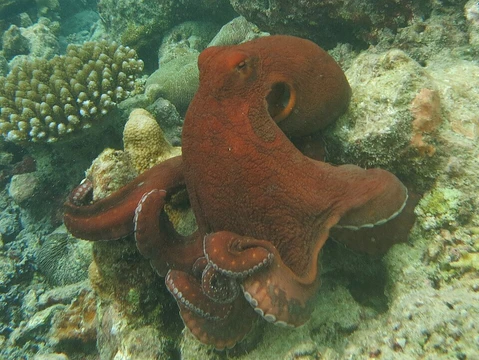
Reef slopes and drop-offs (30–150 m): The mid-slope faces host the densest assemblages of reef-associated species, including groupers, snappers, parrotfish, and octopuses. Substrate shifts from branching and plate corals to massive boulder formations. Currents along the shelf edge bring nutrient-rich water from the open Coral Sea basin, sustaining higher productivity than the lagoon interior.
Outer shelf and deep basin (150 m–1,000+ m): Beyond the reef crest, the Coral Sea deepens into a broad basin. Seamounts and submarine canyons along the continental slope create localized upwelling and serve as aggregation sites for pelagic species, cetaceans, and deep-water invertebrates. This zone is less well-characterised but is recognised as a key corridor for migratory species moving between the Pacific and the Australian continental shelf.
Did You Know?
- The Great Barrier Reef, which lies within the Coral Sea, is the largest coral-reef system on Earth and is recognised as a UNESCO World Heritage property.
- New Caledonia's lagoon, situated in the eastern Coral Sea, is one of the largest lagoons in the world by surface area.
- The Coral Sea was given its name by Captain James Cook during his 1774 voyage, after he observed the brightly coloured coral formations along the Australian coast.
- The Great Barrier Reef Marine Park, established to protect the reef and surrounding waters, is one of the largest marine protected areas in the world.
More in Distribution & Habitat
Elsewhere in Big blue octopus
Spotted an error? Know more?
Reader corrections go straight into our review queue. Suggest an edit · How this site is sourced