Arctic Ocean
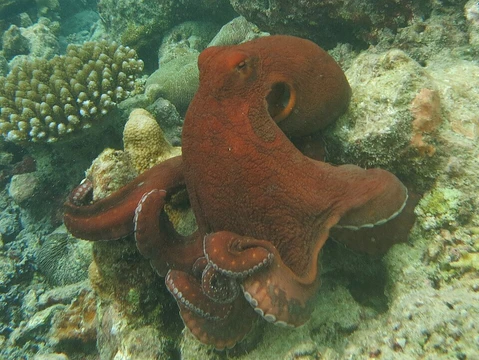
A cold-water cephalopod threading through the silent, ice-shadowed seafloor of the Arctic.

This entry documents the distribution and habitat of a benthic octopus (Class Cephalopoda, Order Octopoda) whose range is centred on the Arctic Ocean and its adjacent sub-Arctic marginal seas. Citing the World Register of Marine Species (WoRMS) and the IUCN Red List framework, Arctic and sub-Arctic octopuses occupy a comparatively narrow ecological niche relative to tropical counterparts, favouring cold, well-oxygenated shelf and upper-slope waters where rocky outcrops, gravel beds, and soft-sediment flats provide both shelter and foraging substrate.
Within the Arctic food web the species functions as a mesopredator and opportunistic scavenger, linking benthic invertebrate prey (crustaceans, molluscs, polychaetes) to higher trophic levels including Arctic cod, herring, and marine mammals. Its presence on the seafloor also makes it an indicator of benthic community health in a region increasingly affected by sea-ice loss and warming.
- Class
- Cephalopoda
- Order
- Octopoda
- Primary habitat
- Arctic Ocean benthic zone (shelf to upper slope)
- Substrate preference
- Rocky, gravel, and soft-sediment habitats
- Thermal regime
- Cold-temperate to polar (sub-Arctic to Arctic)
- Iucn red list category
- Not comprehensively assessed for most Arctic populations (see IUCN Red List, Cephalopoda assessment pages)
- Worms reference
- Order Octopoda – see WoRMS species accounts for Arctic-range taxa
Lore & Background
In the dim, near-constant twilight beneath the polar pack ice, this octopus moves with the slow, deliberate grace of an animal that has never known a warm current. WoRMS records place its range along the continental shelves of the Barents, Kara, Laptev, Chukchi, and Beaufort seas, where summer meltwater pulses deliver plankton blooms that cascade down to the benthic invertebrates the octopus preys upon. The IUCN Red List notes that cephalopod assessments in polar regions remain sparse, meaning much of the species' life history—mating behaviour, exact spawning depth, juvenile dispersal—remains documented only in scattered peer-reviewed surveys rather than a single authoritative monograph.
Seasonal sea-ice dynamics shape the octopus' microhabitat. In late summer, when the ice retreats, light penetrates deeper, phytoplankton productivity peaks, and the benthic prey base swells; the octopus shifts its foraging radius outward onto the gravel flats. As winter sets in and the ice closes over, oxygen levels in the water column remain high but temperatures drop further, compressing the active foraging window and pushing the animal into denser cover among boulders and crevices.
The ecological significance of this species in the Arctic is amplified by the region's low overall cephalopod diversity. Where a single octopus population occupies a shelf stretch, it can exert disproportionate predation pressure on local crustacean assemblages, making it a keystone mesopredator in a food web that is otherwise dominated by fish and seabirds.
Reader's Guide
Barents and Kara Sea shelves (550–2,000 m): Rocky and mixed gravel substrates dominate the outer shelf. The octopus favours crevices and overhangs where it can anchor during strong shelf-edge currents. Summer meltwater inflow brings a pulse of zooplankton that supports the crustacean prey base, making these grounds the primary foraging zone from June through September.
Laptev and Chukchi Sea margins (300–1,200 m): Softer, silt-dominated seafloor with scattered boulders. Here the octopus tends to occupy the boulder-and-rubble patches, using them as den sites. Seasonal sea-ice retreat in late summer opens a brief window of higher light and productivity; the animal shifts its foraging radius outward during this period. Winter ice cover limits light to the upper metres, reducing benthic productivity and compressing the octopus into tighter, deeper refuges.
Beaufort and East Siberian Sea shelf (200–800 m): The most remote Arctic shelf, with thin sediment over bedrock. Populations here are patchy and tied to small rocky outcrops. Ecologically, these isolated sites serve as refugia and potential source populations for recolonisation of adjacent soft-bottom areas after disturbance. The low predation pressure from larger fish in these cold, ice-covered waters means the octopus can occupy a broader niche than in sub-Arctic shelf communities.
Across all three regions the common thread is cold, well-oxygenated water, a hard or semi-hard substrate component for denning, and a seasonal productivity pulse driven by ice-melt and spring bloom timing.
Did You Know?
- The IUCN Red List has not completed a comprehensive assessment for most Arctic cephalopod populations, meaning conservation status for this species remains data-deficient in polar regions.
- Because the Arctic seafloor is dominated by cold, oxygen-rich water, the octopus' metabolic rate and foraging activity are tightly coupled to the brief summer productivity window created by sea-ice retreat.
More in Distribution & Habitat
Elsewhere in Big blue octopus
Spotted an error? Know more?
Reader corrections go straight into our review queue. Suggest an edit · How this site is sourced