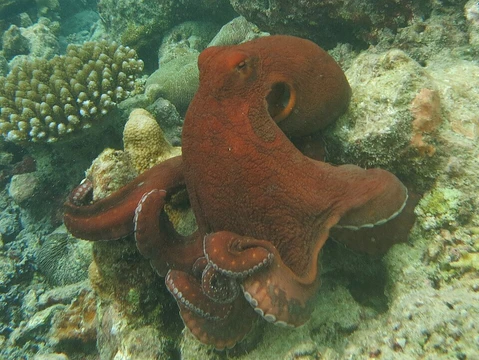
Octopodidae
Eight armed, shell-less, and cunningly intelligent — the true octopuses rule the reef.

Octopodidae is a family of marine cephalopods within the order Octopoda (class Cephalopoda, phylum Mollusca), encompassing what are commonly called the 'true octopuses.' The family is typified by the genus *Octopus* and includes species distributed across all of the world's oceans, from shallow intertidal zones to deep-sea habitats. Unlike their argonaut relatives, octopodids possess no external shell; instead, most retain a thin, internal chitinous structure called a pen (or rostrum) that provides limited structural support (WoRMS; Bouchet & Rocroi, 2005). They are characterized by eight muscular, suckered arms, a highly developed nervous system, and sophisticated chromatophore-based color change, making them among the most behaviorally complex invertebrates known (MolluscaBase; WoRMS).
- Taxonomic rank
- Family (Octopodidae)
- Order
- Octopoda
- Class
- Cephalopoda
- Phylum
- Mollusca
- Type genus
- Octopus
- Habitat
- Marine; all ocean basins, intertidal to deep-sea
- Key diagnostic feature
- Eight suckered arms; internal pen; no external shell
Lore & Background
Reproduction in Octopodidae typically involves a single mating event; in many species the male dies shortly after copulation, and the female guards her eggs until they hatch, often dying soon thereafter. This semelparous life strategy, combined with their high metabolic demands and lack of a protective shell, contributes to the generally short adult lifespan of octopodid species, though exact durations vary by species and depth (Bouchet & Rocroi, 2005).
Reader's Guide
Family Octopodidae (Order Octopoda): The defining trait is the presence of eight muscular arms, each bearing two rows of suckers, combined with the absence of an external shell. Where the argonaut (family Argonautidae) retains a thin, chambered egg-case shell and the opisthoteuthid (family Opisthoteuthidae) of the deep sea shows reduced eyes and a more gelatinous mantle, the octopodid carries only a slender internal pen of chitin, leaving the body fully flexible (WoRMS; Bouchet & Rocroi, 2005).
At the genus level, *Octopus* is separated from the deep-water genus *Amphiocuda* (also within Octopodidae) by the number and arrangement of gill filaments and by the structure of the male hectocotylus arm. Compared with the cuttlefish (order Sepiida), which bears a large internal cuttlebone and ten appendages (eight arms plus two tentacles), the octopodid has no such rigid internal skeleton and no separate tentacles—its eight arms are functionally equivalent (MolluscaBase).
Against the squid (order Omalostrephes / Ommastrephoidea), the octopodid lacks a funnel-shaped mantle used for jet propulsion of the same magnitude, has no lateral fins along the mantle, and possesses a more centralized, brain-dominant nervous system rather than the distributed ganglia of many squid. These features together make the octopodid the most morphologically 'arm-dominated' of the three major cephalopod lineages (WoRMS).
Did You Know?
- Octopodids are the only invertebrate family in which tool use—such as carrying coconut shells as shelter—has been documented in multiple species (WoRMS; Bouchet & Rocroi, 2005).
- Their blood is blue when oxygenated because it relies on hemocyanin, a copper-based respiratory pigment, rather than the iron-based hemoglobin found in vertebrates (MolluscaBase).
- Unlike most molluscs, octopodids have no external shell at all; the only remnant of the ancestral molluscan shell is a thin, internal chitinous pen that provides minimal structural support (WoRMS).
- All eight arms of an octopodid bear suckers on both rows, a feature that distinguishes them from the two tentacles of a squid, which have suckers only along a single row (Bouchet & Rocroi, 2005).
More in Taxonomy & Classification
Elsewhere in Big blue octopus
Spotted an error? Know more?
Reader corrections go straight into our review queue. Suggest an edit · How this site is sourced