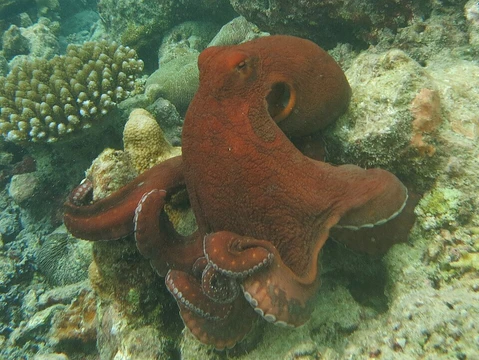
Coconut stacking
An octopus builds a tower from coconut shells and watches it fall, then builds it again.

Coconut stacking is a documented object-manipulation behavior observed in the common octopus (Octopus vulgaris) in captive and public-aquarium settings. The animal retrieves one or more coconut shells (or similar curved, bowl-shaped debris), orients them, and arranges them into a vertical tower or overlapping pile. It is one of the most frequently cited examples of spontaneous, goal-directed tool-like manipulation in a non-primate invertebrate.
The behavior stands out in cephalopod cognition research because it involves sequential planning, bilateral coordination of multiple arms, and a clear endpoint (a stable stack) that the octopus appears to monitor and correct. Unlike foraging or shelter-building, stacking does not serve an obvious immediate survival function, which leads observers to classify it as play or exploratory problem-solving.
- Species
- Octopus vulgaris (common octopus)
- Taxonomic group
- Class Cephalopoda, Order Octopoda
- Behavior class
- Object manipulation / stacking (play or exploratory)
- Primary observation context
- Captive / public-aquarium enrichment settings
- Cognitive evidence
- Spatial planning, sequential arm coordination, endpoint monitoring
- Distinguishing feature
- No immediate foraging or shelter function; classified as play-like
Lore & Background
In the broader literature on cephalopod cognition, object manipulation occupies a central place. Octopuses are well known for unscrewing jar lids, carrying crab shells as mobile shelters, and using pufferfish as hammers. Coconut stacking extends this repertoire: the animal does not merely move a single object but sequences multiple placements, checks stability, and re-positions shells that slide or topple. Observers in public aquaria have reported the behavior recurring across days, suggesting it is not a one-time novelty response.
What makes the behavior particularly striking is the distributed control problem. An octopus has no central brain that commands each arm independently; roughly two-thirds of its neurons reside in the arms themselves. Stacking a tower therefore requires the coordination of at least four to six arms working in concert—two holding the base shell steady while two or more position the next layer—without a single 'motor cortex' issuing a unified command. The fact that the animal can execute this, correct errors mid-sequence, and restart after a collapse is taken as evidence of local arm-level planning integrated with a central 'intent' signal.
The behavior has also been discussed in the context of enrichment. In a barren tank, an octopus may show repetitive stereotypies; when coconut shells, rocks, or other manipulable objects are added, stacking and other exploratory sequences increase. Researchers interpret this as the animal seeking novel sensorimotor challenges rather than mere distraction, placing it closer to 'play' in the ethological sense than to random fiddling.
Reader's Guide
Observed action: The octopus selects a coconut shell from the substrate, orients it concave-side up using two or more arms, and places it on the sand or on a previously placed shell. It then retrieves a second shell, aligns it over the first, and presses or wedges it into position. This sequence repeats, building a vertical or slightly leaning tower of two to six shells.
Context: The behavior is consistently reported in captive settings—public aquaria and research tanks—where coconut shells or similar curved objects are present as enrichment. It is not a foraging or shelter behavior; the shells are not eaten, and the octopus does not retreat into the stack.
Problem solved / function: No immediate survival problem is addressed. The closest functional analog is exploratory play: the animal tests grip strength, spatial alignment, and structural stability. The octopus monitors the stack's integrity, correcting a leaning shell or rebuilding after a collapse, which implies an internal model of the tower's expected shape.
Why it stands out: In a creature with no bones, no central motor cortex, and a nervous system in which the majority of neurons are distributed through the arms, the ability to execute a multi-step, multi-object construction task—and to self-correct mid-sequence—provides some of the strongest non-primate evidence for sequential planning and tool-like manipulation in the animal kingdom.
Did You Know?
- Roughly two-thirds of an octopus's neurons are located in its arms, meaning each arm can perform semi-independent actions; stacking requires integrating these distributed controllers into a single coordinated task.
- Coconut stacking is classified by many ethologists as 'play' because it lacks an immediate foraging, shelter, or reproductive payoff, yet the animal repeats it across sessions.
- The common octopus (Octopus vulgaris) is the species most frequently associated with this behavior in aquarium observation records, though other octopod species have shown similar shell-manipulation sequences.
More in Behavior & Intelligence
Elsewhere in Big blue octopus
Spotted an error? Know more?
Reader corrections go straight into our review queue. Suggest an edit · How this site is sourced