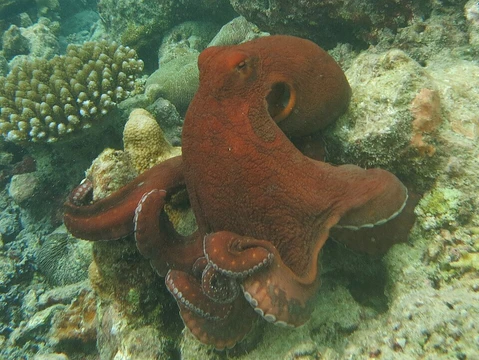
Den building
A solitary architect builds a fortress from broken shells, one sucker at a time.

Den building is a hallmark behavior of octopuses (order Octopoda) in which the animal actively collects, arranges, and seals shell fragments, stones, and other hard debris to construct a sheltered cavity. Documented across species from the common octopus (Octopus vulgaris) to the giant Pacific octopus (Enteroctopus dofleini), the behavior is one of the most frequently cited examples of non-human tool use and spatial problem-solving in the marine invertebrate world.
The den serves as a multi-functional structure: it conceals the animal from visual predators, buffers against rapid temperature or current changes, and provides a secure site for egg-laying in females. Because octopuses are solitary, the den is effectively the animal's entire home base, and the construction process—selecting materials, testing fit, and sealing gaps—has been observed repeatedly in both field and laboratory settings.
- Taxon
- Order Octopoda (class Cephalopoda)
- Well-studied species
- Octopus vulgaris; Enteroctopus dofleini
- Typical habitat
- Rocky intertidal and shallow subtidal zones
- Primary function
- Predator concealment; thermal buffering; egg-guarding site
- Materials used
- Shell fragments, pebbles, coral rubble, other hard debris
- Cognition evidence
- Sequential material selection, gap-testing, iterative rebuilding
Lore & Background
In the rocky shallows of the Mediterranean, the common octopus has been observed spending extended periods gathering small pieces of broken bivalve shell and arranging them into a tight, roughly spherical enclosure. The animal tests each fragment by pressing it against the rim of the cavity with its suckers, rotating it, and withdrawing it if the fit is poor. This trial-and-error sequence, documented in multiple field studies, is not random: the octopus preferentially selects pieces that reduce the largest remaining gap, suggesting a spatial assessment that goes beyond simple reflex.
The giant Pacific octopus, the largest living octopus, constructs dens of comparable logic but vastly greater scale, often wedging itself between large boulders and then reinforcing the gaps with smaller stones and shell. Once the cavity is sealed to a width that only its own mantle can pass through, the animal retreats into the interior, leaving only a narrow slit. This self-imposed bottleneck is a deliberate anti-predator strategy: the den is sized so that a larger predator cannot follow.
Females of several species remain in the den for the entire incubation period, guarding thousands of eggs and refusing to feed. The den, in this context, becomes not merely a shelter but a nursery, and the construction quality directly affects survival of the brood. This long-term investment in a single structure is unusual among invertebrates and has made octopus den building a focal example in discussions of behavioral flexibility and proto-cognition.
Reader's Guide
Observation begins with the octopus selecting a site: a depression between rocks or a natural crevice in a reef substrate. The animal then extends one or two arms into the surrounding rubble, grasping individual shell fragments or small stones with its suckers. Each piece is brought to the rim of the cavity and pressed into place; if the fit is inadequate, the octopus withdraws the fragment and tries another. This iterative selection-and-testing cycle is the core of the behavior and is what distinguishes it from passive hiding.
As the den takes shape, the octopus works to minimize the largest opening. It may rotate, stack, or overlap fragments to close gaps, demonstrating a clear sequential plan rather than random piling. The final structure is typically a near-spherical or ovoid cavity with a single narrow aperture, sized so that the octopus's mantle can enter but a larger predator cannot follow.
Once sealed, the animal retreats fully inside, leaving only the slit visible. If disturbed, the octopus may evacuate, relocate, and rebuild at a new site—sometimes within the same foraging area. The repeated ability to assess a new substrate, select appropriate materials, and reconstruct a functional shelter within a short time-frame is widely cited as evidence of spatial reasoning and behavioral flexibility in a brainless-peripheral, decentralized nervous system.
Did You Know?
- The den's entrance is deliberately sized to exclude larger predators, a self-imposed bottleneck that the octopus tests by attempting to pass its own mantle through the final gap before sealing it.
- Females of several octopus species remain inside the den for the entire egg-incubation period, guarding the brood and forgoing all feeding until the young hatch.
- The construction sequence—select, test, rotate, seal—has been recorded in both wild and laboratory settings, showing that the behavior is not a one-time reflex but a repeatable, goal-directed process.
- Because octopuses lack a central brain in the vertebrate sense, coordinating multi-arm material handling for den building has made them a key model in studies of distributed cognition and decentralized motor control.
More in Behavior & Intelligence
Elsewhere in Big blue octopus
Spotted an error? Know more?
Reader corrections go straight into our review queue. Suggest an edit · How this site is sourced