False Bay
Where cold Benguela upwelling meets sheltered reef, the octopus finds its most reliable South African den.

False Bay is a semi-enclosed embayment on the southern coast of the Western Cape province, South Africa, situated between Cape Point to the west and Cape Hangenberg to the east, roughly 30 km south of Cape Town. It is one of the most biologically productive temperate-subtropical bays on the African continent, shaped by the convergence of the cold, nutrient-rich Benguela Current with warmer Agulhas-influenced waters, creating a mosaic of rocky reef, kelp forest, sandy flat, and mudflat habitats that support an exceptionally dense assemblage of marine invertebrates, fish, and marine mammals.
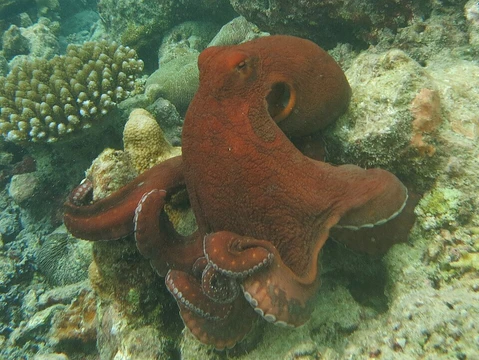
For the octopus species documented in this entry, False Bay provides a critical foraging and denning ground. The bay's complex rocky substrates, abundant benthic invertebrate prey, and relatively sheltered waters make it a year-round habitat rather than a seasonal stopover, and it is one of the few South African localities where the species is consistently recorded across multiple depth bands.
- Habitat type
- Semi-enclosed temperate-subtropical bay
- Province / country
- Western Cape, South Africa
- Approximate coordinates
- 34°S, 18°E
- Dominant currents
- Benguela Current (cold, upwelling-influenced)
- Key substrates
- Rocky reef, kelp forest, sandy and muddy flats
- Notable co-occupants
- Cape fur seals (Arctocephalus pusillus), African penguins (Spheniscus demersus)
- Depth range (bay proper)
- Intertidal to ~50 m
Lore & Background
False Bay has been a focal point of South African marine biology since the early 20th century, when the first systematic benthic surveys along the Cape Peninsula documented the extraordinary density of invertebrate life on its rocky shores. The bay's semi-enclosed geometry limits wave energy and creates calm, stratified water columns in which the Benguela upwelling delivers a steady pulse of nutrients. This, in turn, sustains dense beds of Ecklonia and Laminaria kelp, whose stipes and holdfasts form a three-dimensional matrix of crevices, overhangs, and sheltered micro-habitats that are ideal denning sites for a den-seeking octopus.
The bay's ecology is further shaped by the presence of a large resident colony of Cape fur seals on Duiker Island and surrounding rocks. Seal predation pressure has been shown to alter the foraging behaviour of mesopelagic fish, which in turn shifts the benthic invertebrate community structure. For the octopus, this top-down cascade means that prey availability in False Bay is not static but fluctuates with seal population dynamics, making the bay a natural long-term study site for predator–prey interactions in a temperate benthic system.
Seasonally, the Benguela upwelling intensifies in the austral winter (June–August), cooling surface waters and increasing primary productivity. The octopus is observed to shift its foraging range slightly inshore during these months, taking advantage of the denser invertebrate assemblages on the shallow rocky platforms (2–15 m), before retreating to deeper reef ledges (25–50 m) during the warmer, more stratified summer months when prey disperses over a wider area.
Reader's Guide
False Bay proper (2–15 m, rocky reef and kelp forest): The octopus favours the sheltered, wave-protected inner shelves of the bay where Ecklonia and Laminaria kelp provide dense stipe cover and abundant invertebrate prey. Substrate is predominantly bedrock with interstitial gravel and rubble; the animal selects dens beneath boulders or within crevices no wider than its own mantle. This band is the primary foraging zone in winter, when Benguela upwelling peaks and benthic invertebrate density is highest.
Deeper reef ledges (20–50 m, mixed rocky-sandy substrate): During the warmer austral summer, the species shifts to these deeper ledges, where water temperatures are more stable and the kelp canopy thins. Here the substrate transitions to coarser sand interspersed with rock outcrops, and the octopus relies more on solitary denning in sub-reef cavities. Prey shifts from dense invertebrate aggregations to more scattered, mobile crustaceans and small fish.
Intertidal and shallow subtidal platforms (0–5 m): In spring, individuals are occasionally recorded on exposed rocky platforms near the bay's headlands, particularly around the Duiker Island seal colony, where seal-washed detritus and dense invertebrate fouling create a rich foraging microhabitat. This is the least predictable zone and is used opportunistically rather than as a permanent denning area.
Ecological significance: False Bay's position at the Benguela–Agulhas transition makes it a natural laboratory for studying how upwelling-driven productivity cascades through a benthic food web and ultimately shapes the distribution, foraging, and reproductive timing of a den-seeking cephalopod.
More in Distribution & Habitat
Elsewhere in Big blue octopus
Spotted an error? Know more?
Reader corrections go straight into our review queue. Suggest an edit · How this site is sourced