Gulf of California
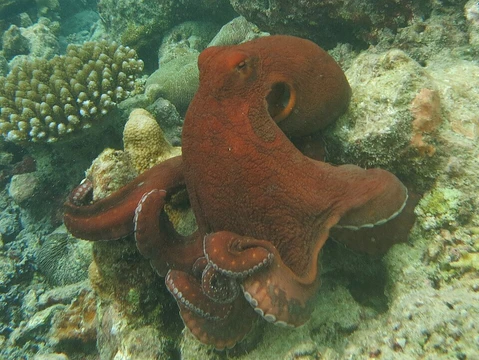
A master of disguise threading through the living stone of the Sea of Cortez.

The octopus (class Cephalopoda) inhabiting the Gulf of California occupies a pivotal niche in one of the most biodiverse marine ecosystems on Earth. Nestled between the Baja California Peninsula and the Mexican mainland, the gulf presents a mosaic of rocky reefs, sandy flats, mangrove channels, and deep basins that together support a wide vertical and horizontal range of octopod habitats. As a benthic ambush predator, the octopus links prey communities—crustaceans, bivalves, small teleosts—to the higher trophic levels of fish and marine mammals that forage on them.
Because the Gulf of California is a semi-enclosed basin with strong seasonal upwelling, temperature gradients, and a transition between eastern-Pacific and tropical faunas, the octopus populations found here exhibit considerable local adaptability in foraging behavior, den selection, and reproductive timing. Their presence is a reliable indicator of healthy, structurally complex benthic communities, and their removal or decline would ripple through the gulf's food web.
- Taxonomic class
- Cephalopoda
- Habitat type
- Benthic (bottom-dwelling)
- Feeding strategy
- Ambush predator
- Arms
- Eight
- Blood pigment
- Hemocyanin (copper-based, blue)
- Hearts
- Three
- Gulf of california location
- Between the Baja California Peninsula and mainland Mexico
Lore & Background
In the Gulf of California the octopus is a creature of the interstices. It claims the crevices beneath volcanic boulders, the tangled matrix of dead coral heads, the root tangles where mangrove channels meet open water, and the sheer faces of the deep basins that plunge past several hundred metres below the surface. Its mantle, studded with chromatophores and iridophores, can shift from mottled ochre to near-black in a fraction of a second, rendering it effectively invisible against the substrate it rests upon. To a foraging rockfish or a passing sea turtle, the octopus is simply part of the rock.
Reproduction in the gulf's warmer shallows is a terminal event: after a single spawning episode the animal ceases feeding, guards the egg mass, and dies. In the deeper, cooler basins the cycle can stretch, and the octopus may live considerably longer before that final, solitary vigil. Males and females are strictly territorial around their dens, and encounters between individuals are rare, usually brief, and often violent.
Local fishing communities along the gulf's shores have long regarded the octopus as both a valuable catch and a sign of reef health. Its abundance in a given cove is read as a barometer: where the octopus thrives, the structural complexity and prey base of the benthic community are intact. Where it vanishes, something in the web has been severed.
Reader's Guide
Shallow rocky reefs and kelp beds (0–30 m): The octopus favours the structural complexity of boulder fields, dead coral rubble, and kelp holdfasts along the gulf's inner and outer coasts. Substrate is typically volcanic basalt or consolidated limestone. Seasonal upwelling in late spring brings cooler, nutrient-rich water that boosts prey density, and the octopus tracks this pulse by shifting to slightly deeper ledges.
Mangrove and estuarine channels (0–10 m): Juveniles and smaller individuals use the tangled root systems and muddy-sand margins where the gulf meets river outflow. These zones offer shelter from open-water predators and a steady supply of small invertebrates. The locale is ecologically significant as a nursery ground and a feeding corridor linking estuarine productivity to open-reef communities.
Deep basins and seamounts (50–300+ m): In the central and southern gulf, the octopus occupies the steep walls and flat abyssal plains where the seafloor drops sharply. Here the substrate shifts to fine sediment over hard rock, and the animal is found in scattered crevices and under isolated boulders. These deeper populations experience lower, more stable temperatures and reduced light, and they tend to be larger and longer-lived. The basins act as a thermal refuge during the gulf's warm summer months and as a long-term reservoir of genetic diversity for the species.
Did You Know?
- The Gulf of California is one of the most biodiverse marine regions on the planet, supporting a higher concentration of marine species than the Caribbean Sea.
- An octopus has no bones, allowing it to compress its entire body through an opening only slightly wider than its beak.
- The gulf's semi-enclosed geometry creates strong seasonal upwelling, which periodically delivers nutrient-rich deep water to the surface and drives pulses of productivity that octopuses exploit.
- Octopuses possess distributed neural tissue: roughly two-thirds of their neurons are located in their arms, enabling each arm to process tactile information semi-independently.
More in Distribution & Habitat
Elsewhere in Big blue octopus
Spotted an error? Know more?
Reader corrections go straight into our review queue. Suggest an edit · How this site is sourced