Bering Sea
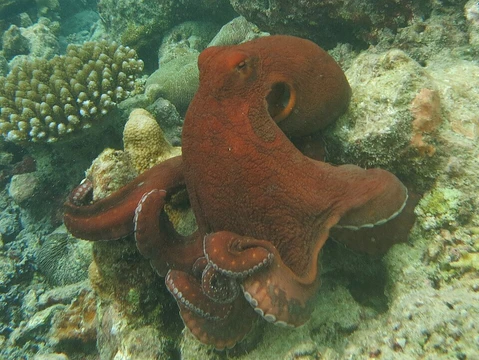
The Bering Sea's cold, boulder-strewn shelves are ruled by the North Pacific's largest octopus.

Enteroctopus dofleini, the giant Pacific octopus, is the dominant cephalopod megafauna of the Bering Sea's nearshore and shelf habitats. As the largest octopus species by mass, it occupies a keystone predator role in cold-water North Pacific ecosystems, exerting top-down control on benthic invertebrate communities across rocky and kelp-associated substrates from the Bering Sea southward along the Pacific coast.
Within the Bering Sea specifically, E. dofleini inhabits the productive, seasonally stratified waters where high primary productivity supports dense kelp forests, mussel beds, and urchin assemblages. Its presence shapes community structure through predation on crabs, urchins, and bivalves, and its den architecture creates microhabitats for juvenile fish and invertebrates. The species is a cold-adapted, long-lived octopod whose life history is tightly coupled to the thermal and food-web dynamics of the Bering Sea shelf.
- Species
- Enteroctopus dofleini (Doflein, 1904)
- Common name
- Giant Pacific octopus
- Region of focus
- Bering Sea (North Pacific)
- Typical depth range
- Intertidal to ~200 m (shelf and upper slope)
- Preferred substrate
- Rocky, boulder, and kelp-forest habitats
- Thermal preference
- Cold-water; Bering Sea shelf temperatures roughly 1–10 °C
- Maximum recorded mass
- ~60 kg (individuals reported in the 40–60 kg range)
Lore & Background
Enteroctopus dofleini is the apex benthic predator of the Bering Sea's rocky and kelp-associated communities. Adults construct dens among boulders, under overhangs, or within dense kelp holdfasts, and they raid surrounding patches of Dungeness crab, red urchin, and mussel beds with a voracity that can depress local invertebrate densities for weeks after a single foraging bout. Their mucus-lined dens, often lined with discarded shells and fragments, serve as nursery microhabitats for juvenile rockfish and invertebrates, linking the octopus's foraging ecology to broader community assembly.
The Bering Sea's seasonal productivity pulse—driven by spring phytoplankton blooms that cascade into dense zooplankton and benthic invertebrate recruitment—sets the tempo of the octopus's life cycle. Females typically oviposit during the cooler months, guarding egg masses of up to 500,000 ova for several months before dying. Males are long-lived relative to other octopods, with individuals surviving two to four years in the Bering Sea's cold, nutrient-rich waters. The species' broad temperature tolerance within the cold-water range allows it to track shifting kelp and rock habitats across the shelf as currents and seasonal ice retreat alter local conditions.
Fisheries interactions in the Bering Sea are significant: E. dofleini is both a target of a limited recreational fishery and a bycatch in crab pots, where its cryptic coloration and strong arm musculature make it a persistent nuisance. Conservation assessments note that the species is not currently listed as threatened, but its dependence on intact kelp and rocky substrate makes it vulnerable to habitat degradation, warming events, and trawling disturbance on the shelf.
Reader's Guide
Bering Sea shelf and nearshore (0–200 m): E. dofleini is most abundant over rocky and boulder substrates, the holdfasts of Laminaria and Saccharina kelp forests, and the interstices of mussel and barnacle beds. The species favours areas with moderate to strong bottom current that sustains food delivery but is not so turbulent as to prevent den maintenance. Seasonal ice retreat in spring opens previously ice-covered shelf areas, exposing fresh benthic habitat that the octopus colonises as temperatures rise above ~2 °C.
Bering Sea upper slope (200–500 m): During summer stratification, some individuals are recorded at the upper slope edge, likely tracking prey aggregations of deep-water crabs and urchins. The substrate here shifts to coarser gravel and fractured bedrock, offering fewer den sites but higher prey density.
Nearshore estuarine and fjord margins: Juveniles and subadults are found in shallow, sheltered bays and fjord mouths where wave energy is low and the substrate is a mix of cobble, sand, and sparse kelp. These areas serve as nursery grounds and are ecologically significant because they buffer the species' early life stages from the more variable open-shelf environment.
Ecologically, the Bering Sea's high nutrient input from upwelling and ice-melt freshwater creates a benthic food web of unusual density. E. dofleini sits at the top of this web, and its predation pressure is a key regulator of urchin and crab populations, preventing overgrazing of kelp and maintaining the structural complexity that supports the broader community.
Did You Know?
- A single female E. dofleini can produce an egg mass containing up to 500,000 ova, which she guards continuously for several months until she dies.
- The species' horizontal-pupil eye is an adaptation to the low-light, high-glare conditions of the Bering Sea's turbid, kelp-shaded nearshore waters.
- In the Bering Sea, E. dofleini is a known bycatch in snow-crab and king-crab fisheries, where its powerful arms can foul pot doors and lines.
- The Bering Sea's seasonal sea-ice retreat can shift the usable benthic habitat range for the octopus by tens of kilometres year to year, depending on ice extent and shelf temperature.
More in Distribution & Habitat
Elsewhere in Big blue octopus
Spotted an error? Know more?
Reader corrections go straight into our review queue. Suggest an edit · How this site is sourced