Mollusca
Eight arms, one shell, or neither — the ocean's most architecturally diverse invertebrate phylum.

Mollusca is the second-largest phylum of animals, uniting an extraordinary range of invertebrate body plans under a shared architectural blueprint: a muscular foot, a mantle (pallium) that in many lineages secretes a shell, and, in most classes, a toothed rasping organ called the radula. From the coiled whorls of a gastropod to the eight-armed, jet-propelled body of a cephalopod, molluscs occupy nearly every aquatic habitat on Earth and a significant number of terrestrial ones, though the overwhelming majority of described species are marine.
In marine ecosystems molluscs function as keystone filter-feeders (bivalves), active predators (cephalopods), sediment engineers (gastropods), and habitat builders (reef-associated bivalves and coralline structures). Their fossil record reaches back to the Cambrian, and their morphological spread — from the armored, eight-plated chiton to the shell-less, highly intelligent octopus — makes them among the most visually and ecologically diverse animal groups in the ocean.
- Rank
- Phylum
- Recognised classes
- 7 (Gastropoda, Bivalvia, Cephalopoda, Polyplacophora, Monoplacophora, Scaphopoda, Aplacophora)
- Described species
- over 85,000
- Primary habitat
- Marine (with freshwater and terrestrial representatives)
- Key synapomorphies
- Mantle, muscular foot, radula (in most lineages)
- Oldest fossil record
- Cambrian period
Lore & Background
The molluscan body plan was assembled early in animal evolution. By the mid-Cambrian, shelled gastropods, bivalves, and nautiloid cephalopods were already diversifying in shallow seas, and by the Ordovician the major classes we recognise today had begun to take shape. The phylum's success is often attributed to the versatility of the mantle: a single tissue layer that can seal a chambered shell, expand into a jet-propulsion siphon, or reduce to a thin epidermal sheet in shell-less forms. This single organ, combined with the contractile foot, allows one ancestral body to radiate into snails, clams, chitons, tusk shells, and the highly derived cephalopods.
Ecologically, molluscs are inseparable from marine food webs. Bivalve beds — oysters, mussels, clams — filter vast volumes of seawater, converting suspended phytoplankton into detritus that feeds downstream invertebrates and fish. Cephalopods occupy the apex of many mesopelagic and benthic food chains, while gastropods and polyplacophorans regulate algal growth on hard substrates. The loss of a single keystone bivalve species can cascade through an entire reef or estuary, underscoring how central molluscs are to ecosystem function.
Cephalopods, the most neurologically advanced molluscs, represent a remarkable evolutionary experiment: a phylum otherwise characterised by slow, shell-bound locomotion produced, in the octopus and squid lineages, a fast, camera-eyed, problem-solving predator with distributed intelligence. This contrast — the patient bivalve versus the darting octopus — is perhaps the phylum's most striking internal diversity, and it is the axis around which the comparative notes below are organised.
Reader's Guide
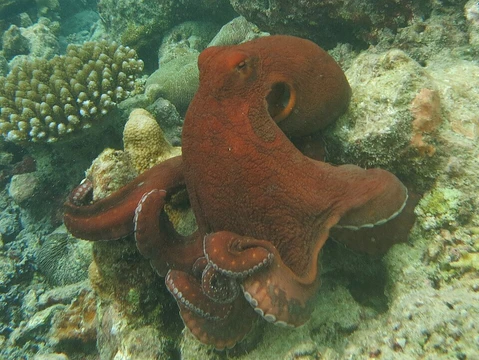
Phylum Mollusca — the big blue octopus belongs here, in class Cephalopoda. Its diagnostic feature is a highly reduced or absent shell (retained only as a small internal pen in some lineages), a camera-type eye, and a mantle cavity repurposed as a jet-propulsion chamber. This sets it apart from its nearest invertebrate cousins within the same phylum.
Versus Gastropoda (snails, slugs): the octopus has bilateral symmetry with eight radially arranged arms rather than a single coiled or uncoiled foot, and it lacks the radula entirely, feeding with a beak and tentacles instead of a rasping tongue.
Versus Bivalvia (clams, mussels, oysters): the octopus is an active, mobile predator with a closed circulatory system and three hearts, whereas bivalves are sessile or slow filter-feeders with two hinged valves and a gill-based feeding apparatus.
Versus Polyplacophora (chitons): the octopus has no dorsal plate armour; its 'shell' is at most a tiny internal rod, while the chiton retains eight overlapping calcareous plates and a broad, creeping foot.
Versus Scaphopoda (tusk shells) and Monoplacophora: both are slow, burrowing or crawling forms with a single elongated or discoidal shell and a reduced nervous system, in stark contrast to the octopus's distributed neural network and high-speed locomotion.
In short, the big blue octopus is the phylum's most derived, most mobile, and most neurologically complex member — the radical edge of a body plan that elsewhere favours stillness and shell.
Did You Know?
- Octopuses, the most advanced molluscs, possess three hearts: two branchial hearts pump blood through the gills, and one systemic heart circulates it to the rest of the body.
- The nautilus, a cephalopod with a chambered external shell, is often called a 'living fossil' because its body plan has changed very little in roughly 500 million years.
- A single adult oyster can filter hundreds of litres of seawater per day, making bivalve beds among the most important natural water-filtration systems in coastal marine ecosystems.
- The giant clam (genus Tridacna) is the largest living bivalve, with some individuals exceeding 300 kg, and it hosts photosynthetic symbiotic algae (zooxanthellae) within its mantle tissue.
More in Taxonomy & Classification
Elsewhere in Big blue octopus
Spotted an error? Know more?
Reader corrections go straight into our review queue. Suggest an edit · How this site is sourced