Branchiae
Thin, blue, and endlessly pumping—the living membrane that lets a mollusc breathe the sea.

Branchiae (singular: branchia; from Greek brankhia, 'gill') are the primary respiratory structures of aquatic invertebrates, responsible for extracting dissolved oxygen from seawater and expelling carbon dioxide. In marine mollusks the equivalent organs are termed ctenidia, while in crustaceans they appear as plate-like, feathery, or lamellar appendages attached to the thorax or abdomen. Across phyla, the underlying principle is the same: a large, thin, highly vascularised surface held in intimate contact with a unidirectional flow of water to maximise gas exchange.
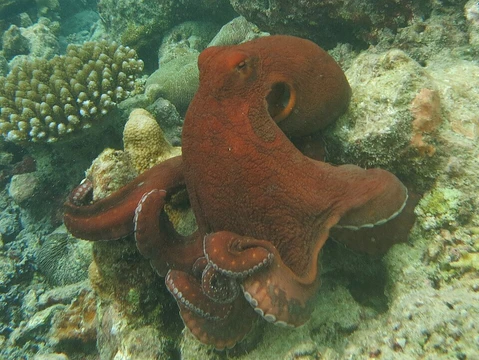
Beyond respiration, branchiae in bivalve mollusks (barnacles, mussels, oysters, clams) perform a second critical role—filter feeding—by trapping phytoplankton and detritus in mucus-laden cilia. In cephalopods the gills are paired (two ctenidia in octopods and decapods; a single ctenidium in nautiloids) and housed within the mantle cavity, where the mantle musculature drives a continuous pump of water over the filaments.
- Structure type
- Respiratory (and, in bivalves, filter-feeding) organ
- Phyla in which found
- Mollusca (Bivalvia, Cephalopoda), Arthropoda (Crustacea), and others
- Respiratory pigment (molluscs & crustace
- Hemocyanin (copper-based; blue when oxygenated)
- Dominant exchange mechanism
- Countercurrent exchange across gill lamellae
- Etymology
- Greek brankhia (βράγχια), 'gill'
- Dual function in bivalvia
- Respiration + filter feeding (ciliary mucus traps)
Lore & Background
In bivalve mollusks the ctenidium is a broad, leaf-like sheet suspended in the mantle cavity, studded with rows of microscopic cilia that beat in metachronal waves. Water drawn in through the incurrent siphon passes over the gill surface; oxygen diffuses into the haemolymph while carbon dioxide diffuses out, and simultaneously food particles are swept into the labial palps. The same structure that keeps a mussuckle alive also feeds it—a convergence of respiratory and digestive physiology found in no other invertebrate group to this degree.
In cephalopods the gill architecture is more compact. The ctenidium is a dense tuft of primary, secondary, and tertiary filaments anchored to the visceral mass. The mantle acts as a muscular bellows: contraction forces water over the filaments and into the funnel, while relaxation draws fresh seawater in through the mantle cavity. Octopods possess two such tufts; the nautilus, a more ancestral form, retains a single ctenidium, a condition shared with the earliest molluscan body plan.
Crustacean gills (pleopodal or thoracic plates) are structurally more variable—some are flat lamellae, others feathery or even modified for osmoregulation—but the principle of a thin epithelium separating haemolymph from flowing water remains universal. Hemocyanin, the copper-based respiratory pigment common to both molluscs and crustaceans, gives the blood its characteristic blue colour when oxygenated, a visual signature of branchial gas exchange that has persisted for over 500 million years.
Reader's Guide
Ctenidium (gill tuft): In bivalves this is a broad, leaf-shaped sheet; in cephalopods a dense bundle of filaments. It occupies a large fraction of the mantle cavity—roughly one-third to one-half of the visceral volume in an octopus—making it the single largest organ by volume after the stomach. Remarkable because no other invertebrate group combines this scale of respiratory surface with the dual filter-feeding role seen in bivalves.
Primary, secondary, and tertiary filaments: The hierarchical branching of the ctenidium multiplies surface area enormously. In a 30 cm octopus the total gill surface can exceed several hundred square centimetres, a ratio far greater than the body's external skin. This is what allows a soft-bodied animal with no rigid ribcage to sustain high metabolic rates.
Mantle cavity and siphon: The muscular chamber surrounding the gills. Its rhythmic contraction creates the unidirectional water flow essential for countercurrent exchange. Without this pump the gill filaments would quickly equilibrate with ambient water and gas exchange would stall.
Ciliary epithelium (bivalves): Microscopic hair-like cilia on the gill surface beat in coordinated waves, trapping particles in mucus. This makes the bivalve gill simultaneously a lung and a net—functionally unique among invertebrate respiratory organs.
More in Anatomy & Physiology
Elsewhere in Big blue octopus
Spotted an error? Know more?
Reader corrections go straight into our review queue. Suggest an edit · How this site is sourced