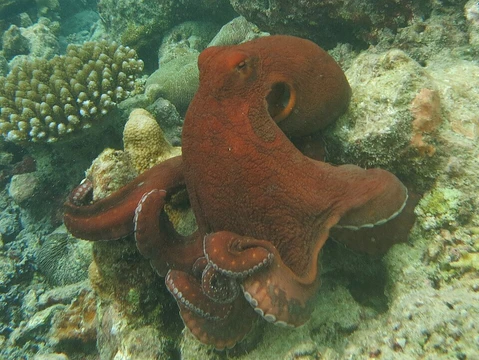
Suckers
A hundred tiny mouths that grip, taste, and let go—all in one flicker.

Suckers are the circular, muscular adhesion discs that line the ventral (inner) surface of each arm in octopuses, most thoroughly documented in the common octopus (Octopus vulgaris). Each arm bears hundreds of these structures arranged in two longitudinal rows, and together they give the animal its extraordinary ability to grip, manipulate, and taste its environment simultaneously. In the broader cephalopod lineage, suckers represent a highly derived form of oral disc that distinguishes octopods from their more distant relatives such as the nautilus, whose arms carry simpler, less muscular suckering structures.
Functionally, a single sucker is a self-contained unit of muscle, epithelium, and sensory tissue. It can generate powerful negative-pressure adhesion, release and re-attach in fractions of a second, and—uniquely among invertebrate appendages—detect chemical cues through a dense array of chemoreceptors. This dual mechanical-and-sensory role makes the octopus sucker one of the most versatile structures in the invertebrate body plan.
- Structure type
- Muscular suction disc with chemosensory epithelium
- Location
- Ventral surface of all eight arms (Octopus vulgaris)
- Arrangement
- Two longitudinal rows per arm, hundreds of discs total
- Primary functions
- Adhesion, manipulation, chemoreception (taste)
- Key sub-structures
- Manus (central pit), annulus (muscular ring), ciliated epithelium
- Notable property
- Can detach from the arm and function independently for a short period
- Taxonomic scope
- Present in all octopods; reduced or absent in nautiloids
Lore & Background
In cephalopod anatomy, the sucker is far more than a suction cup. Histological sections of Octopus vulgaris arms reveal that each disc is a layered organ: an outer muscular annulus contracts to seal the rim against a substrate, while the central manus—a small papilla projecting into the pit—can be everted or retracted to modulate the seal. The entire interior is lined with ciliated epithelium whose cilia beat to move fluid and dissolved chemicals past a dense population of taste receptor cells. This means that every time an octopus grips a rock, a shell, or a prey item, it is simultaneously tasting the surface at the point of contact. No other invertebrate appendage integrates adhesion and chemosensory sampling so tightly.
Perhaps the most remarkable property, first reported in mid-twentieth-century physiological work and confirmed in later electrophysiology studies, is that a severed sucker can continue to contract, release, and re-attach for several minutes after being cut from the arm. The local neural circuitry and muscle tissue are sufficient for a short period of autonomous function, a degree of peripheral autonomy that has no clear parallel in other invertebrate limbs. This has made the detached sucker a classic preparation in comparative neurophysiology laboratories.
Compared with the suckers of squid (which are fewer, less muscular, and lack the same density of chemoreceptors) or the simple oral discs of the nautilus, the octopus sucker represents a peak of cephalopod morphological elaboration. The combination of strong negative-pressure generation, rapid release, and continuous chemical sampling underpins the octopus's foraging strategy, its ability to open bivalve shells, and its capacity to explore complex reef architecture with its arms extended and its eyes elsewhere.
Reader's Guide
Manus (central pit): The small, papilla-like structure at the center of each sucker. It projects into the suction chamber and can be everted or retracted by local muscle fibers to fine-tune the seal against a substrate. Relative to the whole arm, each manus is barely a millimetre across, yet it is the point where the strongest negative pressure is generated. Unlike the simple adhesive pads of many gastropods, the manus is a three-dimensional, actively shaped structure rather than a flat disc.
Annulus (muscular ring): The thick, circular band of smooth muscle surrounding the manus. Contraction of the annulus draws the rim of the sucker inward, increasing the vacuum in the pit and producing the grip. The annulus can release in under a second, allowing rapid repositioning. Compared with the sucker muscles of squid, the octopus annulus is proportionally thicker and more striated, supporting the stronger forces needed to pry open bivalve shells.
Ciliated epithelium and chemoreceptors: The entire pit is lined with a single layer of ciliated cells whose cilia create a gentle current that sweeps dissolved molecules past taste receptor cells. This means adhesion and chemosensory sampling occur at the exact same point in space and time. No other invertebrate appendage combines a powerful suction mechanism with a dense taste epithelium in this way.
Autonomous circuitry: A small local ganglion and intrinsic muscle allow a severed sucker to contract and release for several minutes without central nervous input—a degree of peripheral autonomy unmatched in other invertebrate limbs.
Did You Know?
- A single octopus arm carries hundreds of suckers, and each one contains its own taste receptors, so the animal samples the chemistry of every surface it touches.
- A sucker cut free from the arm can still grip, release, and re-attach for several minutes, demonstrating a degree of peripheral autonomy rare in invertebrate limbs.
- The annulus muscle of an octopus sucker can generate enough negative pressure to hold the animal's full body weight on a vertical rock face, yet release in a fraction of a second.
- Squid and cuttlefish also bear suckers on their arms, but their discs are fewer, less muscular, and lack the dense chemoreceptor arrays found in octopods.
More in Anatomy & Physiology
Elsewhere in Big blue octopus
Spotted an error? Know more?
Reader corrections go straight into our review queue. Suggest an edit · How this site is sourced