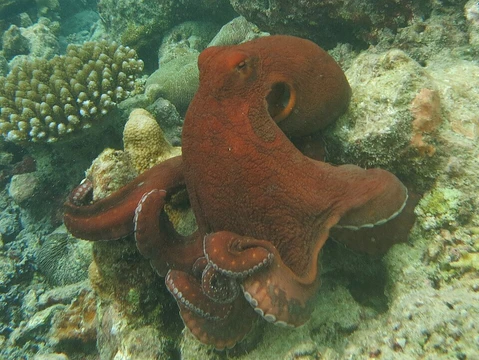
Mimicry
One octopus, a dozen costumes, and zero interest in being itself.

The mimic octopus (Thaumoctopus mimicus) is a small, benthic cephalopod of the Indo-Pacific that has become the most celebrated example of active, multi-species mimicry in the animal kingdom. Described by Franck and Norman in 2004 in the journal *Marine Biology*, it is the only known octopus species that deliberately alters its body shape, coloration, and locomotion to resemble a series of other, often venomous or unpalatable, marine animals as a defensive strategy.
Unlike the passive cryptic coloration common to many cephalopods, the mimic octopus performs a sequence of discrete, species-specific 'roles'—flattening its body to pass as a flatfish, extending two arms forward to mimic a sea snake, or inflating its mantle and splaying its arms to resemble a lionfish. Each performance is context-dependent, triggered by the presence of a particular predator, and is abandoned once the threat passes, returning the animal to its default mottled, tentacled form.
- Species
- Thaumoctopus mimicus
- Described by
- Franck & Norman, 2004 (Marine Biology)
- Region
- Indo-Pacific (Indonesia, Philippines, and surrounding waters)
- Habitat
- Shallow benthic — seagrass beds, rocky reefs, coral rubble
- Size class
- Small; roughly 20–30 cm total length
- Documented mimicry targets
- ≥ 8 species (lionfish, flatfish, sea snake, stonefish, and others)
Lore & Background
Before 2004, the animal was known only as a handful of unremarkable specimens in museum drawers. Franck and Norman's fieldwork in Indonesian seagrass meadows changed that: a single individual, observed over repeated dives, was filmed cycling through at least eight distinct body plans in under a minute, each one a recognizable caricature of a local predator or unpalatable species. The paper that followed—short, precise, and accompanied by time-lapse video—immediately reclassified the animal from a curiosity to a model system for studying adaptive mimicry in invertebrates.
What makes the behavior extraordinary is not any single imitation but the sequence. The octopus does not simply change color; it reconfigures its entire silhouette. Arms are tucked, extended, or splayed. The mantle is inflated or compressed. Locomotion shifts from a slow crawl to a serpentine undulation. Each 'role' is held only while the triggering stimulus is present, and the animal reverts to its default form the moment the predator loses interest. This reversibility and context-sensitivity distinguish true mimicry from the static camouflage that characterizes most cephalopod color change.
The ecological logic is straightforward: in a shallow, predator-dense seagrass habitat, a small, soft-bodied octopus has few options. By borrowing the visual signature of a lionfish's spines, a sea snake's venom, or a stonefish's toxicity, it converts what would be a profitable meal into a risk not worth taking. The mimic octopus thus solves the problem of defense not by fighting, fleeing, or hiding, but by convincing the predator it is looking at something else entirely.
Reader's Guide
When a potential predator approaches, the mimic octopus selects one of several pre-programmed body plans and executes it in a matter of seconds. The most frequently documented performance is the lionfish imitation: the octopus inflates its mantle, erects its arms in a radial fan, and adopts a slow, undulating crawl that mirrors the lionfish's characteristic gait. A flatfish role requires the animal to press its ventral surface to the substrate, flatten its mantle laterally, and oscillate two arms in a fin-like rhythm while remaining otherwise motionless.
The sea-snake imitation is perhaps the most visually striking. Two arms are extended forward and held rigid, the remaining six are drawn back, and the whole body undulates in a lateral S-curve that closely matches the locomotion of a hydrophid sea snake. The stonefish role involves a low, compressed posture with the mantle held high and the arms tucked beneath, reproducing the lumpy, venomous silhouette of the scorpionfish.
What distinguishes these performances from ordinary cephalopod color change is their structural and kinematic specificity. The octopus is not merely matching a pattern; it is rebuilding its three-dimensional outline and altering its gait to match a particular species. Each role is reversible, context-triggered, and abandoned within seconds once the threat departs. Together, these observations—first recorded by Franck and Norman in 2004 and supported by subsequent field studies—stand as some of the strongest evidence that a single invertebrate can deploy a flexible, multi-option defensive repertoire analogous to learned behaviour in vertebrates.
Did You Know?
- The mimic octopus was formally described in 2004, but the species had been sitting misidentified in museum collections for years before Franck and Norman recognized it as something new.
- The mimicry is not fixed: the same individual has been observed switching between a lionfish role and a flatfish role within a single dive, selecting whichever best matches the predator currently in the vicinity.
- No other known octopus species has been documented performing multi-species active mimicry; the behaviour appears to be unique to Thaumoctopus mimicus.
More in Behavior & Intelligence
Elsewhere in Big blue octopus
Spotted an error? Know more?
Reader corrections go straight into our review queue. Suggest an edit · How this site is sourced