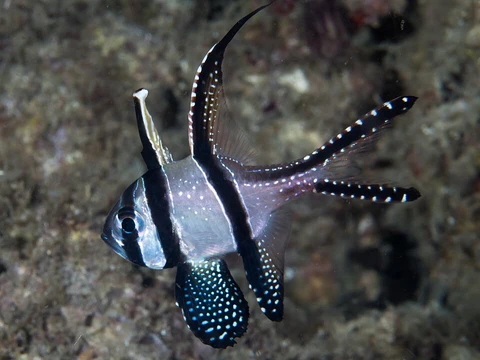
Labroides dimidiatus
The reef's tiny blue-and-white surgeon, trading parasite removal for a meal.

Labroides dimidiatus, the bluespotted cleaner wrasse, is a small Indo-Pacific reef fish (family Labridae) best known for its obligate cleaning-symbiosis behavior. It establishes a fixed 'cleaning station' on the reef, where it waits for larger client fish—tangs, angelfish, butterflyfish, groupers—to approach and open their mouths, gill covers, or bodies while the wrasse picks off ectoparasites, dead skin, and mucus. This mutualistic service keeps the client fish healthy and provides the wrasse with a reliable, low-effort food source.
In the aquarium hobby it is one of the most widely kept reef species, valued for its vivid blue-and-white coloration, its small size (roughly 10 cm / 4 in SL), and its essentially non-aggressive temperament. It is a protandrous hermaphrodite: individuals are born female and a subset will later sex-reverse to male, a transition driven by social hierarchy within a group.
- Common name
- Bluespotted Cleaner Wrasse
- Scientific name
- Labroides dimidiatus (Bloch, 1787)
- Family
- Labridae (wrasses)
- Distribution
- Red Sea, East Africa, throughout the Indo-Pacific to Fiji and the Great Barrier Reef
- Typical depth range
- 1–20 m on shallow coral reefs
- Max length
- ≈ 10 cm (4 in) SL
- Reproductive strategy
- Protandrous hermaphrodite (female → male)
Lore & Background
On any healthy Indo-Pacific reef between one and twenty metres, you will almost certainly find a cleaning station: a small, open pocket of rock or sand where a single bluespotted cleaner wrasse hovers, its body a saturated cobalt scattered with irregular white blotches, its mouth working in quick, precise strokes. Client fish queue in a loose, almost choreographed line—a yellow tang, a blue-green chromis, a juvenile grouper—each holding still while the wrasse darts between scales, into gill opercula, along the lateral line. The interaction is so reliable that researchers have used it as a model system for studying mutualism, client recognition, and the economics of a 'service' animal in a wild context.
The wrasse itself is a small, laterally compressed fish with a single dorsal fin, a pointed snout, and a mouth built for picking rather than biting. Males, which are larger and more intensely colored, defend a small territory around the station and will aggressively chase away rival wrasses of the same sex. Females are slightly smaller and paler. Because the species is protandrous, a dominant female in a group may transition to male if the resident male is removed or dies, a shift that takes weeks and involves changes in coloration, body shape, and behavior.
In the aquarium trade the species has been imported since the early 1970s and remains a staple of mixed reef systems. Its popularity is less about spectacle and more about function: it is, in practical terms, a living water-quality and parasite-control service that costs a small amount of frozen mysis and a few centimetres of open swim space.
Reader's Guide
Temperature: 24–27 °C (75–81 °F) is the standard tropical reef band; they're most active and color-true in the upper half. Salinity 1.020–1.025 SG, pH 8.1–8.4, dKH 8–12—these are baseline reef numbers any established system already hits.
Tank: 150 L (40 US gal) minimum is the consensus floor; 200 L+ with live rock and open swim space lets them establish a proper cleaning station. They are not a nano-tank fish.
Tank mates: This is where the wrasse earns its keep. It coexists beautifully with tangs, angelfish, butterflyfish, and damselfish. It will not chase or harass peaceful community fish. One honest caveat: with no suitable cleaning clients, it may nip anemone tentacles. Avoid pairing with delicate LPS corals in a mixed system.
Feeding: Accepts frozen brine shrimp, mysis, and flake, but its primary drive is live tissue—picking ectoparasites and dead skin off client fish. A small tang or angelfish in the tank effectively replaces that food source. Supplement with protein-rich frozen foods 2–3× weekly.
Breeding: Protandrous hermaphrodites (female-first, sex-reversal to male). Sex change has been observed in long-established captive groups, but no repeatable breeding protocol is published. In the wild, pairs form near a cleaning station and the male guards a small territory. For a captive attempt, keep two or more in a large system and let social hierarchy drive the transition.
Did You Know?
- The cleaning interaction is so specific that client fish can be trained to visit a particular station, and will even 'pay' by holding still longer for a cleaner wrasse they recognise by sight.
- Labroides dimidiatus is a protandrous hermaphrodite: every individual starts life as a female, and a subset will later sex-reverse to male when a dominant male in the group is removed.
- The species has a documented range spanning the Red Sea, the entire Indian Ocean, and the western Pacific to Fiji and the Great Barrier Reef—one of the broadest distributions of any reef wrasse.
- In the wild, a single cleaner wrasse may service dozens of client fish species per day, making it one of the most ecologically central small fish on a coral reef.
More in Aquarium
Elsewhere in Banggai cardinalfish
Spotted an error? Know more?
Reader corrections go straight into our review queue. Suggest an edit · How this site is sourced