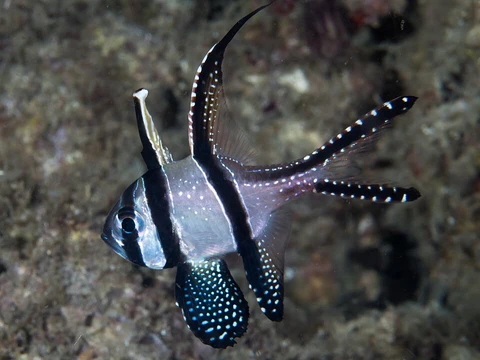
Chaetodon plebeius
A white canvas bearing one dark saddle, drifting through the coral light of the western Pacific.

Chaetodon plebeius, commonly known as the saddleback butterflyfish, is a small reef-dwelling fish in the family Chaetodontidae. It is immediately recognizable by its bold dark-brown saddle-shaped mark on an otherwise white body, paired with a translucent yellow caudal fin. Adults range up to approximately 15 cm in total length and are found across the western Pacific, from the Indonesian archipelago through the Philippines, Papua New Guinea, the Solomon Islands, Vanuatu, and New Caledonia.
Like most butterflyfishes, C. plebeius occupies a niche in shallow coral-reef communities, foraging among branching corals and in lagoon and outer-reef slope habitats. It is a broadcast spawner, typically releasing gamites at dawn, and its conspicuous coloration makes it a frequent subject in both ecological surveys and the ornamental-aquarium trade.
- Common name
- Saddleback butterflyfish
- Family
- Chaetodontidae
- Max recorded length
- ~15 cm TL
- Distribution
- Western Pacific (Indonesia, Philippines, PNG, Solomon Is., Vanuatu, New Caledonia)
- Habitat
- Coral-reef lagoons and outer reef slopes, typically 1–20 m
- Diet
- Omnivorous: zooplankton, small benthic invertebrates, filamentous algae
- Reproductive mode
- Broadcast spawner (dawn spawning)
Lore & Background
The saddleback butterflyfish earns its name from a single, striking ovoid mark of dark brown to near-black pigment that sits across the upper flank and dorsal region, resembling a rider's saddle. The rest of the body is a clean, pale white, and the caudal fin carries a soft yellow wash that intensifies slightly in courtship displays. Juveniles are less boldly patterned, with a more uniform silvery-white body and a small dark eye-stripe, gradually developing the adult saddle as they mature through the first year of life.
In the field, C. plebeius is most often encountered in small groups of two to six individuals patrolling the upper reaches of branching Acropora and Porites thickets, or hovering just above rubble and sand flats in lagoon channels. It is not highly territorial compared to some congeners; rather, it maintains a loose, shifting association with a particular patch of reef, foraging by picking zooplankton from the water column and nipping small invertebrates from coral surfaces. Its pale coloration provides a degree of crypsis against the bright, high-contrast reef background, while the saddle mark may serve as a disruptive pattern against visual predators.
The species is a regular component of the live-fish export trade from Indonesian and Philippine collection sites. Because it is visually striking and relatively hardy in captivity compared to many chaetodontids, it commands a steady, if modest, market price. Collection is typically by hand-netting or small seine operations in shallow lagoon waters, and the fish tolerates transport well enough to arrive alive in most shipments, though stress-induced mortality remains a concern for aquaculture and hobbyist keepers alike.
Reader's Guide
Chaetodon plebeius is generally regarded as a species of low conservation concern. Its range spans much of the western Pacific and it is not currently the subject of a specific CITES listing, but it does not benefit from the broad protections afforded to, say, elasmobranchs or certain corals. The IUCN Red List has not assigned it a threatened category, and in most surveys it remains a common component of shallow-reef assemblages.
The principal pressure is the ornamental-aquarium trade. Collection is concentrated in Indonesian and Philippine lagoons, where hand-netting and small seine operations remove individuals from the wild on a continuous, low-intensity basis. Annual export volumes for the species are not published as a single figure in FAO or CITES statistics, but it appears regularly in Indonesian live-fish export manifests alongside other white-bodied chaetodontids. Because the species is widespread and the collection footprint is diffuse across thousands of reef sites, localized overharvest is possible but has not been documented at a scale that would trigger a range-wide status change.
The nuance matters: a 'Least Concern' or unassessed status does not mean the fish is immune to cumulative stressors. Coral-reef degradation, bleaching events, and the loss of the branching-coral microhabitats it depends on for foraging and shelter can reduce local population viability even when the species as a whole remains abundant. For aquarists, the ethical question is not whether the species will go extinct, but whether a particular lagoon's breeding cohort is being depleted faster than it can replenish. Sourcing from managed, small-scale collection operations with documented site rotation is the practical safeguard most trade-watch groups recommend.
Did You Know?
- The dark 'saddle' marking is absent in juveniles and only becomes fully developed after the first year, making it a useful field mark for age estimation in reef surveys.
- C. plebeius is a dawn spawner: pairs rise in the water column at first light to release gamites, a behaviour shared across many Chaetodon species but particularly reliable in this one.
More in Conservation
Elsewhere in Banggai cardinalfish
Spotted an error? Know more?
Reader corrections go straight into our review queue. Suggest an edit · How this site is sourced