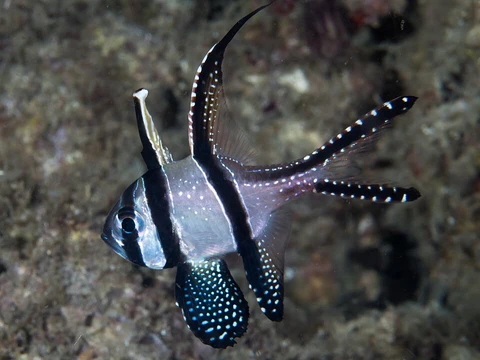
Chromis viridis
A school of emerald sparks over the reef's outer edge—peaceful, plentiful, and unmistakably green.

Chromis viridis, commonly known as the Green Chromis or Green Damselfish, is a small, vividly green reef fish in the family Pomacentridae. First described by Bloch in 1787, it is one of the most widely distributed and recognizable damselfish across the Indo-Pacific, from the Red Sea and East African coast eastward through the Philippines, Indonesia, and up to southern Japan. In the wild, they form loose schools over shallow coral reefs, often hovering near algae beds or the outer edges of the reef structure where light is abundant.
In the marine aquarium trade, Chromis viridis is a staple species—frequently one of the first reef fish a hobbyist acquires. Their hardiness, peaceful temperament, and striking uniform green coloration make them a reliable anchor for community reef tanks. They are rarely aggressive, rarely fin-nipped, and readily accept a wide variety of prepared foods, which has cemented their reputation as a 'gateway' reef fish.
- Scientific name
- Chromis viridis (Bloch, 1787)
- Family
- Pomacentridae
- Common name
- Green Chromis / Green Damselfish
- Distribution
- Indo-Pacific: Red Sea, East Africa, Philippines, Indonesia, Japan
- Typical max length
- ≈ 5–6 cm (SL)
- Habitat
- Shallow coral reefs, algae-rich zones, outer reef slopes
Lore & Background
In the wild, Chromis viridis occupies a niche that is deceptively simple: they are the 'background chorus' of shallow reef communities. Where more colorful or territorial damselfish hold small, defended patches, the Green Chromis drifts in loose aggregations of dozens, feeding on suspended detritus, microalgae, and tiny invertebrates. Their coloration—a uniform, almost fluorescent green that can shift to a faint blue-green on the dorsal and caudal fins under bright tropical light—serves as effective camouflage among swaying algae and sun-dappled water columns.
Their schooling behavior is a key survival strategy. Predators such as groupers, snappers, and larger jacks find it difficult to single out one small green fish from a swirling cloud of dozens. The species is also notably tolerant of variable conditions: it can be found in relatively turbid lagoonal waters as well as clear outer-reef zones, and it tolerates a wider range of light intensities than many of its congener relatives in the genus Chromis.
In aquarium culture, the Green Chromis has a long and unremarkable (in the best sense) history. It has been imported in bulk since the early days of the marine hobby, and its ease of care means it appears in virtually every introductory reef-keeping guide. Unlike many damselfish that become notoriously territorial, C. viridis rarely establishes a rigid territory, making it one of the few Pomacentrids that can be kept in a mixed-species community without the usual 'damselfish drama.'
Reader's Guide
Green Chromis are among the most forgiving reef-keeping damselfish you'll find. They'll tolerate a range, but they thrive when water sits at 24–27 °C, pH 8.1–8.4, and salinity around 1.020–1.025. A minimum of 75 L is workable for a small group, but 100 L or more gives them room to school naturally.
They're omnivorous and unselective. A quality marine flake or pellet base, supplemented with frozen mysis or brine shrimp a couple of times a week, keeps them vivid. They'll also graze on microalgae and detritus, so a lightly stocked reef with some algae growth suits them well.
Breeding in captivity is straightforward compared to many reef fish. Provide a flat, clean rock or tile surface; a gravid female will select a site, clean it, and lay a batch of eggs. She guards the clutch for roughly 4–6 days while the male may or may not assist. Fry are free-swimming within a day of hatching and accept infusoria or finely crushed pellet.
Tank-mate honesty: Chromis viridis are peaceful and will coexist with most reef fish, but they can be outcompeted by more aggressive damselfish or wrasses. They're generally safe with invertebrates and corals. Avoid pairing them with small, slow-moving fish that might get nipped during feeding frenzies. In a well-planted reef with moderate flow, a school of six or more will display the best color and confidence.
Did You Know?
- Chromis viridis was described by Marcus Elieser Bloch in 1787, making it one of the earliest marine fish species formally named in Western ichthyology.
- Despite being a damselfish, C. viridis rarely displays the aggressive territorial behavior typical of the family; it is one of the few Pomacentrids that can be kept in mixed-community tanks without significant conflict.
- The species can shift from a uniform bright green to a faint blue-green on its dorsal and caudal fins depending on light intensity and time of day.
- In the wild, schools of Green Chromis can number in the dozens and function as a 'decoy cloud' that confuses visual predators such as groupers and snappers.
Frequently Asked Questions
What is Chromis viridis?
Chromis viridis, commonly called the Green Chromis or Green Damselfish, is a small, vividly green reef fish in the damselfish family Pomacentridae. First formally described by Bloch in 1787, it remains one of the most instantly recognizable damselfish across the entire Indo-Pacific.
Where does Chromis viridis live in the wild?
Its range stretches from the Red Sea and East African coast through the Philippines and Indonesia up to southern Japan. In the wild it hovers in loose, shifting groups over shallow coral reefs, favouring algae-rich patches and the sunlit outer margins of the reef structure.
How large does Chromis viridis get?
Adults reach roughly five to six centimetres in standard length, placing it among the smaller damselfish species. That compact size is a big reason it fits so neatly into community reef tanks.
Is Chromis viridis a good choice for a community aquarium?
Yes—it has been a long-standing staple of the marine aquarium trade because it is peaceful, hardy, and visually striking. It thrives in a well-lit reef setup where a small group can school near algae beds or open reef edges.
Why is Chromis viridis ecologically important on the reef?
As a small, abundant grazer on the outer reef slope, it helps keep microalgae in check and supports the balance of the shallow reef community. Its wide distribution and schooling habit also make it a reliable, easy-to-spot indicator of overall reef health across the Indo-Pacific.
More in Aquarium
Elsewhere in Banggai cardinalfish
Spotted an error? Know more?
Reader corrections go straight into our review queue. Suggest an edit · How this site is sourced