Caudal fin
The engine at the stern—where trunk muscle becomes open-water motion.

The caudal fin, or tail fin, is the posterior-most appendage in the great majority of fish and serves as the principal propulsive surface. In teleost fishes it is typically homocercal—externally symmetric about the horizontal axis—even though the vertebral column extends further into the upper lobe than the lower. Through oscillatory or undulatory body movements, the caudal fin converts muscular power generated along the trunk into directed thrust, making it the dominant source of forward (and, when needed, backward) propulsion in most aquatic vertebrates.
Caudal-fin morphology varies widely across taxa and correlates strongly with swimming strategy: lunate, deeply forked fins favour sustained high-speed cruising in open water, while rounded or truncate fins suit manoeuvrable, burst-and-hold lifestyles in structurally complex habitats. The fin is supported by lepidotrichia (bony fin rays) and attached to the body via the caudal peduncle, a narrow, muscular region that transmits trunk undulations into tail-beat frequency and amplitude.
- Structure type
- Paired? No — single, unpaired median fin
- Position
- Posterior terminus of the axial skeleton
- Internal support
- Lepidotrichia (bony fin rays) and, in some groups, ceratotrichia
- Teleost symmetry
- Homocercal (externally symmetric)
- Elasmobranch symmetry
- Heterocercal (upper lobe dominant)
- Primary biomechanical role
- Thrust generation via lateral oscillation
- Attachment
- Caudal peduncle (narrow muscular isthmus)
Lore & Background
Evolutionarily, the caudal fin represents the most conserved locomotor structure in vertebrates. The ancestral condition, visible in extant elasmobranchs and sturgeon-like fishes, is heterocercal: the vertebral column projects into the upper lobe, giving the tail a dorsal bias that couples swimming with pitch control. The teleost homocercal tail, in which the notochord or neural spines stop short of the upper lobe and the fin is balanced around the horizontal midline, is a derived adaptation that decouples thrust from pitch, allowing more efficient sustained swimming.
Developmentally, the caudal fin in teleosts forms from the caudal fin fold, a thickened region of the embryonic tail that undergoes apoptosis to carve the lobe notches and then ossifies into the lepidotrichial skeleton. Regeneration of lost or damaged caudal-fin tissue is well documented in zebrafish and other small teleosts, involving a blastema-like proliferative zone and re-differentiation of fin rays—a process that has made the caudal fin a standard model in developmental and regenerative biology.
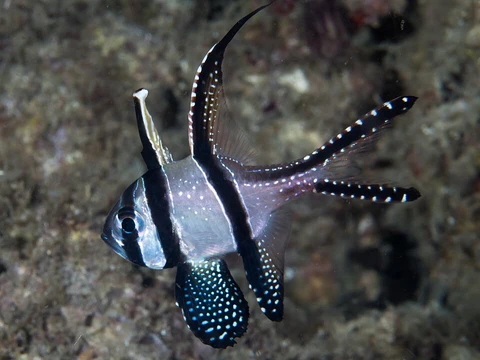
Functionally, the caudal fin operates as a hydrofoil whose angle of attack, surface area, and stiffness are tuned to the species' ecological niche. Tunas and marlins carry deeply lunate, stiff tails built for continuous high-thrust cruising at speeds exceeding 60 km/h. By contrast, a damselfish or a cardinalfish such as Pterapogon kauderni bears a more rounded or slightly emarginate tail, optimised for rapid, low-amplitude bursts among coral branches where sustained speed is irrelevant but agility is paramount.
Reader's Guide
The eye lands first on the overall silhouette of the tail: in a clown cardinalfish the caudal fin is broadly rounded to slightly emarginate, a soft, almost translucent lobe that contrasts sharply with the bold vertical bar pattern of the body. Unlike the deeply lunate, knife-edged tails of pelagic tunas, this tail is low-aspect and broad, built for short, high-frequency bursts rather than sustained thrust. Looking closer, the membrane between the lepidotrichia is thin and slightly opalescent, with no pigment beyond a faint dusky margin along the posterior edge—unlike the heavily pigmented tails of many wrasses or snappers, where the fin reads as a solid dark fan.
Count the rays: the caudal fin in Pterapogon kauderni carries roughly 14 to 16 primary lepidotrichia, each slender and slightly recurved at the tip, fanning out from a compact caudal peduncle that is noticeably narrower than the body depth. The peduncle itself is smooth-scaled, almost scaleless in the last few millimetres before the fin base, a texture that distinguishes it from the ctenoid-scaled trunk. The fin membrane shows fine, parallel striations running radially from ray to membrane edge—these are the inter-ray septa, visible as faint lines when the fish is backlit.
Compare this to a typical damselfish: the cardinalfish tail is slightly taller relative to its width, giving it a more oval, almost fan-like profile, and the posterior margin is gently convex rather than the straight or slightly concave edge seen in many Pomacentrids. In a live, beating specimen the tail oscillates at a low amplitude, the lobes flexing as a unit rather than the individual rays splaying independently, a signature of the homocercal teleost plan.
Did You Know?
- Zebrafish can regenerate a damaged caudal fin within weeks, a process involving a transient blastema-like zone and re-ossification of lepidotrichia, making it a standard model in regenerative medicine research.
- The caudal peduncle—the narrow muscular isthmus between body and tail—houses the caudal musculature and is the primary site where trunk undulation is converted into tail-beat frequency and amplitude.
More in Description
Elsewhere in Banggai cardinalfish
Spotted an error? Know more?
Reader corrections go straight into our review queue. Suggest an edit · How this site is sourced