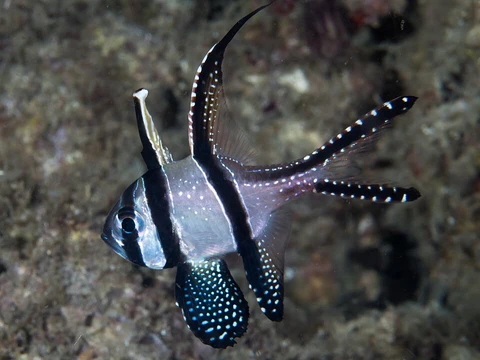
In the aquarium
A captive-bred alternative to a wild-caught species on the brink.

The Banggai cardinalfish is a popular aquarium fish among fishkeepers — but its journey from the reefs of Indonesia to your living room is a story of survival, economics, and controversy.
Quick Facts
- Genus
- Pterapogon
- Species
- kauderni
Facts from the source article.
Lore & Background
The Banggai cardinalfish is a popular aquarium fish among fishkeepers.
The fish is collected by local fishers and sold into the aquarium trade. This species first appeared in the international trade around 1995 or 1996. By 2001, 600,000 to 700,000 fish were exported annually. Trade estimates for 2001 through 2004 are 700,000 to 900,000 fish per year with collection occurring throughout the archipelago. Surveys identified significant (>90%) declines in two populations that were fished from 2001 to 2004, including the extinction of a population off of Limbo Island.
This fish has been successfully bred in captivity. Captive breeding presents an alternative to wild-caught fish. Initially, the relatively high cost–benefit ratio of its production combined with the large number of less expensive wild-harvested fish prevented expansion of aquaculture efforts. In recent years, prices for captive bred or aquacultured specimens have plummeted as large numbers have entered the market. As of early 2018 aquacultured individuals are regularly available for as little as $14 U.S. per fish, and aquacultured specimens make up the vast majority of the market. In addition, a newly emerging threat in the form of a viral disease has been documented in wild-harvested individuals maintained in captivity.
Collection for the aquarium trade has threatened this species with extinction. This increases the demand for captive-bred specimens. It is listed as an endangered species by the IUCN based on its small range, the fragmentation of its distribution, and its continuing decline due to exploitation for the international aquarium trade. In 2007, the species was proposed to be listed for protection under CITES Appendix II, which could limit export of wild-caught individuals, but Indonesia would not support this, and the proposal was withdrawn.
Reader's Guide
This section reproduces what the species' own Wikipedia article states about it in captivity, together with that article's citations. No care parameters — tank size, temperature, reef-safety, temperament — are published by any of the taxonomic or biological databases used elsewhere on this page, and none have been added here.
Sources Wikipedia: Banggai cardinalfish — In captivity — https://en.wikipedia.org/wiki/Banggai_cardinalfish — Licence: CC BY-SA 4.0 — Accessed 2026-09-19
Did You Know?
- No open taxonomic or biological database publishes aquarium care parameters for this species — so this page reproduces a cited Wikipedia section instead of inventing them.
- The Banggai cardinalfish was one of the first marine ornamentals to be driven toward extinction by the pet trade.
- Captive-bred Banggai cardinalfish now cost as little as $14 — a fraction of what they once fetched — making them an ethical and affordable choice for home aquariums.
A Narrow Homeland Under Threat
The Banggai cardinalfish occupies one of the most restricted ranges of any marine species, confined almost entirely to the waters surrounding the Banggai Archipelago in Indonesia. Its natural territory spans roughly 5,500 square kilometers, with isolated populations clustered around the shallow waters of seventeen large islands and ten smaller ones. A modest additional group persists in Luwuk harbor off Central Sulawesi. Beyond this core area, the species has only appeared through human intervention: aquarium traders introduced a population into the Lembeh Strait in North Sulawesi around 2000, and small numbers were documented in Secret Bay on northwest Bali as recently as May 2014. Despite these scattered introductions, the total wild population is estimated at just 2.4 million individuals. The species is now classified as endangered, a status driven by heavy wild capture for the global aquarium trade, habitat degradation, and outbreaks of iridovirus disease that cause significant mortality. The combination of an extremely small geographic footprint, limited dispersal ability, and ongoing exploitation places this fish at considerable risk of local and even global extinction.
A Distinctive Silhouette
At a maximum length of just eight centimeters, the Banggai cardinalfish is a compact fish, yet its appearance is unmistakable among all members of the cardinalfish family. Its first dorsal fin bears a distinctive tassel-like structure, while the rays of its anal fin and second dorsal fin are notably elongated. The tail fin is deeply forked, and the body is marked by three bold black bars running across the head and torso. The front edges of both the anal fin and the second dorsal fin carry prominent black borders, adding to the fish's striking contrast. Taxonomically, this species stands alone: it is the sole representative of its genus, which was once grouped within Pterapogon before being split into its own distinct genus. Sexual dimorphism is subtle in everyday observation, as the fish are sexually monomorphic, but males reveal a conspicuous enlarged oral cavity during the brooding period. The species is the only diurnal member of its family, active during daylight hours rather than the nocturnal pattern typical of most cardinalfishes.
Life Among the Spines
In the shallow, sheltered waters of the Banggai Islands, the Banggai cardinalfish lives in stable social groups that typically number around nine individuals, though aggregations in calm lagoons can reach as many as five hundred. These fish favor depths of roughly 1.5 to 2.5 meters, settling among coral reefs, seagrass beds of Enhalus acoroides, and open stretches of sand and rubble, with a clear preference for the leeward sides of larger islands. Their most remarkable behavioral trait is their intimate association with the long-spined sea urchin Diadema setosum: the fish can slip among the urchin's sharp spines without sustaining a sting, using them as a living fortress when threatened. Young fish gravitate toward sea anemones, while juveniles and adults favor urchins, branching corals, sea stars, hydrozoans, and mangrove prop roots. The groups are notably sedentary, with very limited movement between clusters, a constraint tied to their reliance on plankton drifting through currents. Individual fish display strong homing behavior, returning to their original group location after disturbance. When collectors remove these fish, the abundance of their associated invertebrate neighbors has been shown to decline, underscoring the ecological web they anchor.
Courtship, Brooding, and a Brief Life
Reproduction in the Banggai cardinalfish follows a pattern that sets it apart from many marine relatives. The species is a paternal mouthbrooder: after spawning, the male carries the eggs and subsequently the hatched young in his enlarged oral cavity for an undetermined period. Notably, there is no free-swimming planktonic larval stage; the young develop entirely within the father's mouth. Courtship is initiated by the female, who isolates a chosen male from the colony by establishing a spherical spawning site roughly 50 to 60 centimeters in diameter, positioned several meters from the main group. The pair then vigorously defends this territory. A characteristic display called side by side trembling involves the female approaching the male from behind with a vigorous shaking motion while he remains still, before she positions herself alongside him. Pair formation can occur up to two weeks before spawning. The female's body size governs egg size and fecundity, while the male's size determines total reproductive output, which is why pairing tends to occur between similarly sized individuals. In optimal captivity the fish may live around four years, but in the wild their lifespan is likely only one to two years.
Gallery


More in Aquarium
Elsewhere in Banggai cardinalfish
Spotted an error? Know more?
Reader corrections go straight into our review queue. Suggest an edit · How this site is sourced