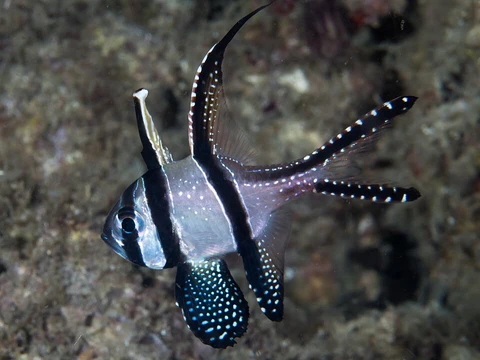
Synchiropus splendidus
A jewel the size of a thumbnail that rules a crevice of coral by night.

Synchiropus splendidus, widely known as the mandarinfish or mandarin dragonet, is a small reef-dwelling fish in the family Callionymidae. Native to the Indo-Pacific — from the Coral Sea and Great Barrier Reef through the Philippines, Indonesia, and into northern Australian waters — it inhabits shallow coral reefs where it forages among live rock and rubble for tiny crustaceans. Males are noticeably larger and more vividly colored than females, displaying bold orange, blue, and green markings that have made the species one of the most sought-after ornamental fish in the reef-keeping hobby.
Though unassuming in size, the mandarinfish occupies a quiet ecological niche as a nocturnal invertebrate specialist. It is neither schooling nor overtly aggressive, but a single male will defend a modest patch of rockwork against conspecifics. In the aquarium trade it is prized less for spectacle than for the patience it demands: a well-established reef, a steady supply of micro-fauna, and a keeper who respects its night-shift feeding rhythm.
- Common name
- Mandarinfish / Mandarin dragonet
- Family
- Callionymidae (dragonets)
- Native range
- Indo-Pacific (Coral Sea, Great Barrier Reef, Philippines, Indonesia, N. Australia)
- Typical adult size
- ≈ 5–7 cm (2–3 in)
- Sexual dimorphism
- Males larger and more brightly colored than females
- Activity period
- Nocturnal forager
- Diet in the wild
- Small crustaceans (copepods, amphipods, isopods)
Lore & Background
In the wild, Synchiropus splendidus lives close to the substrate on fore-reef slopes and in the shallower lagoonal zones of the Indo-Pacific. It is a creature of crevices: by day it tucks into a narrow gap in the rock, its laterally compressed body and cryptic coloration blending with the encrusting coralline algae. When the reef dims at dusk, it emerges to pick copepods and tiny amphipods from the rock face with a quick, darting strike — a feeding style more reminiscent of a goby than of a typical dragonet.
Males carry a subtle but unmistakable territory. They patrol a rough circle of perhaps a meter or two around their chosen rock, flashing their iridescent flanks at any rival male that drifts too close. Females, smaller and more muted, are less conspicuous but equally adept at navigating the three-dimensional maze of a healthy reef. The species does not school; each adult is essentially a solitary forager bound to a patch of live rock rich in micro-fauna.
In the ornamental trade the mandarinfish has a reputation that is as much about the keeper as the fish. It tolerates a wide band of reef parameters but is unforgiving of instability. A tank that has cycled for months, with a dense population of copepods and amphipods in the live rock, will sustain a mandarinfish for years. The same fish in a new, bare-bottom setup will starve within weeks, not because it is exotic, but because its entire foraging strategy depends on a living reef ecosystem that simply does not exist yet.
Reader's Guide
Synchiropus splendidus is a reef fish, not a community fish — it wants an established system with mature live rock teeming with copepods, amphipods, and small crustaceans. A tank under 150 L (40 US gal) is workable, but 200 L+ gives the male the territory he expects. They'll tolerate 23–26 °C and pH 8.1–8.4, but they thrive when parameters sit at the stable end of that range; swings stress them more than the values themselves.
Feed them at lights-out. They are nocturnal foragers and will ignore most daytime pellet offerings. Target-feed small frozen copepods or brine shrimp with a pipette near the rockwork after the lights go down. Once they learn the routine, they'll patrol the same crevices every night.
Tank mates: they are peaceful toward most reef fish but will harass another mandarinfish of the same sex. A single male with one or two smaller, non-aggressive species (small gobies, cleaner wrasse) works well. Avoid fast swimmers that outcompete them for food, and avoid aggressive wrasses or large tangs that may bully them.
Breeding in captivity is rare and unproven in home systems; do not plan around it. In the wild, the male gathers a small clutch of eggs and guards them until they hatch, a behavior occasionally observed in long-established reef tanks.
Did You Know?
- Despite its name, the mandarinfish is not a true dragonet (family Syngnathidae); it belongs to Callionymidae, a family of small, bottom-dwelling fishes that includes the weever and the dragonet proper.
- Males can be up to 30 % larger than females and display far more saturated orange and blue markings, a difference visible even in juvenile fish as they mature.
- The species is a nocturnal forager: in a well-stocked reef tank it will often ignore daytime feeding entirely and only emerge to pick at live rock after the lights go out.
- Synchiropus splendidus is listed as Least Concern on the IUCN Red List, though it is heavily collected for the ornamental trade across its Indo-Pacific range.
More in Aquarium
Elsewhere in Banggai cardinalfish
Spotted an error? Know more?
Reader corrections go straight into our review queue. Suggest an edit · How this site is sourced