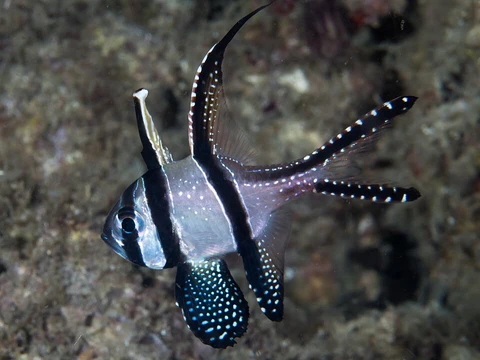
Bungi
A jewel-box red fish locked to a single strait of water off Sulawesi.

Pterapogon kauderni, the Banggai cardinalfish, is a small reef fish endemic to the Banggai Strait off northeastern Sulawesi, Indonesia. Its known range is confined to a handful of islands and seamounts in this strait—most notably the Bungi Islands—making it one of the most geographically restricted marine teleosts in the Indo-Pacific.
Within its tiny home range the species is a conspicuous, brightly colored inhabitant of shallow coral heads, and its extreme endemism has made it a focal point for biogeographic studies of the Sulawesi Sea archipelagos. It is also one of the most widely traded small reef fish in the ornamental-aquarium trade, a fact that has drawn both commercial interest and conservation attention.
- Scientific name
- Pterapogon kauderni
- Family
- Apogonidae (cardinalfishes)
- Distribution
- Banggai Strait, Indonesia (Bungi Islands and nearby reefs)
- Endemism
- Narrow endemic to the Banggai Strait
- Habitat
- Shallow coral-reef heads and overhangs
- Sexual dimorphism
- Males deep red; females orange
Lore & Background
The Banggai cardinalfish is a textbook case of allopatric isolation in the marine realm. The Banggai Strait, a narrow channel threading between the Bungi and Sula island groups, has acted as a semi-enclosed basin for millions of years. Tectonic uplift, shifting sea levels, and the strait's limited connectivity to the open Celebes Sea created a natural laboratory in which a single cardinalfish lineage diverged in situ. The result is a species whose entire known range spans roughly a few hundred kilometres of scattered reef, a range so tight that a single storm-driven current could, in principle, displace the whole population.
Behaviourally the fish is a small, territorial sentinel. Males claim a patch of branching or massive coral—often Porites or Acropora heads—and guard a nest of eggs beneath an overhang. The male's deep crimson body and the female's softer orange make the pair easy to spot against the grey-brown coral, yet their small size (a few centimetres) keeps them low on the predator menu. They are diurnal, hovering in the upper water column above their chosen head, darting for small crustaceans and planktonic invertebrates.
Because the species occurs nowhere else on Earth, any localised threat—coral bleaching, sedimentation from coastal development, or over-harvesting for the aquarium trade—carries the weight of global extinction. This has made the Bungi and neighbouring reefs a priority for Indonesian marine-protection planning, and the fish a symbol of how a single, vivid little animal can anchor an entire conservation narrative.
Reader's Guide
Heartland: the Bungi Islands, a small archipelago sitting in the middle of the Banggai Strait, roughly 200 km northeast of the Sulawesi mainland. The reefs here are shallow, lagoon-protected, and dominated by massive and branching corals—Porites lobata, Acropora species, and Favia heads—growing on a thin veneer of sand over volcanic bedrock. Pterapogon kauderni favours the upper 1–5 m of these heads, sheltering beneath overhangs and in the crevices of branching colonies where the water column is just deep enough to hide a five-centimetre fish from passing predators.
Expanding outward, the known range stretches to the Sula Islands to the north, the Wakatobi seamounts to the south, and a handful of isolated patches along the northeastern Sulawesi shelf. In every case the habitat is the same: a shallow, well-lit coral head in a lagoon or back-reef setting, with a sandy or rubble substrate at the base and a canopy of branching coral above. The strait's semi-enclosed geometry—narrow channels between island chains, limited exchange with the open Pacific—means that what you see at Bungi is, essentially, the whole world this species knows.
That narrowness is the wonder. A fish that could, in principle, range across thousands of kilometres of Indo-Pacific reef is instead pinned to a scattering of heads in one strait. Every reef you survey here is, in effect, a different chapter of the same very short book.
Did You Know?
- The entire known population of Pterapogon kauderni is confined to the Banggai Strait; the species has never been recorded outside this narrow region of Indonesian waters.
- Males and females differ in hue—males are a deep, saturated red while females are a softer orange—making sex easy to determine at a glance on the reef.
- The species is one of the most popular small reef fish in the global ornamental-aquarium trade, which has prompted calls for sustainable harvest quotas in the Banggai Strait.
- Its extreme endemism makes it a key study species for understanding how tectonic isolation and sea-level change shape marine biodiversity in the Sulawesi Sea archipelagos.
More in Distribution
Elsewhere in Banggai cardinalfish
Spotted an error? Know more?
Reader corrections go straight into our review queue. Suggest an edit · How this site is sourced