Gramma loreto
A tiny nocturnal jewel of the reef, hidden by day and alive by night.

Gramma loreto, commonly known as the Pearly Monarchfish or Pearly Monarch, is a small nocturnal reef fish in the family Nemipteridae (the soldierfishes). Native to the western Pacific and eastern Indian Ocean, it inhabits coral-reef environments from shallow lagoons to deeper slopes, typically resting in the crevices of coral heads during daylight hours and emerging after dark to forage over open substrate and soft corals.
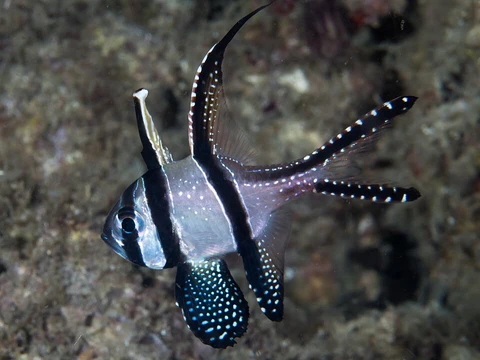
In the marine aquarium trade, Gramma loreto is a long-standing favourite for small-to-medium reef systems. Its compact size, peaceful temperament, and striking black-and-white spotting pattern—punctuated by a pale 'pearl' marking on the head and soft orange-yellow finnage—make it one of the most instantly recognisable small reef species. Its strictly nocturnal activity pattern gives keepers a unique window into the reef's night ecology.
- Common name
- Pearly Monarchfish / Pearly Monarch
- Family
- Nemipteridae (soldierfishes)
- Typical adult length
- ≈ 4–5 cm (1.5–2 in)
- Native range
- Western Pacific; eastern Indian Ocean
- Habitat depth
- Roughly 5–40 m on coral reefs
- Activity pattern
- Nocturnal; rests in coral crevices by day
- Temperament
- Peaceful, non-territorial
Lore & Background
By day the Pearly Monarch is easy to overlook. It tucks itself into a narrow gap beneath a branching Acropora or wedges into the hollow of a boulder, its black body mottled with dense white spots that break up its silhouette against the reef matrix. The small pale oval on the snout—giving the species its 'pearly' epithet—catches the last sliver of light even in shadow. To a passing angelfish or a curious wrasse, it simply looks like another piece of the reef.
Night changes everything. As the reef's diurnal predators settle, the monarch slips out and hovers just above the sand or drifts over soft-coralline outcrops, picking up copepods, small mysids, and detrital particles with quick, deliberate dart-movements. Its orange-yellow pectoral and caudal fins flare in the dim blue light, a small flash of colour in an otherwise muted nocturnal scene. It is not a fast swimmer; it relies on the reef's structural complexity and its own cryptic colouration rather than speed.
In the aquarium, this nocturnality is both the species' charm and its challenge. Keepers who only observe their tank in daylight see a fish that seems perpetually shy or 'sick.' Those who dim the lights or watch after the household has gone quiet discover an active, curious little forager that will hover in the open water column, inspecting every piece of live rock and soft coral as if cataloguing a new territory.
Reader's Guide
Tank size: 90 L / 25 gal or larger is the practical minimum; the fish needs open swimming space at night even though it's tiny. A well-established reef with live rock, soft corals, and a sandy bottom gives it the crevices it instinctively seeks.
Water: standard tropical marine parameters—24–27 °C (75–81 °F), pH 8.1–8.4, salinity 1.020–1.025. It tolerates a range, but it thrives when the water is stable and the nitrate is kept low. Avoid sudden parameter swings; it's small and doesn't buffer well.
Lighting: this is the big one. Because it's nocturnal, a dimmed or off lighting cycle in the evening will coax it out. If you run a full photoperiod, expect to see it only in the first and last minutes of the cycle. A 10–15 minute dim-down before full shutoff is a gentle transition that reduces stress.
Feeding: offer small frozen mysis, brine shrimp, or finely chopped rotifer paste in the evening after lights-out. It will take food from the open column and from crevices. Supplement with a quality marine pellet crushed to dust. It's not a picky eater, but it's a small-mouthed one—keep food particles under 2 mm.
Tank mates: genuinely peaceful. It coexists well with other small reef fish—clownfish, small chromis, dascyllus, blennies, and other peaceful gobies. Avoid aggressive or large-bodied species that could bully it out of its hiding spot or simply outcompete it for food. It is not a threat to invertebrates; shrimp and snails are safe.
Breeding: there is no well-documented, repeatable captive-breeding protocol for Gramma loreto in the public literature. It is a broadcast spawner in the wild, but captive spawning has not been reliably achieved. Treat any 'breeding guide' you find online with scepticism unless it cites a peer-reviewed or long-running aquarist source.
Did You Know?
- Its strict nocturnal activity means that in a well-lit daytime-only aquarium it can appear permanently 'shy' or stressed, when in fact it is simply waiting for the lights to go out.
- The small pale oval marking on the snout that gives the species its 'pearly' name is a fleshy, slightly raised structure rather than a flat colour patch, visible even when the fish is pressed flat against rock.
- In the wild it is often found in loose aggregations of a dozen or more individuals resting in the same coral head, suggesting a mild social tendency that is rarely expressed in a single-species aquarium.
More in Aquarium
Elsewhere in Banggai cardinalfish
Spotted an error? Know more?
Reader corrections go straight into our review queue. Suggest an edit · How this site is sourced