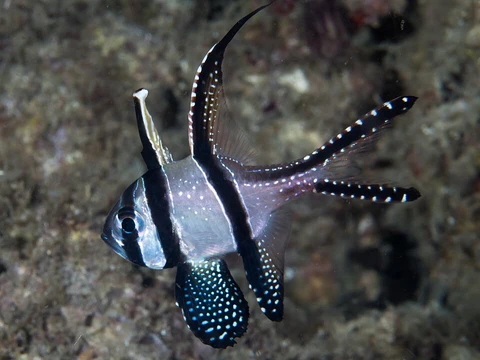
Dascyllus aruanus
A blue-green reef sentinel that turns a handful of live rock into its own tiny kingdom.

Dascyllus aruanus, most widely known as the ornate damselfish or Fiji damselfish, is a small, vividly colored member of the family Pomacentridae. First described from the waters around Fiji, this species occupies the middle ground between the flashier chromis and the more subdued chromis-lookalikes, wearing a blue-green body laced with darker blue markings and a conspicuous dark ocellus on the dorsal fin. It is one of the most frequently encountered damselfishes in the Indo-Pacific lagoon and outer-reef zones, and consequently one of the most commonly offered to hobbyists entering the marine-reef trade.
In its natural setting the ornate damselfish plays a quietly essential role: it grazes microalgae from live rock and coral surfaces, polices small invertebrate populations, and serves as forage for larger reef predators. Its semi-territorial but not overtly aggressive temperament makes it a workable resident of community reef tanks, provided the keeper respects its need for open swimming space and a stable, well-filtered environment.
- Scientific name
- Dascyllus aruanus
- Common names
- Ornate damselfish, Fiji damselfish, Blue-green damselfish
- Family
- Pomacentridae
- Maximum length
- ≈ 7 cm (2.8 in)
- Distribution
- Indo-Pacific; type locality Fiji, also recorded across the western Pacific
- Habitat
- Coral reefs, lagoon and outer-reef slopes, typically 2–20 m
- Diet (wild)
- Omnivorous – microalgae, zooplankton, small benthic invertebrates
Lore & Background
The ornate damselfish is a creature of the shallow, sun-drenched Indo-Pacific. In Fijian lagoons it hovers in small, loosely coordinated groups above broken coral rubble and the undersides of overhanging ledges, each individual defending a patch of turf algae no larger than a dinner plate. The blue-green body, streaked with darker blue lines and crowned by a bold black spot on the dorsal fin, is not mere ornamentation; it breaks up the fish's outline against the dappled light of the reef, a form of disruptive camouflage that works best when the fish is stationary and the water is clear.
Reproductively, the species follows the classic pomacentrid pattern. A dominant male establishes a nest site—a flat piece of rock or a small overhang—and performs a series of fanning and circling displays to attract a female. The female deposits a batch of sticky, orange-tinged eggs on the substrate; the male then guards them for several days, fanning them with his pectoral fins to keep oxygen flowing and driving off any would-be egg-predators. Once the fry hatch, they disperse into the water column, spending their first weeks in the open lagoon before recruiting back onto the reef as juveniles.
In the aquarium trade the ornate damselfish occupies a particular niche: it is hardy enough to survive the stresses of collection and transport, colorful enough to justify its price, and small enough to fit in a 150-litre (40-gallon) system. Its semi-territorial nature means it can coexist with other damselfishes if the tank offers ample visual barriers and swimming space, but two males in a cramped tank will quickly escalate from posturing to overt chasing. Keepers who respect those boundaries find a fish that is active, curious, and remarkably long-lived for a damsel of its size.
Reader's Guide
Setting up the tank. A 150-litre (40-gallon) system is the practical minimum; 200 litres (55 gallons) or more gives the fish room to establish a territory without feeling hemmed in. Standard Indo-Pacific reef parameters apply—salinity 1.020–1.025, pH 8.1–8.4, temperature 24–27 °C (75–81 °F). They'll tolerate a range, but they thrive when the water is clean, the flow is moderate-to-strong, and the light is bright enough to keep live rock and coral looking vivid. A good protein skimmer and regular 10–15 % water changes will do more for their longevity than any supplement.
Feeding. In the wild they graze continuously; in the tank they'll accept frozen brine shrimp, mysis, and finely chopped marine pellets, but they do best when you supplement with a quality flake or pellet formulated for herbivorous and omnivorous reef fish. Offer small meals two to three times daily. Watch for a greenish tint to the flanks—that's a sign their gut flora is happy. If the fish starts losing color or developing a sunken belly, increase the proportion of algae-based foods (Norithi wafers, dried nori held in the current) and check for competition from more aggressive tank-mates.
Tank mates. The ornate damselfish is semi-territorial, not bull-headed. It will coexist fine with other damselfish species in a well-planted, rock-heavy tank where sight lines are broken up—just avoid two adult males of the same species in a small system. It is generally non-aggressive toward peaceful wrasses, gobies, and small anthias, but it will chase slow, long-finned species (angelfish, bannerfish) that drift into its patrol zone. Invertivore caution: it may nip at small hermit crabs or the tentacles of soft corals if food is scarce, so keep the tank well-stocked and well-fed.
Breeding (narrated step-by-step). In a mature, stable tank a dominant male will select a flat rock or a small overhang and begin cleaning it. He'll then perform a rapid, fanning display—pectoral fins spread, body quivering—directed at any receptive female present. The female approaches, and in a quick burst deposits a clutch of 200–500 sticky, orange-tinged eggs onto the cleaned surface. The male immediately begins guarding: he fans the eggs with his pectoral fins to circulate oxygenated water, chases any fish that comes within a few centimetres, and may darken in coloration. After roughly four to six days of guarding, the eggs hatch. The fry are tiny, translucent, and drift into the water column; in the tank they'll need infusoria or commercially prepared microworms for the first few days before transitioning to finely crushed brine shrimp. The male will often resume his territory immediately, ready for the next cycle.
Did You Know?
- The species epithet 'aruanus' is tied to its type locality in Fiji, making it one of the few damselfishes whose very name points to a single island group.
- The bold dark ocellus (eye-spot) on the dorsal fin is a key field mark that separates D. aruanus from the superficially similar D. melanurus and D. trimaculatus.
- In a well-set-up reef tank a single male can successfully breed multiple times a year, and the clutch size can exceed 500 eggs per spawning event.
- Ornate damselfish are among the most frequently collected pomacentrids for the global marine-aquarium trade, a fact that makes sustainable sourcing and captive-breeding programs especially important.
More in Aquarium
Elsewhere in Banggai cardinalfish
Spotted an error? Know more?
Reader corrections go straight into our review queue. Suggest an edit · How this site is sourced