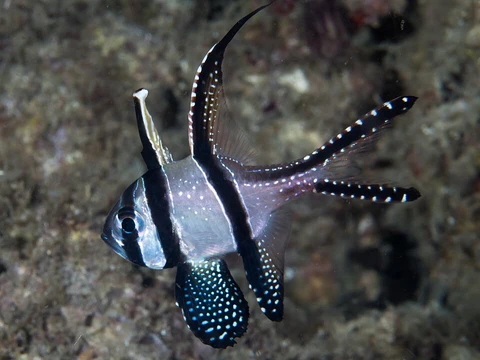
Pterapogon kauderni
A five-centimetre striped sentinel of the Banggai shallows, guarding its eggs beneath the surface.

Pterapogon kauderni, widely known as the Banggai Cardinalfish, is a small, laterally compressed marine fish endemic to the shallow lagoons and sheltered reef flats of the Banggai Islands, central Indonesia. Described by Pieter Bleeker in 1852 and placed in the cardinalfish family Apogonidae, it is immediately recognizable by its four to five bold, dark horizontal stripes set against a silvery-cream body, a slightly upturned mouth, and a translucent dorsal fin. In the wild it occupies the upper water column over live rock and seagrass beds, typically between 0 and 10 m depth, and is most active during twilight and night hours.
In the global marine-aquarium trade the Banggai Cardinalfish holds a distinctive niche: it is one of the very few saltwater species that can be reliably bred in captivity by a non-specialist, making it a cornerstone species for hobbyist reef-keeping and a model organism for studying marine reproductive biology.
- Scientific name
- Pterapogon kauderni (Bleeker, 1852)
- Family
- Apogonidae (cardinalfishes)
- Endemic range
- Banggai Islands, Sulawesi Sea, Indonesia
- Typical adult length
- ≈ 5 cm (SL)
- Habitat
- Shallow lagoons, sheltered reef flats, seagrass edges
- Activity pattern
- Crepuscular / nocturnal
- Reproduction
- Oviparous; male guards buoyant egg clutch
Lore & Background
The Banggai Cardinalfish is a textbook example of a geographically restricted reef specialist. Its entire known wild population is confined to the archipelago of the Banggai Islands, a cluster of small volcanic islands in the Sulawesi Sea. FishBase and regional ichthyological surveys record it in calm, shallow waters where live rock, fallen coral heads, and patches of seagrass create the low-flow microhabitats the species favours. It rarely ventures into open water; instead it clings to the upper surfaces of substrate, often draping its body just beneath the air–water interface, a behaviour that distinguishes it from most other cardinalfishes.
Behaviourally, P. kauderni is crepuscular. During daylight it remains largely motionless, wedged into a crevice or hovering in the shadow of an overhang. As light fades, it becomes visibly active, cruising the upper water column in short, darting forays to pick up zooplankton and small crustaceans. Males establish small territories around a chosen shelter and will display—flattening the body, fanning the pectoral fins—against intruding males of the same species, though aggression toward other reef fish is minimal.
The species' reproductive biology has made it a focal point in marine aquaculture research. The female releases a batch of small, buoyant eggs near the surface; the male then assumes full parental care, fanning the clutch for approximately three to four days until the larvae hatch and disperse. This paternal-guarding strategy, combined with the species' small size and relatively simple husbandry needs, made P. kauderni one of the first marine fish to be bred routinely outside of laboratory settings, a milestone frequently cited in the reef-aquarium literature.
Reader's Guide
Think of them as tiny, striped sentinels of the upper water column. They'll tolerate 23–27 °C, but they settle in and show their best coloration around 25 °C with a pH of 8.1–8.4 and specific gravity 1.022–1.025. Keep flow gentle—these are lagoon fish, not open-ocean cruisers—and provide ample live rock and overhangs where they can drape themselves over the surface at dusk.
Breeding is straightforward once a pair bonds. The female releases a clutch of buoyant eggs near the surface; the male then fans and guards them for roughly 3–4 days, keeping them oxygenated and free of algae. Fry are free-swimming within a day of hatching and will take infusoria or finely crushed brine shrimp.
On tank mates: they're peaceful with most small reef species but will chase off other Pterapogon or similarly striped cardinalfish. A 90 L (24 gal) nano-reef is the minimum for a single pair; 150 L+ is more comfortable for a small group. Avoid aggressive tangs or large wrasses that patrol the surface. A well-established system with a week of acclimation will have them darting between anemone tentacles within a few days.
Did You Know?
- Pterapogon kauderni is endemic to the Banggai Islands—its entire wild range spans a small archipelago in the Sulawesi Sea, making it one of the most geographically restricted cardinalfishes.
- It is one of the very few marine fish species that can be bred successfully by non-professional hobbyists in a home saltwater tank, a fact that has made it a staple of reef-aquarium literature since the 1990s.
- The male, not the female, provides all parental care: he guards the buoyant egg clutch for roughly three to four days and fans the eggs to ensure oxygenation before the larvae hatch.
- Unlike most cardinalfishes that dwell in the mid-water or near the substrate, P. kauderni is a surface-dweller, often observed draped just beneath the air–water interface in calm lagoon settings.
More in Aquarium
Elsewhere in Banggai cardinalfish
Spotted an error? Know more?
Reader corrections go straight into our review queue. Suggest an edit · How this site is sourced