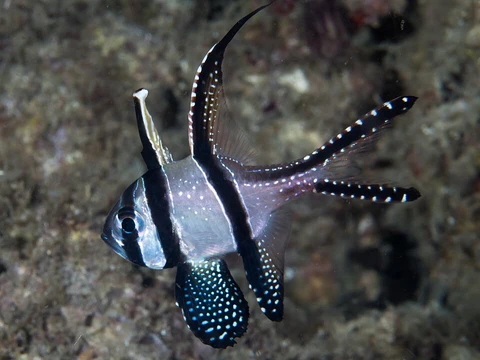
Amphiprion ocellaris
Three white bars, one anemone, and a lifetime of mutual trust on the reef.

Amphiprion ocellaris, commonly known as the ocellaris clownfish or simply the 'clownfish,' is a small, brightly colored reef fish in the family Pomacentridae. First described by Cuvier in 1830, it is the species most people picture when they hear 'clownfish,' and the one popularized worldwide by the animated film *Finding Nemo*. Its vivid orange body, three bold white bars edged in black, and unmistakable association with sea anemones make it one of the most recognizable marine animals on Earth.
In the wild, A. ocellaris inhabits shallow coral reefs, lagoons, and rocky shorelines across the Indo-Pacific, from the Red Sea and East Africa eastward to the central Pacific. It lives in a tight mutualism with several species of sea anemone, gaining protection from predators in exchange for cleaning, nutrient transfer, and territorial defense. In the aquarium trade it is arguably the single most popular marine fish, prized for its hardiness, bold coloration, and relatively straightforward care compared to other reef species.
- Common name
- Ocellaris clownfish
- Scientific name
- Amphiprion ocellaris
- Family
- Pomacentridae
- Distribution
- Indo-Pacific (Red Sea to central Pacific)
- Typical adult length
- ≈ 7–11 cm (3–4 in)
- Symbiotic partner
- Sea anemones (e.g., Heteractis magnifica, Stichodactyla haddoni)
- Reproductive strategy
- Protandrous hermaphrodite; all individuals born male
Lore & Background
On a sun-dappled reef shelf in the Andaman Sea, a cluster of Heteractis magnifica sways in the current. Woven through their stinging tentacles is a small orange fish, darting in and out with a confidence that would be suicidal for any other reef dweller. This is the ocellaris clownfish at work: a fish that has, over millions of years of co-evolution, developed a specialized mucus coat that renders it immune to the anemone's nematocysts. In return, it patrols the anemone's perimeter, shoos away butterflyfish that would nibble the tentacles, and defecates nearby, depositing nutrients that feed the anemone's zooxanthellae. Neither survives well without the other.
The social structure inside a single anemone is a small, rigid hierarchy. Every clownfish is born male. The largest, most dominant individual in the group transitions into the breeding female, and the next-largest becomes the breeding male. If the female dies, the male shifts roles, and the social ladder reorganizes within days. This protandrous hermaphroditism means that a single anemone can house a small family of two to six individuals, all of the same sex except the top two, all sharing one stinging home.
In the aquarium world, A. ocellaris has become a gateway species for marine keeping. Its tolerance of a wider range of water parameters than many other reef fish, its willingness to accept a variety of foods, and its bold, almost theatrical coloration have made it the default first choice for hobbyists building a reef tank. It is the fish that turns a glass box into a window on the Indo-Pacific.
Reader's Guide
Temperature: 24–27 °C (75–81 °F) is the sweet spot. They'll tolerate a degree or two outside that, but sustained excursions past 29 °C stress their immune system and invite ich. Salinity: 1.020–1.025 specific gravity (about 35 ppt) mirrors their natural lagoon habitat; keep it stable rather than chasing a single number. pH: 8.1–8.4, with alkalinity around 8–12 dKH. They are not as demanding as a tang, but they notice a slow drift.
Tank: A minimum of 100 L (≈ 25 gal) gives one pair room, but 200 L+ is better if you want to add a second anemone or a small group. Provide a live anemone if possible—Heteractis magnifica or Stichodactyla haddoni are the classic pairings—but a healthy clownfish will also do well in a well-planted reef tank without one, as long as it has a few caves or rock crevices to claim.
Feeding: Omnivorous and opportunistic. A staple of high-quality marine flakes and pellets, supplemented 2–3× per week with frozen mysis, brine shrimp, or chopped nori. They'll strip algae off glass, which is part of their charm.
Breeding: Once a pair is established (usually 6–12 months in a new tank), the female will select a flat, clean surface—slate, a rock ledge, even a smooth tile—and scrape it clean. She then lays a single disc of 100–300+ eggs over 2–3 hours. The male fertilizes immediately and then takes sole charge: fanning the eggs with his pectoral fins to keep oxygen moving, eating any that show signs of fungus, and aggressively chasing anything that approaches. After roughly 8–12 days at 26 °C, the fry hatch as tiny, translucent larvae that drift for 1–2 weeks before settling and developing their orange coloration.
Tank mates: Peaceful with most small reef fish—chromis, damselfish, small wrasses, and shrimp are fine. They will, however, bully other anemonefish species (especially A. percula) and can be nippy toward small, slow-moving fish. Two A. ocellaris in one tank will establish a stable pair; three will almost certainly result in a fight. Keep them with a compatible anemone and a few neutral species and the tank stays calm.
Did You Know?
- Every ocellaris clownfish is born male; the largest individual in a group becomes the breeding female, and if she dies, the male transitions to the female role within days.
- The mucus coating on a clownfish's skin is chemically distinct from that of other reef fish, which is why it can swim freely among anemone tentacles that would kill any other fish on contact.
- Amphiprion ocellaris was the species (or a close relative) depicted in the 2003 film *Finding Nemo*, which single-handedly drove a massive spike in marine-fishkeeping interest worldwide.
- A single breeding female can lay several hundred eggs in one clutch, and the male guards and fans them for roughly 8–12 days until they hatch.
Frequently Asked Questions
Who is Amphiprion ocellaris?
Amphiprion ocellaris is a small reef fish in the Pomacentridae family, first scientifically described by Cuvier in 1830. It is the species most people picture when they hear the word 'clownfish,' and its bright orange-and-white coloration makes it one of the most instantly recognizable marine animals alive.
What does Amphiprion ocellaris look like?
The ocellaris clownfish displays a vivid orange body crossed by three bold white bands, each outlined in black. Adults typically reach about 7 to 11 centimeters in length, giving them a compact, striking silhouette against coral reefs.
What is Amphiprion ocellaris's role on the reef?
Its defining role is a lifelong mutualistic partnership with sea anemones such as Heteractis magnifica or Stichodactyla haddoni, where the fish gains protection from predators while the anemone benefits from cleaning and nutrient exchange. This bond is the ecological centerpiece of the species' life on shallow coral reefs and rocky shorelines.
Where does Amphiprion ocellaris live in the wild?
In the wild, the ocellaris clownfish occupies shallow coral reefs, lagoons, and rocky shorelines spanning the Indo-Pacific, from the Red Sea all the way to the central Pacific. It thrives in warm, sheltered waters where suitable anemone hosts are available.
Why is Amphiprion ocellaris so culturally significant?
The animated film Finding Nemo turned this particular clownfish into a global icon, introducing the species to audiences far beyond the aquarium hobby. Its instantly memorable look and the story of a protective parent searching across the ocean made it a household name and a symbol of family and adventure in popular culture.
More in Aquarium
Elsewhere in Banggai cardinalfish
Spotted an error? Know more?
Reader corrections go straight into our review queue. Suggest an edit · How this site is sourced