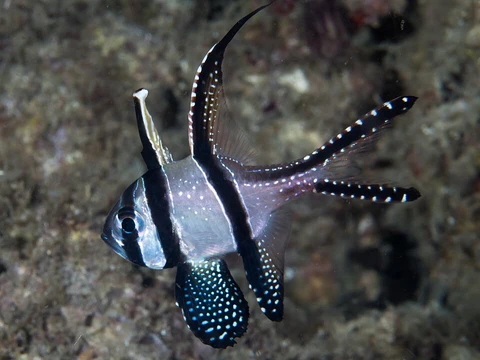
Pterapogon kauderni
A pink-and-white nocturnal cardinalfish that hides in anemones and fathers its young in its mouth.

Amada44 · CC BY-SA 3.0
Pterapogon kauderni, widely known as the Banggai cardinalfish, is a small, strikingly colored reef fish endemic to the shallow waters surrounding the Banggai Islands of central Indonesia. A member of the family Apogonidae, it is one of the most recognizable species in its genus and a favorite among reef aquarists and marine biologists alike for its unusual reproductive biology and bold coloration.
The fish is best known for its nocturnal habits, its habit of sheltering within sea-anemone tentacles during daylight, and the fact that males—rather than females—carry fertilized eggs in their mouths until hatching. These traits, combined with a vivid coral-pink body bisected by a crisp white horizontal stripe through the eye, make it one of the most instantly identifiable cardinalfishes on any Indo-Pacific reef.
- Common name
- Banggai cardinalfish
- Family
- Apogonidae (cardinalfishes)
- Genus
- Pterapogon
- Distribution
- Endemic to the Banggai Islands, Indonesia
- Reproductive mode
- Ovoviviparous; male mouthbrooder
- Activity pattern
- Nocturnal; shelters in anemones by day
- Distinguishing mark
- Single white horizontal stripe through the eye
Lore & Background
The Banggai cardinalfish occupies a narrow but ecologically meaningful niche on the reefs of the Banggai archipelago. By day it retreats deep into the tentacle columns of stinging anemones—principally Heteractis and Stichodactyla—where its mottled flanks and the anemone's own coloration render it nearly invisible to diurnal predators. At nightfall it emerges to forage on small crustaceans, polychaetes, and other invertebrate prey hovering near the reef substrate, its large, forward-facing eyes adapted to the dim ambient light of a reef at rest.
Reproduction in Pterapogon kauderni follows the ovoviviparous pattern characteristic of many apogonids: the female releases a small clutch of eggs, the male fertilizes them, and then ingests the batch into his buccal cavity. There the eggs develop over roughly two weeks, and the male guards them by refusing to feed, expelling the free-swimming fry only when they are fully formed. This paternal investment means that a single male can sustain only one clutch at a time, a constraint that shapes the species' social structure and territorial behavior on the reef.
Because the species is endemic to a relatively small island group, its population is inherently limited and sensitive to localized disturbances. Collection pressure for the ornamental aquarium trade, combined with the fragility of anemone habitats, has made sustainable sourcing a recurring topic in conservation discussions around Banggai reef fauna.
Reader's Guide
The specific epithet kauderni honors the Swedish collector Hermann Kaudern, whose field specimens from the central Indonesian archipelago formed the basis for the species' formal description by C. T. Regan in 1912. The name thus commemorates the person who brought the fish to the attention of European ichthyology rather than the person who wrote the diagnosis.
Pterapogon is a small, distinctive genus within Apogonidae, containing only a handful of recognized species. Its members are set apart by a laterally compressed body, a single dorsal fin with spines and soft rays in a single series, and—most notably in P. kauderni—a bold white lateral stripe that runs straight through the eye and along the mid-flank, a pattern that appears to serve as disruptive camouflage against the striped tentacles of its anemone hosts.
In the broader reef context, 'cardinalfish' (family Apogonidae) refers to a diverse assemblage of small, often nocturnal, mostly reef-associated fishes. The name is thought to derive from the red-and-black coloration of some species, evoking the vestments of a Catholic cardinal, though many apogonids are pink, orange, or mottled rather than red. Across the family, cardinalfishes share a suite of traits: a large mouth relative to body size, a single dorsal fin, and in many species, ovoviviparous reproduction with male parental care. On a healthy Indo-Pacific reef, apogonids are ubiquitous—hiding in crevices, under overhangs, and within anemones—and form a critical link between the invertebrate prey base and the larger piscivorous fish that take them.
Did You Know?
- Unlike most fishes, it is the male Banggai cardinalfish that carries the fertilized eggs in his mouth for roughly two weeks, during which he cannot feed.
- The species is endemic to the Banggai Islands; it has not been recorded in the wild from any other location in the Indo-Pacific.
- Its white stripe through the eye is thought to function as disruptive camouflage, breaking up the fish's outline against the striped tentacles of the anemones in which it shelters.
- Pterapogon is a very small genus—only a few species are recognized—making P. kauderni one of the more prominent members of its taxonomic group.
A Narrow Slice of the Ocean
The Banggai cardinalfish occupies one of the most geographically constrained ranges of any marine species. Its entire natural habitat is confined to the Banggai Archipelago in Indonesia, spanning roughly 5,500 square kilometers. Within that modest area, the population—estimated at around 2.4 million individuals—is fragmented across isolated groups clustered around the shallow waters of seventeen large islands and ten smaller ones. A minor population persists near Luwuk harbor off Central Sulawesi, and a separate group was established in the Lembeh Strait of North Sulawesi after aquarium traders introduced the species there in 2000. By 2014, small numbers had even been spotted in Secret Bay on Bali's northwest coast. Despite these scattered occurrences, the species remains classified as endangered. Heavy wild capture for the aquarium trade, combined with broader human degradation of its coastal environment and outbreaks of fatal iridovirus infections, continue to pressurize already vulnerable populations.
Life Among the Spines
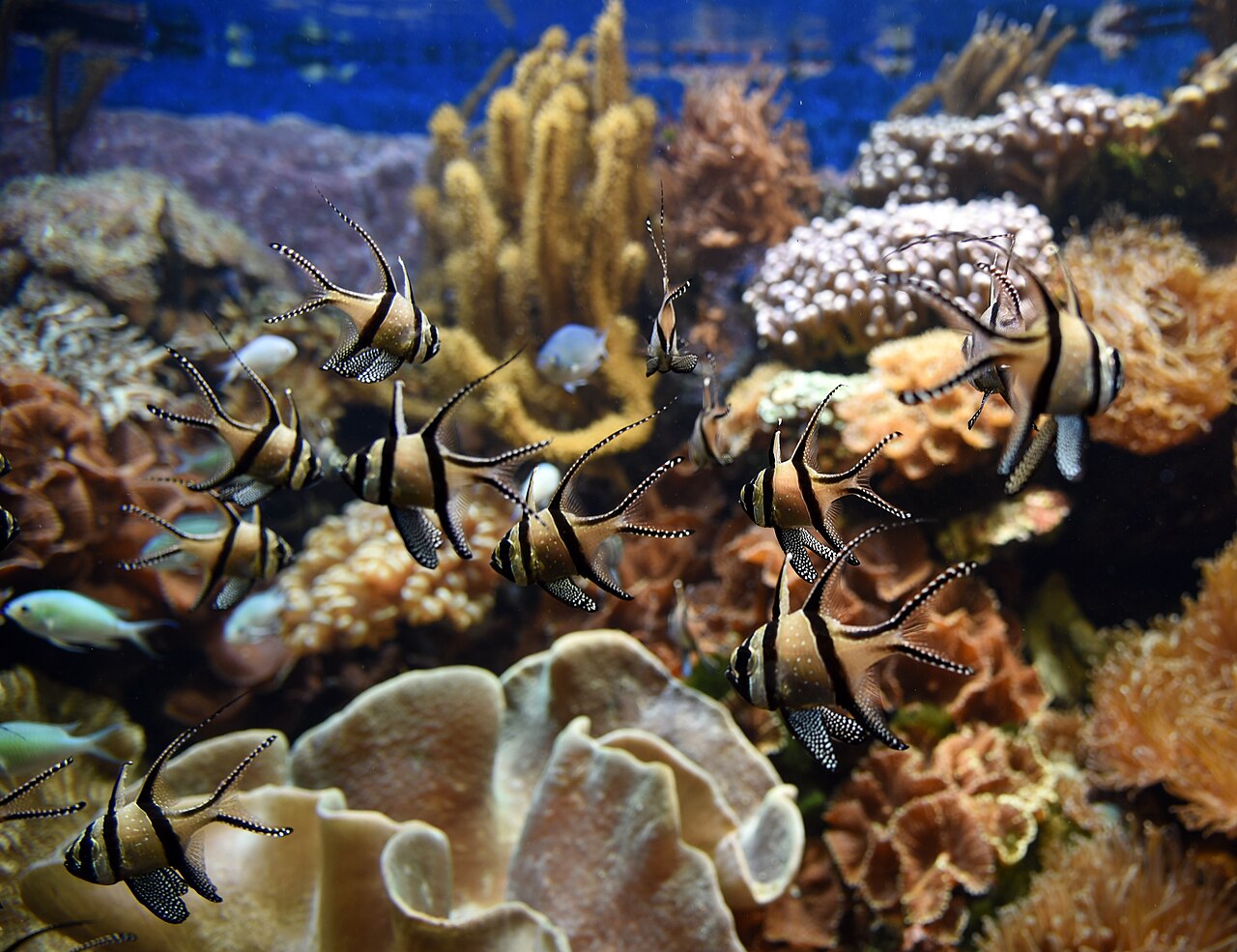
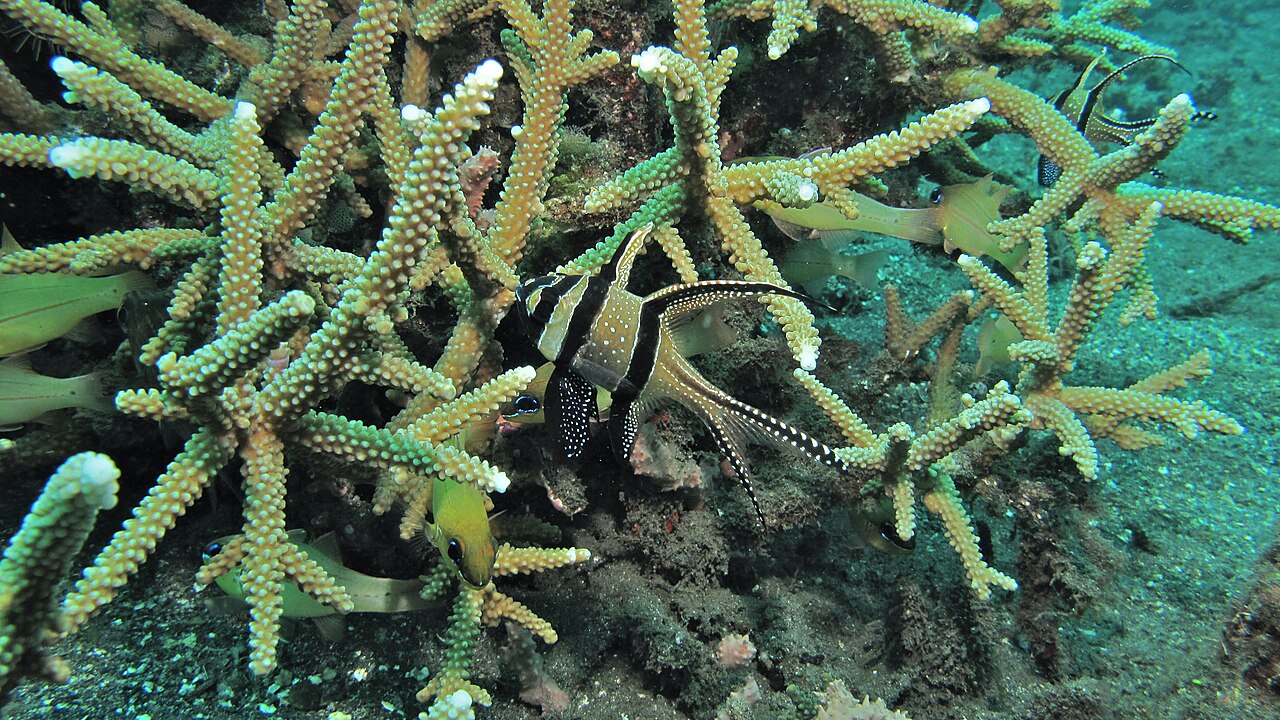
Unlike nearly every other cardinalfish, Pterapogon kauderni is strictly diurnal, spending its active hours in the bright shallows rather than retreating to darkness. It is a demersal species that typically assembles in stable groups of roughly nine individuals at depths between 1.5 and 2.5 meters, favoring calm, sheltered waters on the leeward sides of larger islands. Its preferred microhabitats include coral reefs, seagrass meadows of Enhalus acoroides, and open patches of sand and rubble. The fish show a remarkable affinity for long-spined sea urchins (Diadema setosum), hovering just above the spines and slipping among them when threatened without suffering a sting. Younger fish gravitate toward sea anemones, while older individuals favor branching corals, sea stars, hydrozoans, and mangrove prop roots. Groups can swell to as many as 500 fish in shallow lagoons. These aggregations are notably sedentary, with very limited movement between sites, a trait tied to their reliance on plankton drifting through local currents. This restricted dispersal, coupled with low reproductive output, makes the species particularly susceptible to extinction when collectors remove individuals from the wild.
Courtship and the Father's Burden
Reproduction in the Banggai cardinalfish follows a pattern that sets it apart from most marine fish. The species is a paternal mouthbrooder: after the female deposits her eggs, the male carries them in his enlarged oral cavity until they hatch, and the young remain there for an undetermined period afterward. Notably, there is no free-swimming planktonic larval stage, a rarity among ocean-dwelling species. Courtship is initiated by the female, who selects a mate and isolates him from the colony by establishing a roughly 50-to-60-centimeter spherical spawning site. She approaches him from behind in a vigorous trembling motion while he holds still, then positions herself alongside him. Mating pairs establish and vigorously defend spawning territories a few meters away from the main group. Pairs form up to two weeks before spawning, and the female's size governs egg size and fecundity while the male's size dictates total reproductive output, so individuals of similar sizes tend to pair. The species has a short lifespan—perhaps one to two years in the wild and around four in optimal captivity.
A Distinguished Silhouette
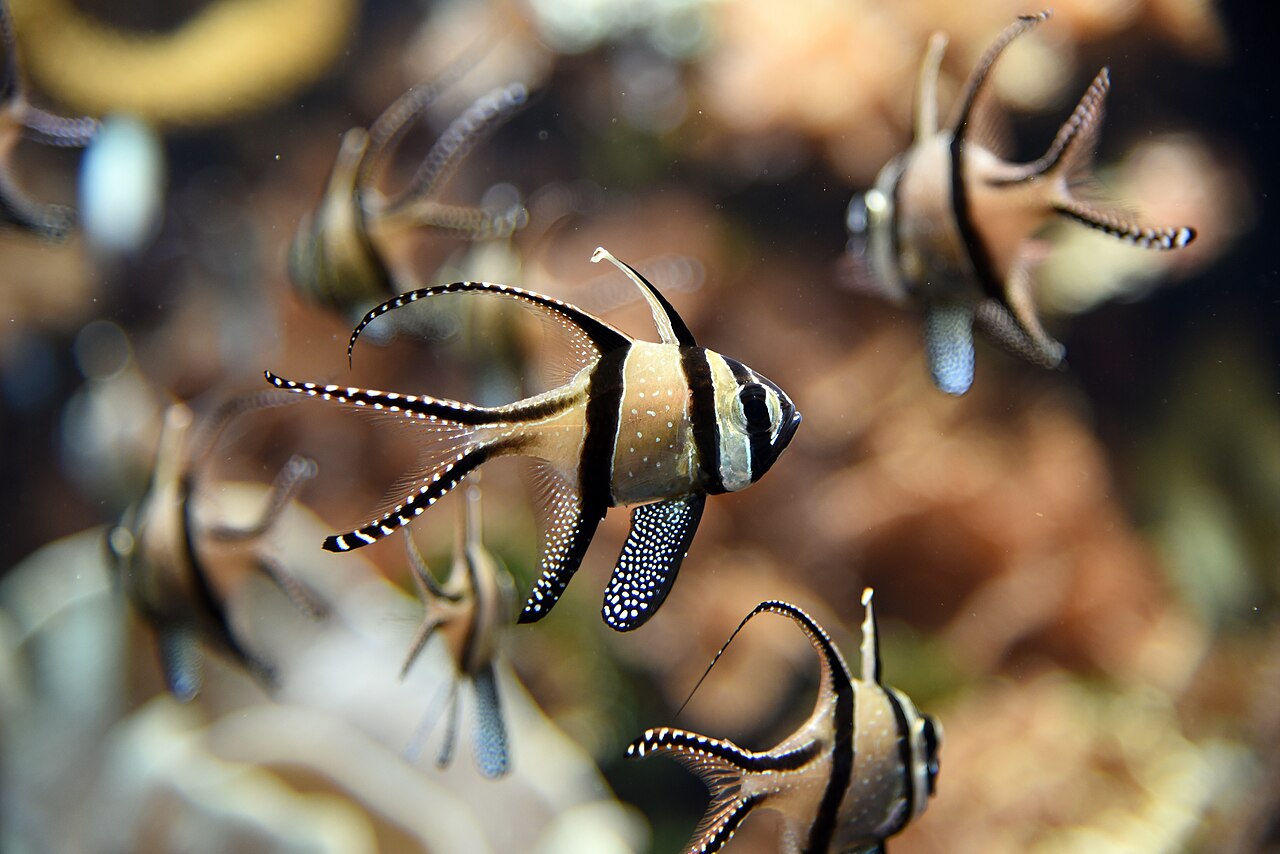
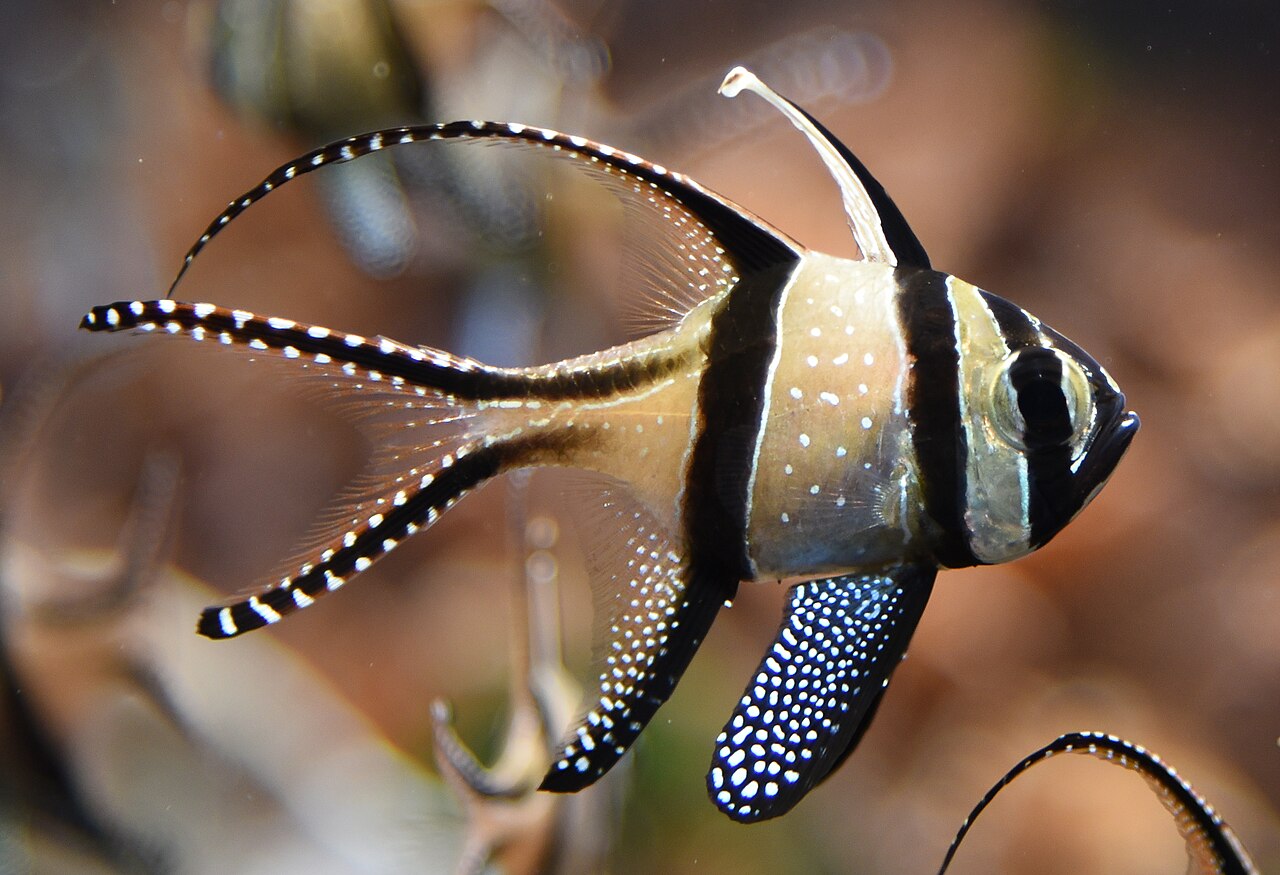
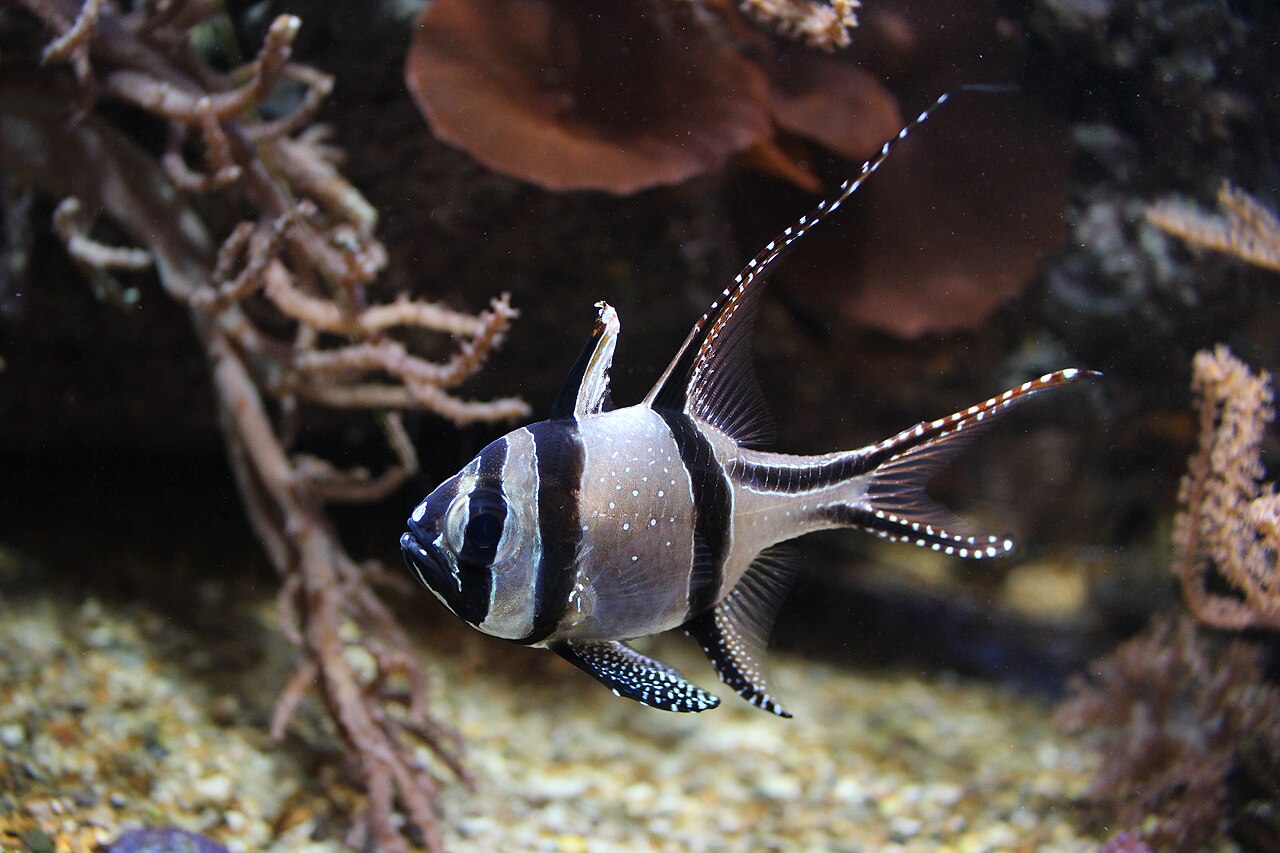
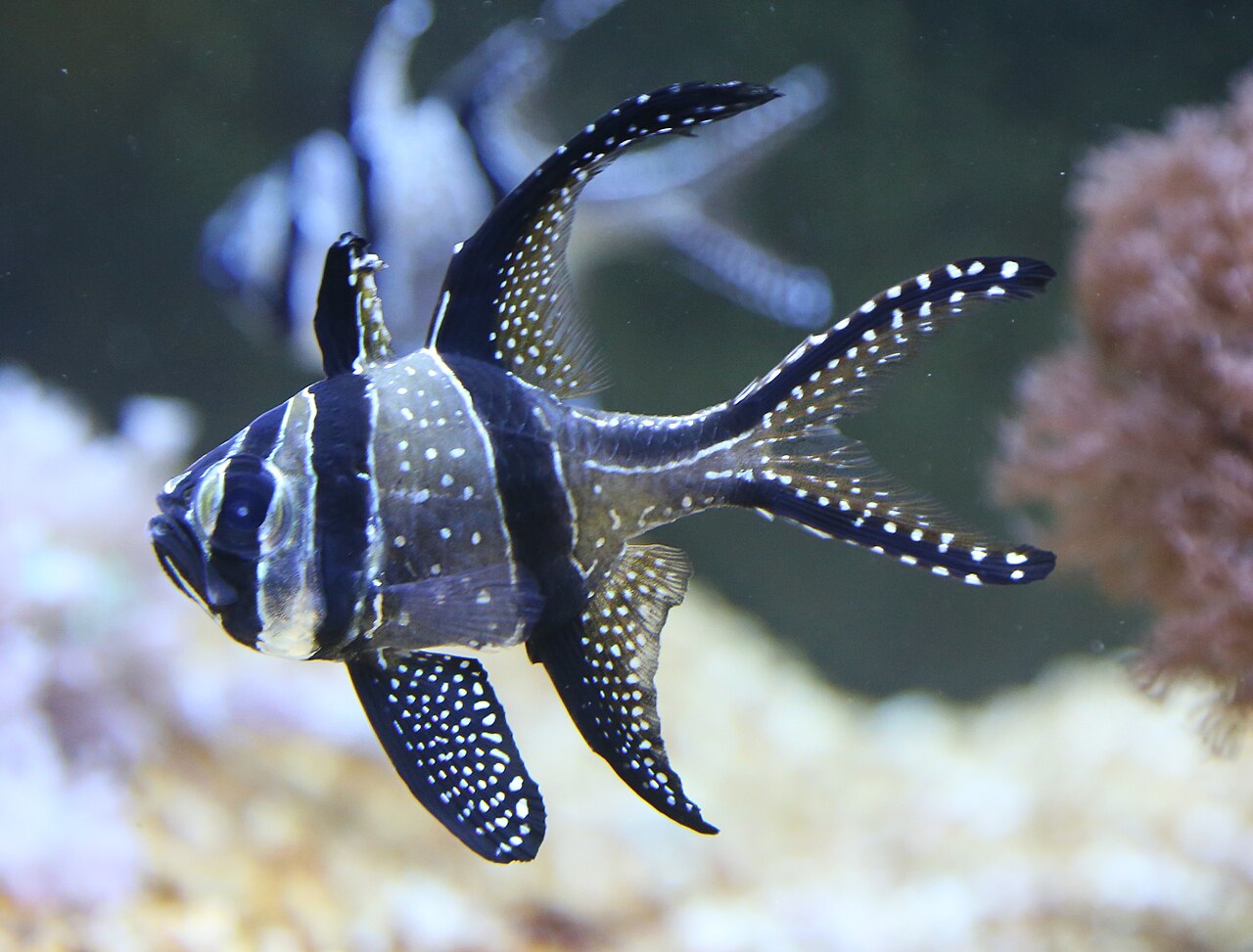
At a maximum of eight centimeters, the Banggai cardinalfish is a compact fish, yet its appearance is instantly recognizable among all cardinalfishes. The first dorsal fin bears a distinctive tassel-like extension, while the anal fin and second dorsal fin display elongated rays. The caudal fin is deeply forked, and the body is marked by three bold black bars running across the head and trunk. The anterior edges of both the anal and second dorsal fins are outlined in prominent black. Males and females are otherwise sexually monomorphic, though a brooding male reveals a conspicuously enlarged oral cavity. Taxonomically, the species is the sole representative of its genus; the sailfin cardinalfish, once lumped within Pterapogon, has since been elevated to its own distinct genus. In the aquarium hobby, the Banggai cardinalfish enjoys considerable popularity and stands out as one of the relatively few marine species that can be bred regularly in captivity. Nevertheless, large numbers continue to be harvested from the wild, and the species is now listed as endangered.
Gallery
Frequently Asked Questions
What is Pterapogon kauderni?
It is the scientific name for the Banggai cardinalfish, a small pink-and-white reef fish belonging to the cardinalfish family Apogonidae. It is one of the most visually distinctive species in its genus and a long-time favorite among reef aquarists.
Where does Pterapogon kauderni live in the wild?
The species is endemic to the shallow coastal waters surrounding the Banggai Islands in central Indonesia and occurs nowhere else naturally on Earth. That restricted range makes it both ecologically significant and vulnerable to overcollection.
How does Pterapogon kauderni reproduce?
The Banggai cardinalfish is ovoviviparous with male mouthbrooding: the male takes fertilized eggs into his mouth and carries them until they hatch into free-swimming fry. This paternal-care strategy is unusual even among cardinalfishes and is a major reason the species is studied in the lab.
Why does Pterapogon kauderni hide in anemones during the day?
The fish is primarily nocturnal and tucks itself among anemone tentacles as daytime cover to stay out of sight from predators while it rests. Its bold pink-and-white coloration, which would be conspicuous in open water, is thus concealed until it becomes active after dark.
Why is Pterapogon kauderni important to the aquarium hobby and conservation?
Its striking appearance and unique reproductive biology have made it a perennial staple of reef-keeping, yet its wild population is confined to a single island group. That combination of high demand and limited range has driven the development of sustainable captive-breeding programs to reduce pressure on wild stocks.
More in Classification
Elsewhere in Banggai cardinalfish
Spotted an error? Know more?
Reader corrections go straight into our review queue. Suggest an edit · How this site is sourced