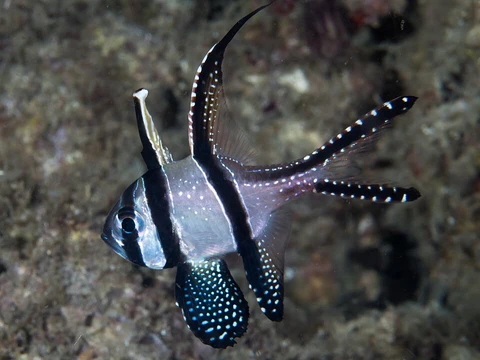
Centropyge loricula
A jewel-blue dwarf angel that turns a modest reef tank into a living painting.

Centropyge loricula, commonly known as the Pacific Dwarf Angel, is a small, vividly colored angelfish in the family Pomacanthidae. Native to the western Pacific Ocean, it is one of the most sought-after dwarf angels in the reef aquarium trade. Unlike its larger congeners, the Pacific Dwarf Angel is well-suited to smaller reef systems due to its modest adult size and relatively peaceful temperament toward non-angelfish species.
In the wild, this species inhabits coral-reef slopes and lagoons where it forages among branching corals and crevices, picking at small invertebrates, algae, and detritus. Its striking blue-and-yellow coloration, combined with a compact body and bold facial markings, makes it immediately recognizable to both divers and aquarists.
- Common name
- Pacific Dwarf Angel
- Scientific name
- Centropyge loricula
- Family
- Pomacanthidae
- Genus
- Centropyge
- Adult size
- ~7–8 cm (approx. 3 in)
- Distribution
- Western Pacific (Philippines, Indonesia, Maldives, Sri Lanka, India)
- Typical depth range
- 5–30 m on coral-reef slopes and lagoons
Lore & Background
Centropyge loricula is a textbook example of the dwarf-angel life strategy: a small, territorially defended reef fish that occupies a niche larger angelfish cannot exploit. Adults hold small patches of reef—often a cluster of branching Acropora or a tangle of soft corals—where they graze on micro-algae, sponge tissue, and tiny crustaceans. Males and females are externally similar, though males tend to be slightly larger and display a more saturated blue on the dorsal and caudal fins. The species is a pair-brooder: a bonded male-female pair will spawn nightly, the female releasing a batch of adhesive eggs onto a flat substrate that the male then fertilizes and guards for roughly 4–6 days until the larvae hatch and disperse into the plankton.
In the aquarium context, the Pacific Dwarf Angel is prized for its compact size and the fact that, unlike many Pomacanthids, it rarely destroys live coral when acclimated to a well-stocked reef. That said, it is not a community fish in the true sense. Two or more Centropyge species in the same tank will almost invariably fight, and even a single Pacific Dwarf Angel may nip at tank-mates that are slow, scaleless, or share a similar body shape. A mature specimen needs a territory of its own—typically the front or side of the rockwork—where it can patrol without constant confrontation.
The species' range spans a broad swath of the western Pacific, from the Andaman Sea through the Philippines and Indonesia to the Maldives and Sri Lanka. Populations on the outer reef slopes tend to be slightly larger and more uniformly blue, while lagoon-dwelling fish often show more orange on the pectoral and pelvic fins. This intraspecific color variation is one of the reasons collectors and breeders have long favored C. loricula over its congeners: the visual diversity within a single species is remarkable.
Reader's Guide
Tank setup: A single Pacific Dwarf Angel is happiest in a 75-gallon (284 L) or larger reef tank with a well-established live rock structure. Provide a clear territory—ideally the front or one side of the rockwork—where it can patrol without constant visual contact with other fish. Fine sand substrate and a gentle flow (4–8× turnover) mimic the lagoon conditions it evolved in. They'll tolerate a range of parameters, but they thrive when temperature sits at 24–27 °C (75–81 °F), salinity at 1.024–1.026, and pH at 8.1–8.4.
Diet: Offer a varied mix of meaty inverts (mysis, brine shrimp, chopped clam), nori or algae wafers, and small amounts of mysis-based pellets twice daily. A reef with established microfauna will supplement this naturally.
Tank mates: Avoid other Centropyge or any Pomacanthid. Slow, scaleless fish (angelfish, large tetras in a freshwater sense—think of them as the reef equivalent) will get nipped. Shrimp and crabs may be eaten. A robust reef with SPS and LPS corals is fine once the angel is acclimated, but expect some nibbling on soft corals during the first weeks.
Breeding: Establish a bonded pair in a 75+ gallon tank with a flat, clean substrate (a small tile or polished rock) near the rockwork. They will begin spawning within 2–6 weeks of acclimation, typically just after lights-out. The female deposits 200–500 adhesive eggs; the male fertilizes and fans them for 4–6 days. Remove the pair after spawning to prevent egg predation. Larvae are planktonic for 3–4 weeks and require rotifers and Artemia nauplii from day one.
Did You Know?
- Pacific Dwarf Angels are nocturnal spawners: the female releases her clutch of adhesive eggs just after the lights go out, and the male guards them through the dark hours.
- Despite its name, C. loricula is not the smallest Centropyge—some congeners top out under 5 cm—but it is among the most color-variable, shifting from deep cobalt to bright orange depending on lagoon vs. slope habitat.
- In the wild, a bonded pair will defend a territory of only a few square feet of reef, yet that patch is policed relentlessly against any other angelfish that strays within sight.
- The species was described in the 19th century and has been a staple of the live-reef trade for decades, making it one of the most widely available dwarf angels in the Western Pacific.
More in Aquarium
Elsewhere in Banggai cardinalfish
Spotted an error? Know more?
Reader corrections go straight into our review queue. Suggest an edit · How this site is sourced