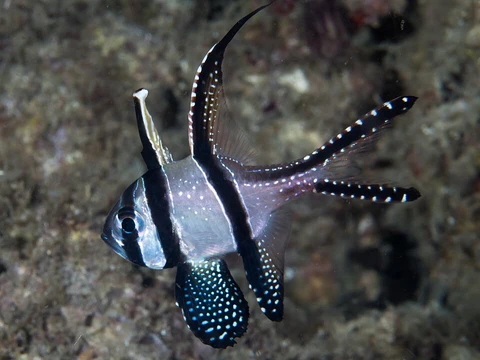
Oral incubation
The reef's smallest nursery is a single pair of jaws, and the eggs are its only cargo.

Oral incubation—commonly called mouth brooding—is a reproductive strategy in which a parent fish takes fertilized eggs into its buccal cavity and carries them there until they develop and hatch. Rather than depositing eggs on a substrate and guarding from outside, the brooding parent literally becomes the nursery, suspending the clutch against the gill arches where oxygen-rich water circulates continuously over the developing embryos. The parent typically ceases feeding for the duration of incubation, relying on stored energy reserves while the eggs mature inside the mouth.
The behavior occurs across several marine families. In pufferfish (Tetraodontidae), it is the male who mouth-broods; in many blennies (Blenniidae) and gobies (Gobiidae) the male is also the brooder; in certain wrasses (Labridae, particularly genera *Halichoeres* and *Thalassoma*) the role falls to the female. Jawfish (Javanodontidae) and some damselfish (Pomacentridae) round out the list of well-documented mouth-brooding lineages. In every case, the mechanism is the same: the eggs are held in the mouth, oxygenated by gill respiration, and released as free-swimming larvae once development is complete.
- Type
- Parental reproductive behavior (buccal/mouth brooding)
- Primary brooding sex
- Male in most lineages; female in some wrasses (Labridae)
- Families documented
- Tetraodontidae, Blenniidae, Labridae, Pomacentridae, Gobiidae, Javanodontidae
- Oxygenation mechanism
- Gill respiration over eggs held in buccal cavity
- Feeding during incubation
- Suspended (parent fasts)
- Release stage
- Free-swimming larvae (post-hatch)
- Substrate role
- Eggs are not attached to substrate; carried entirely in the mouth
Lore & Background
In the shallow, structure-rich habitats where mouth brooding is most common—rocky reefs, seagrass beds, and coral rubble zones—the act of spawning is brief but the parental investment that follows is extraordinary. A male pufferfish, for instance, will court a female, receive the fertilized eggs into his mouth, and then seal his jaws for the incubation period. He cannot eat. He cannot open his mouth to feed on zooplankton or benthic invertebrates. His entire caloric budget for those days is drawn from lipid stores accumulated before spawning. The eggs, pressed against the gill filaments, receive a steady stream of oxygenated water every time he gulps, a continuous, involuntary respiration that doubles as the incubator's life-support system.
In the wrasses that reverse the sex roles, the picture shifts. A female *Halichoeres* will take the fertilized eggs into her mouth after a courtship display, and the male, who has provided sperm and sometimes a spawning site, moves on. The female then fasts and guards the clutch internally. When the larvae are ready—transparent, yolk-sac depleted, with functional swim bladders—she opens her mouth in a rapid pulse and the tiny fish scatter into the water column, immediately drifting into the planktonic phase of their lives.
What makes oral incubation evolutionarily notable is its universality of mechanism across otherwise unrelated lineages. Pufferfish, blennies, wrasses, and jawfish are separated by tens of millions of years of divergence, yet each independently converged on the same solution: use the mouth as a protected, oxygenated chamber. The gill arches, which in most fish are purely respiratory, become in these species a dual-purpose organ—breathing for the parent and for the developing young simultaneously. This convergence suggests a strong selective pressure in reef environments where predation on exposed eggs is intense and where a small, mobile parent can outpace many predators more effectively than a stationary egg mass on a rock.
Reader's Guide
Watch a male pufferfish on a coral rubble patch and you can see the whole cycle unfold in real time. It starts with courtship: the male puffs slightly, hovers in a tight figure-eight, and nudges the female toward a small depression in the rock. She releases a small batch of eggs; he releases milt over them. Then the critical moment—he opens his mouth wide, takes the fertilized eggs in with a quick, deliberate gulp, and seals his jaws shut.
From here, the pufferfish becomes a living incubator. He positions himself in the current, gill covers flaring in a steady metronome. Every gulp draws oxygenated water over the eggs pressed against his gill arches. He does not eat. He does not open his mouth. He simply breathes, and in that breathing, the embryos develop—cell divisions, organ formation, the slow darkening of the eye. His body fat depletes. He grows visibly leaner over the days.
When the larvae are ready, the change is sudden. The pufferfish's gill flaring quickens, his body tenses, and then—snap. His jaws part, and a burst of tiny, transparent larvae shoots out into the water. They are already swimming, already drifting. The pufferfish closes his mouth, turns toward the current, and begins to feed. The nursery is empty. The reef keeps turning.
Did You Know?
- In mouth-brooding pufferfish, the male fasts for the entire incubation period, surviving on stored lipid reserves while his gills oxygenate the eggs simultaneously.
- Oral incubation has evolved independently in at least five separate fish families, making it one of the best-documented cases of convergent parental-care evolution in vertebrates.
- In some wrasses of the genus Halichoeres, the female—not the male—takes the fertilized eggs into her mouth, reversing the typical sex role seen in most other mouth-brooding lineages.
- The gill arches in mouth-brooding fish serve a dual function: they oxygenate the parent's own blood while simultaneously providing a steady flow of oxygenated water over the developing embryos held in the buccal cavity.
Frequently Asked Questions
Which parent mouth-broods in Banggai cardinalfish?
In Banggai cardinalfish, it is the male who takes on the brooding role, holding the fertilized eggs inside his mouth until they hatch. This is consistent with the pattern seen across most lineages that use buccal incubation, where males serve as the primary nursery.
How do the eggs get oxygen while sitting in the fish's mouth?
The brooding male positions the clutch against his gill arches so that each pass of water across his gills washes oxygen-rich flow directly over the developing embryos. This means the eggs are effectively bathed in fresh, oxygenated water around the clock without the parent needing to do anything extra.
Does the male cardinalfish still eat while he's carrying the eggs?
No—he stops feeding entirely for the whole incubation period and instead draws on the energy reserves he built up beforehand. The mouth is fully occupied by the clutch, so taking in food is simply not possible until the larvae are ready to be released.
At what stage does the male release the young?
He holds the eggs until they have fully developed and hatched into free-swimming larvae, at which point he opens his mouth and lets them drift away. There is no intermediate 'guarding from outside' phase; the jaws are the nursery from fertilization all the way to hatching.
Why is oral incubation such a big deal for Banggai cardinalfish survival?
By turning his own mouth into a sealed, oxygenated chamber, the male shields the eggs from predators, currents, and poor water quality that would claim most externally deposited clutches. For a small reef fish with no territory to defend, that pair of jaws is the safest nursery available.
More in Biology
Elsewhere in Banggai cardinalfish
Spotted an error? Know more?
Reader corrections go straight into our review queue. Suggest an edit · How this site is sourced