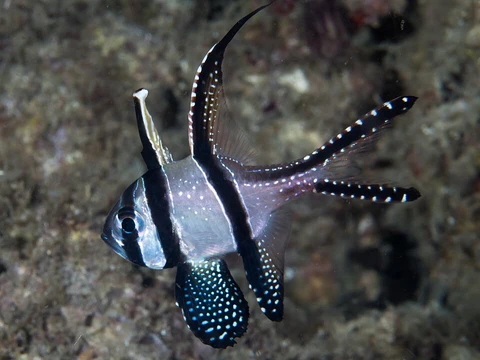
Paracanthurus hepatus
A bolt of electric blue grazing the reef, one of the ocean's most recognizable faces.

Paracanthurus hepatus, commonly known as the blue tang or regal tang, is a small, vividly colored reef fish in the family Acanthuridae (surgeonfishes). Native to the coral reefs of the Indo-Pacific—from the Red Sea and East African coast across the Indian Ocean and into the western and central Pacific—this species is instantly recognizable by its electric-blue body, lemon-yellow caudal fin, and the distinctive liver-shaped black blotch that gives the species its epithet *hepatus* (Latin for 'liver').
In the marine aquarium trade the blue tang is one of the most requested and most recognizable species, a status cemented in popular culture by its role as the character 'Dory' in Pixar's *Finding Nemo* (2003) and its sequel. In the wild it occupies the mid-water column of healthy coral reefs, grazing continuously on microalgae and detritus from live rock and coral surfaces, and plays a meaningful role in keeping algal growth in check on the reef.
- Common name
- Blue Tang / Regal Tang
- Family
- Acanthuridae (surgeonfishes)
- Distribution
- Indo-Pacific (Red Sea, Indian Ocean, western & central Pacific)
- Diet
- Herbivorous – microalgae, detritus, diatoms
- Max adult length
- ≈ 20 cm (8 in) TL
- Habitat
- Shallow coral reefs, typically 1–30 m depth
- Cultural note
- Portrayed as 'Dory' in Finding Nemo (2003)
Lore & Background
The genus name *Paracanthurus* roughly translates to 'near-ear,' a nod to the position of the scalpel-like spine on the caudal peduncle that distinguishes it from the closely related *Cantharius* (now *Zebrasoma*) group. The species epithet *hepatus* was chosen by the original describer for the unmistakable dark, liver-shaped mark that sits mid-flank, bordered by a thin white line. Together the two names encode the fish's most diagnostic features in a single binomial.
Ecologically, *P. hepatus* is a continuous grazer. It spends most of its daylight hours picking microalgae, diatoms, and fine particulate organic matter from the surfaces of live rock, coral rubble, and the reef substrate. This grazing pressure is a key factor in maintaining the balance between algal and coral cover on healthy reefs; where blue tangs (and their congener *Acanthurus* species) are removed, algal overgrowth can accelerate and shade out coral recruits. The fish is generally solitary or found in loose pairs and small groups of three to five, with a dominant individual often defending a small foraging territory against conspecifics.
Reproduction in the wild is broadcast spawning: pairs or small aggregations rise to the water column, typically at dawn, and release clouds of buoyant eggs and milt simultaneously. The eggs are pelagic and drift with surface currents for several days before hatching into translucent larvae that feed on plankton. Settlement onto a reef, when it occurs, is triggered by chemical and visual cues from the adult reef community. The species has been successfully bred in captivity on a limited, commercial scale (notably in the 1990s–2000s by Japanese and Australian hatcheries), but most fish in the aquarium trade remain wild-caught.
Reader's Guide
A blue tang is not a small fish with a small footprint; it is a mid-sized, active grazer that needs room to swim and a substrate to pick at. A commonly cited minimum for a single adult in a marine reef setup is 150 US gal (≈ 570 L), though many experienced keepers prefer 200+ gal to reduce stress and aggression. The fish tolerates a temperature band of roughly 24–27 °C (75–81 °F) and a pH of 8.1–8.4, but it thrives—and shows the most vivid coloration—when those parameters are stable and the tank carries a healthy colony of nitrifying bacteria.
Live rock is non-negotiable. *P. hepatus* is a grazer, not a flake-food fish; it needs a constant supply of microalgae, diatoms, and detritus growing on rock and substrate. In a new tank, expect a period of visible 'starvation' (the fish will still eat, but it will be thinner and less colorful) until the biofilm establishes, typically four to eight weeks. Supplemental feeding with nori, frozen spirulina, or a quality marine herbivore pellet helps bridge that gap.
Water flow should be moderate-to-strong and directional, mimicking the reef flat where the species lives. A pair of out-of-sight powerheads creating gentle, sweeping currents across the rockwork is ideal. Avoid dead spots where detritus accumulates; the tang will not clean those for you.
Tank-mate compatibility is the most common source of failure. Blue tangs are not inherently aggressive, but they are territorial and can become so, especially in confined spaces. They generally coexist with other tangs of *different* species (e.g., a yellow tang *Zebrasoma flavescens*), but two *P. hepatus* in a 150-gal tank is a recipe for chronic stress and fin damage. They will harass small, slow-moving inverts (shrimp, small hermit crabs) and may nip at soft corals they perceive as substrate to graze. They are generally safe with SPS and LPS corals, sea anemones, and most peaceful reef fish.
Breeding in a home system is extraordinarily difficult and outside the scope of a standard reef guide. Commercial operations use large, flow-through or closed-circuit systems, induce spawning with photoperiod manipulation (long-day, 14–16 h photoperiod) and temperature shifts, collect eggs from the water column, hatch them in flow-through jars, and feed the resulting larvae a rotating diet of *Nannochloropsis* and *Isochrysis* microalgae before weaning to rotifers and *Artemia*. If you are considering attempting this, the literature from the 1990s–2000s Japanese and Australian hatchery programs is the starting point; do not rely on general tang-breeding threads.
Did You Know?
- The species epithet 'hepatus' refers to the liver-shaped black mark on the flank—Latin 'hepar' means liver, so the name literally describes the fish's most distinctive pattern.
- The character 'Dory' in Finding Nemo is a blue tang, but the film depicts her as a female with a slightly different coloration; in reality, *P.
More in Aquarium
Elsewhere in Banggai cardinalfish
Spotted an error? Know more?
Reader corrections go straight into our review queue. Suggest an edit · How this site is sourced