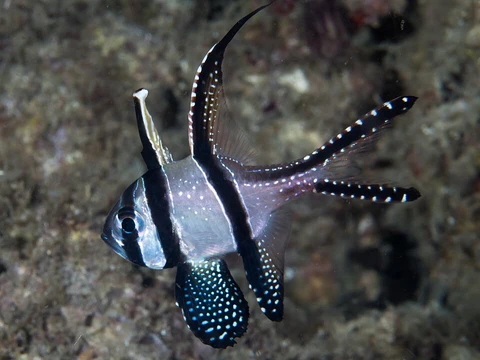
Zebrasoma flavescens
A flash of electric yellow patrolling the reef's upper reaches, one algae strip at a time.

Zebrasoma flavescens, commonly known as the Yellow Tang, is a single-species marine fish in the family Acanthuridae (surgeonfishes). It is one of the most recognizable and widely traded reef fish in the aquarist world, instantly identifiable by its brilliant, uniform yellow coloration and laterally compressed, disc-like body. Native to the shallow coral reefs of the Great Barrier Reef, the Coral Sea, and the broader western Pacific, the Yellow Tang occupies a mid-water to upper-water niche where it forages among branching corals and macroalgae.
In the wild, Z. flavescens functions as a grazer and detritivore, consuming microalgae, filamentous algae, and small invertebrates from reef surfaces. In the aquarium context it has become a staple 'clean-up' and visual centerpiece species, prized for its bold coloration, active swimming, and relatively manageable temperament compared to many other Acanthurids. It is a single, well-defined species with no recognized subspecies or color morphs in the taxonomic literature.
- Common name
- Yellow Tang
- Family
- Acanthuridae (surgeonfishes)
- Native range
- Great Barrier Reef, Coral Sea, western Pacific
- Diet
- Omnivorous – microalgae, filamentous algae, detritus, small invertebrates
- Typical adult length
- ≈ 20–25 cm (8–10 in)
- Temperament
- Generally peaceful; territorial toward conspecifics and other Acanthurids
- Notable anatomy
- Scalpel-like fin ray (surgeonfish spine) on caudal peduncle
Lore & Background
In the coral-reef ecosystem of the Great Barrier Reef, Zebrasoma flavescens occupies a mid-water foraging niche that sits between the reef-crevice dwellers below and the pelagic swimmers above. It is a diurnal species, most active in the bright hours when it strips microalgae and detritus from live coral, dead coral rubble, and sandy patches. At night it retreats into sheltered crevices or the lee of overhangs, a behavior well documented in field observations of Indo-Pacific Acanthurids. Its uniform yellow coloration is thought to serve as disruptive camouflage against the sun-dappled, yellow-green backdrop of shallow reef water, breaking up the fish's outline to both predators and prey.
The Yellow Tang is a member of the Acanthuridae, a family whose members bear a modified fin ray on the caudal peduncle that functions as a defensive scalpel. In Z. flavescens this spine is relatively small compared to some congeners but is still capable of inflicting a painful, sometimes infected wound on a predator. The species is a single, well-circumscribed taxon; unlike some other Acanthurid groups, no subspecies, regional morphs, or color variants are recognized in the ichthyological literature.
In the aquarium trade the Yellow Tang has a long and storied history. It was among the first Indo-Pacific reef fish to be routinely imported in volume, and its bright coloration made it a showpiece in early marine aquaria. Over decades of husbandry, it has become one of the better-understood Acanthurids in captivity, with reliable husbandry protocols established in the aquarist literature. Captive breeding has also been achieved, marking a milestone for the family, though it remains a demanding process requiring precise photoperiod, temperature, and dietary management.
Reader's Guide
Tank size and setup: A Yellow Tang is not a small-fish-in-a-big-fish-body. Established aquarist references consistently recommend a minimum of roughly 200 US gallons (≈ 750 L) for a single adult, with a long tank preferred over a tall one to accommodate its cruising style. Provide open swimming space, a mix of live rock and sand, and a few overhangs or caves where it can retreat at night. A strong but not violent flow is ideal; they like to feel the water moving but will bolt from a direct jet.
Water parameters: Commonly cited in the marine-aquarium literature, the range that supports a healthy Yellow Tang is approximately 24–27 °C (75–81 °F), pH 8.1–8.4, salinity 1.020–1.025, and alkalinity 7.5–9.5 dKH. They will tolerate a range, but they thrive when parameters are stable and within that window. A mature, cycled system with established nitrifying bacteria is non-negotiable; they are sensitive to ammonia and nitrite spikes.
Diet: In the wild they are opportunistic omnivores with a strong algal component. In the tank, offer a varied diet of high-quality marine pellets or flakes, frozen mysis or brine shrimp, and—critically—regular access to macroalgae (Noritho, Ulva, or a live algae farm). A tang that is not eating algae will lose color and become stressed. Supplement with a vitamin C and iodine mix a few times per week.
Tank mates: The Yellow Tang is generally peaceful with most reef fish, invertebrates, and smaller species. It will tolerate wrasses, anthias, damselfish, and most gobies. Where it becomes problematic is with other Acanthurids: two Yellow Tangs in the same tank will establish a hierarchy, and the subordinate will be picked apart. Mixed-species tang communities (e.g., a Yellow Tang with a different Acanthurid) can work in very large systems, but expect some chasing. Avoid housing with aggressive or semi-aggressive species that will outcompete it at the feeding station.
Health: The single biggest threat in captivity is Ich (Cryptocaryon irritans). Yellow Tangs are notoriously susceptible, and a single outbreak can be fatal if not treated promptly. Quarantine all new arrivals for a minimum of three to four weeks with a close observation period. Watch for loss of appetite, flashing, or pale coloration as early warning signs. A stable, well-filtered system with good water change frequency (10–15 % weekly) is the best prevention.
Breeding (captivity): Captive breeding of Z. flavescens has been achieved and is documented in the aquarist and aquaculture literature. The process is demanding. A pair or a small group is housed in a large, well-planted system with a strong photoperiod cycle (typically 12–14 h light). Spawning is usually induced by a gradual increase in light intensity and a shift in the feeding schedule, often occurring at dawn or just before light onset. The female releases a cloud of buoyant eggs and the male fertilizes externally. The eggs are removed immediately and incubated in a separate flow-through or static system at a slightly elevated temperature (around 26–27 °C) for roughly 24–36 hours. Larvae are fed a fine diet of rotifers and, as they grow, nauplii of Artemia. The transition to larger brine shrimp and formulated larval pellets takes several weeks. Survival to fingerling size is the hardest bottleneck; even experienced breeders report significant loss in the first two weeks.
Did You Know?
- Captive breeding of Zebrasoma flavescens was a milestone for the Acanthuridae family, demonstrating that a surgeonfish could be reliably produced in a controlled aquaculture setting.
- In the wild, Yellow Tangs are most active during daylight hours and retreat into reef crevices or overhangs at night, a diurnal pattern shared across most Indo-Pacific Acanthurids.
More in Aquarium
Elsewhere in Banggai cardinalfish
Spotted an error? Know more?
Reader corrections go straight into our review queue. Suggest an edit · How this site is sourced