Sulawesi
A jewel confined to a handful of islands, glowing in the shallows of the Banggai.

Pemerintah Provinsi Sulawesi Tengah · CC BY 4.0
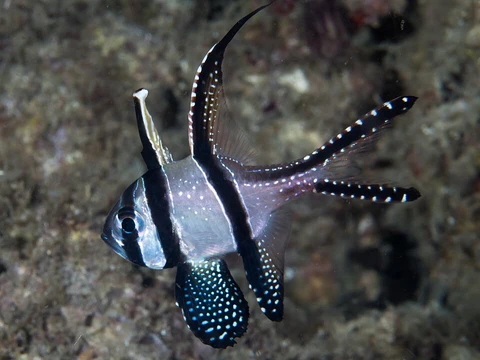
Pterapogon kauderni, commonly known as the Banggai cardinalfish, is a small reef-dwelling fish in the family Apogonidae. It is one of the few marine fish species known to be truly endemic to a single island group: the Banggai Islands, a small archipelago off the southeast coast of Sulawesi, Indonesia. Its restricted range makes it a subject of particular interest to marine biologists studying biogeography and island endemism in the Indo-Pacific.
In the aquarium trade the Banggai cardinalfish has become one of the most popular small reef fish, prized for its bold coloration and manageable size. In the wild it inhabits shallow, well-lit coral reef flats and the edges of lagoons, where it forages among branching corals and rubble for small invertebrates.
- Common name
- Banggai cardinalfish
- Scientific name
- Pterapogon kauderni
- Family
- Apogonidae (cardinalfishes)
- Endemic range
- Banggai Islands, Sulawesi, Indonesia
- Habitat
- Shallow coral reef flats and lagoon edges
- Sexual dimorphism
- Males noticeably larger and more vividly colored than females
Lore & Background
The Banggai cardinalfish occupies a narrow ecological niche on the shallow reef flats of the Banggai archipelago. Males, which are larger and display a deeper orange-red body with prominent blue-edged markings along the fins and a dark lateral band, are the individuals most often observed patrolling the upper reaches of branching Acropora and other stony corals. Females are smaller, paler, and less conspicuously patterned, a distinction that has made sexing the species straightforward for both field observers and aquarists.
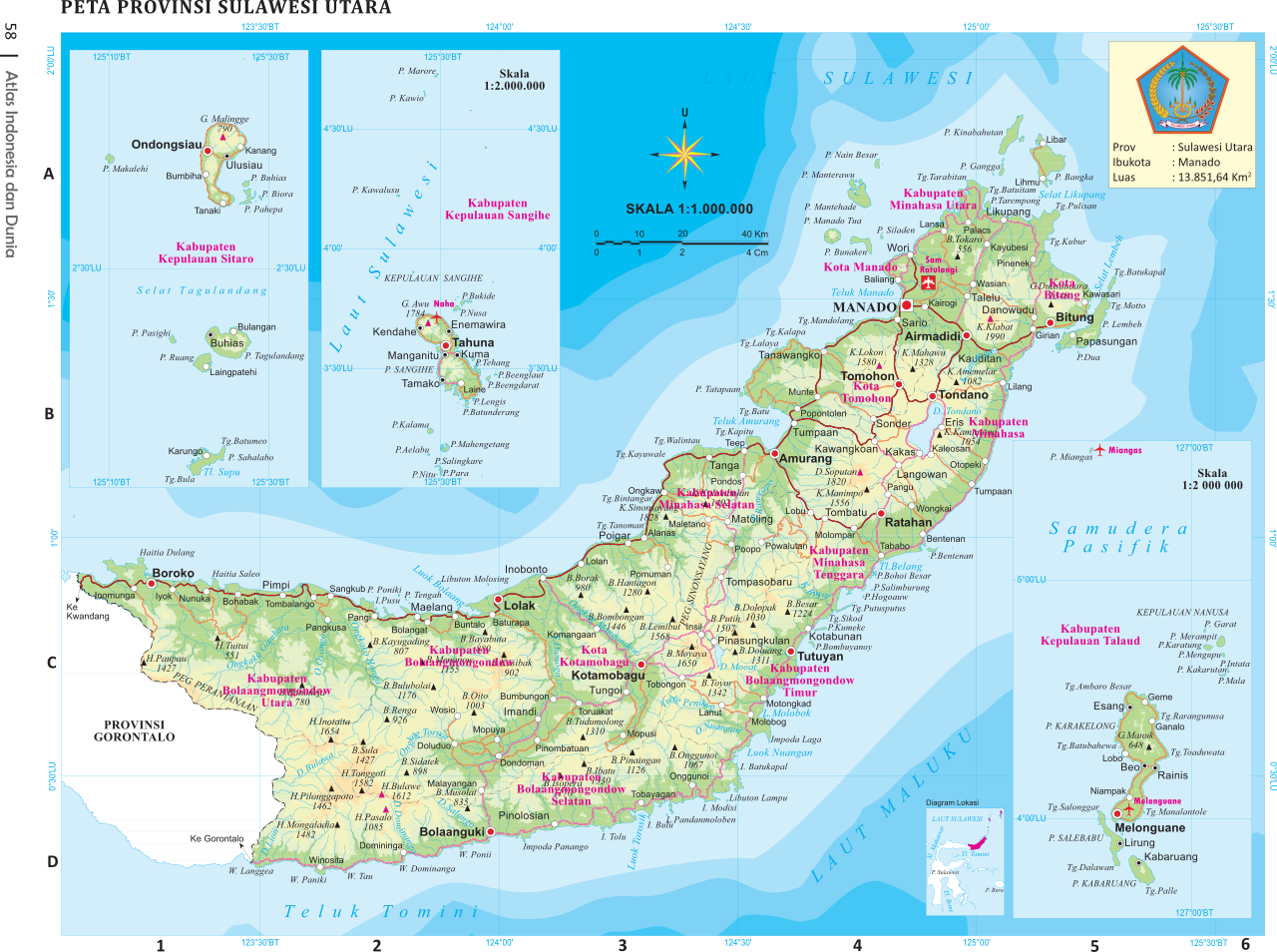
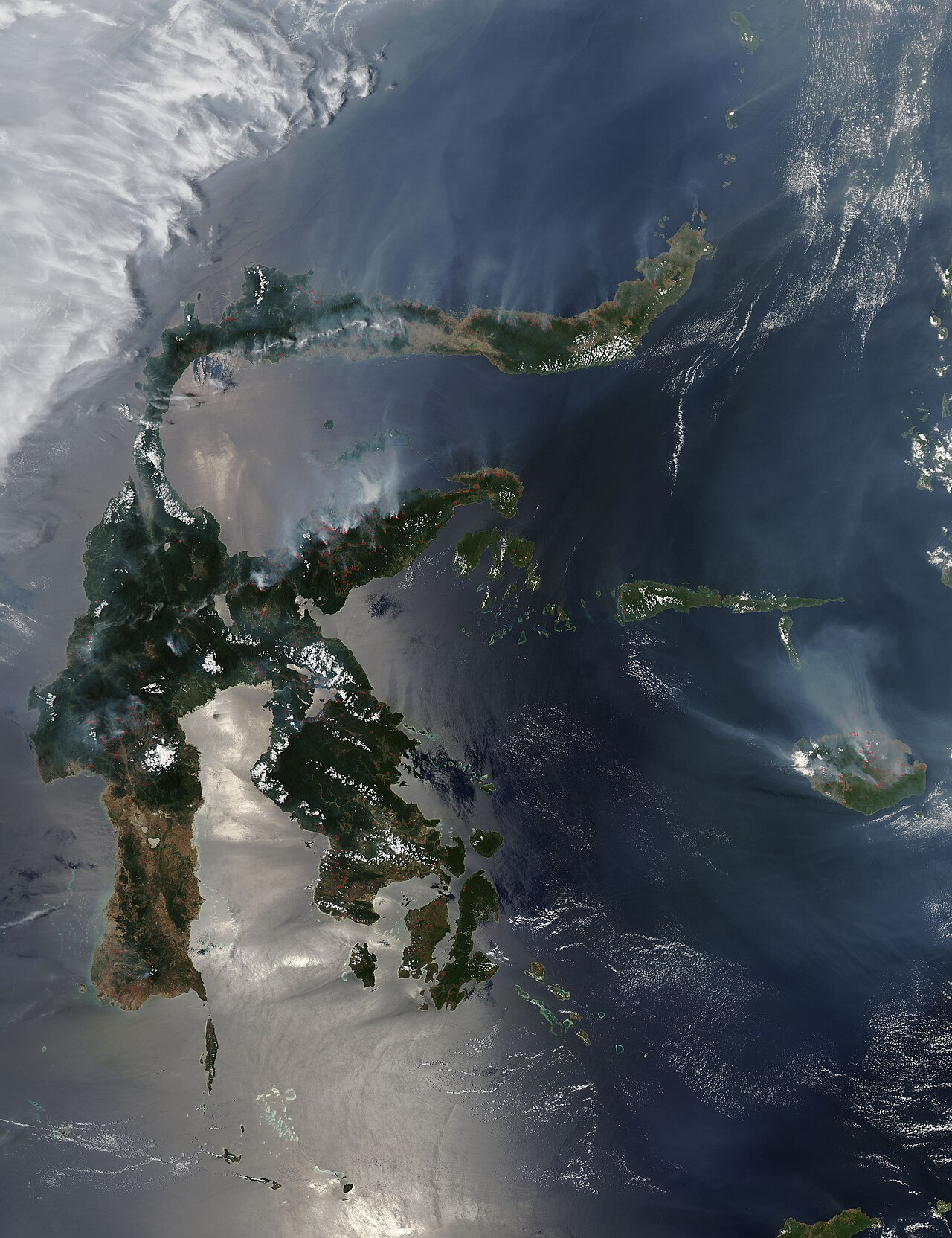
The species' confinement to the Banggai Islands—roughly a dozen small islands in the Banggai Strait—has long puzzled biogeographers. The surrounding waters of the broader Sulawesi Sea and the Celebes Sea host hundreds of other reef fish species, yet P. kauderni has not been recorded outside this small archipelago. This makes it a textbook example of a marine insular endemic, a rarity in a region where many fish species range across thousands of kilometers of reef.
In the aquarium hobby the Banggai cardinalfish gained widespread popularity in the late 1990s and 2000s, largely because it tolerates a wider range of water conditions than many other small reef species and is hardy enough for intermediate-level keepers. Its presence in home aquaria has, in turn, drawn public attention to the fragile reef ecosystems of the Banggai Islands and the importance of protecting the species' only known wild habitat.
Reader's Guide
The Banggai Islands—roughly a dozen small, low-lying islands strung across the Banggai Strait off southeast Sulawesi—are the sole known home of Pterapogon kauderni. The species is most abundant on the shallow, windward reef flats and the outer edges of protected lagoons, typically between 1 and 10 meters depth, where sunlight penetrates fully and branching stony corals (especially Acropora and Pocillopora) form dense, finger-like thickets. The substrate here is a mix of live coral, coral rubble, and fine sand patches, creating the tangled micro-habitat the fish uses for foraging and shelter. Males patrol the upper branches; females tend to hold closer to the substrate or within the denser interior of the coral heads.
Moving beyond the Banggai group, the broader Sulawesi region—including the Bira Strait, the Toli-Toli coast, and the waters around the Sula Islands—hosts a rich and distinct coral fauna, yet P. kauderni has not been reliably recorded outside the Banggai archipelago. That restriction, in a sea where most reef fish span hundreds or thousands of kilometers, is what makes the species a living curiosity. The narrow endemic range underscores how a handful of small islands can harbor a marine species found nowhere else on Earth, a reminder that even in the vast Indo-Pacific, endemism still writes itself in the smallest margins of a map.
Did You Know?
- Pterapogon kauderni is one of the very few marine fish species known to be endemic to a single small island group, the Banggai Islands, rather than a broader sea or region.
- The species shows strong sexual dimorphism: males are noticeably larger and display a deeper orange-red coloration with bold blue-edged fin markings, while females are smaller and paler.
- Despite the extraordinary diversity of the Celebes and Sulawesi Seas, the Banggai cardinalfish has not been reliably recorded outside the Banggai archipelago, making it a classic example of a marine insular endemic.
- The fish is a member of the family Apogonidae, the cardinalfishes, a group that includes over 400 species found on coral reefs worldwide.
A Species Confined to a Tiny Archipelago
The Banggai cardinalfish occupies one of the most restricted ranges of any marine fish, found exclusively in the waters surrounding the Banggai Islands of Indonesia. Its entire natural habitat spans roughly 5,500 square kilometers, and the total wild population is estimated at approximately 2.4 million individuals. These fish cluster around the shallow waters of 17 large and 10 small islands within the archipelago, with a minor population also recorded in Luwuk harbor off Central Sulawesi. Beyond this core range, a small group was established in the Lembeh Strait of North Sulawesi in 2000 after aquarium traders introduced the species 400 kilometers from its native waters, and a handful were observed in Secret Bay on Bali's northwest coast as of May 2014. Despite being one of the relatively few marine species successfully bred in captivity, the Banggai cardinalfish remains heavily dependent on wild collection. Habitat degradation, the spread of iridovirus diseases, and continued harvesting for the aquarium trade have pushed the species into endangered status, making its long-term survival increasingly precarious.
Life Among Urchins and Anemones
As the sole diurnal member of the cardinalfish family, this species spends its daylight hours in shallow lagoons at depths of roughly 1.5 to 2.5 meters, favoring calm, sheltered waters on the protected sides of larger islands. The fish form stable, sedentary groups—typically around nine individuals, though lagoon aggregations can reach as many as 500—that move very little because they rely on plankton drifting through currents. Their most striking ecological relationship is with the long-spined sea urchin Diadema setosum: the cardinalfish can slip among the urchin's spines without suffering a sting, using the spines as a living fortress when predators approach. Young fish prefer the protection of sea anemones, while juveniles and adults gravitate toward urchins, branching corals, sea stars, hydrozoans, and mangrove prop roots. The species also coexists with anemonefish, anemone shrimp, and other cardinalfish genera. Crucially, when aquarium collectors remove these fish, the abundance of their associated invertebrate neighbors has been shown to decline, underscoring how closely the health of these microhabitat communities is tied to the presence of the cardinalfish.
Courtship and the Father's Burden
Reproduction in the Banggai cardinalfish follows a pattern that distinguishes it from most marine fish: the male is the sole parent, carrying fertilized eggs in his enlarged oral cavity. Courtship is initiated by the female, who selects a mate and isolates him from the colony by establishing a spherical spawning site roughly 50 to 60 centimeters in diameter. She then performs a behavior described as 'side by side trembling,' approaching the male from behind with vigorous shaking while he remains still, before positioning herself alongside him. Mating pairs establish and vigorously defend spawning territories several meters away from the main group. The resulting eggs measure about 2.5 millimeters across, and the young remain in the father's mouth for an undetermined period after hatching. Notably, this species skips the free-swimming planktonic larval stage entirely, a trait that limits its dispersal. The fish are sexually monomorphic, and pairing tends to occur between individuals of similar size, since the female's body size governs egg number and size while the male's size determines how many eggs he can carry. Lifespan is brief: roughly four years in optimal captivity and perhaps only one to two years in the wild.
A Small Fish with a Distinctive Silhouette
At a maximum total length of just eight centimeters, the Banggai cardinalfish is a compact fish, yet its body plan sets it apart from every other member of the cardinalfish family. The first dorsal fin is crowned with a distinctive tassel of elongated rays, while the anal fin and second dorsal fin each display conspicuously extended spines with prominent black anterior edges. The tail is deeply forked, and three bold black bars run across the head and body, creating a pattern that makes identification straightforward. Males and females are otherwise sexually monomorphic, but a brooding male reveals a noticeably enlarged oral cavity as he carries the clutch. Taxonomically, the species stands alone within its genus Pterapogon, while a closely related sailfin cardinalfish, once included in that same genus, has since been separated into its own distinct genus. Despite its small size and limited range, the Banggai cardinalfish has become a mainstay of the marine aquarium trade, valued for its attractive appearance and, increasingly, for the fact that it can be bred regularly in captivity—a rarity among saltwater species.
Gallery

Frequently Asked Questions
Where in Sulawesi does the Banggai cardinalfish actually live?
Its entire range is confined to the Banggai Islands, a small archipelago sitting off the southeast coast of Sulawesi, Indonesia. It has never been confirmed beyond this handful of islands.
What makes Sulawesi's role in the Banggai cardinalfish's story so unique?
Sulawesi is the only place on Earth where this species exists, making it one of the very few marine fish truly endemic to a single island group. That extreme restriction sets it apart from the vast majority of reef fish.
What kind of habitat does the Banggai cardinalfish occupy around Sulawesi?
It favors shallow coral reef flats and the edges of lagoons, hanging out in calm, sunlit shallows rather than deep open water. These structured micro-habitats give it the cover and foraging ground it needs.
Can you find the Banggai cardinalfish in other parts of Indonesia or the wider Indo-Pacific?
No—despite living in the broader Indo-Pacific region, this species is locked to the Banggai Islands and has never been documented anywhere else. Its distribution is as narrow as any marine fish we currently know.
Why do marine biologists pay such close attention to Sulawesi's Banggai cardinalfish?
A species restricted to one small archipelago becomes a natural laboratory for studying how islands shape evolution and biogeography. It offers a concrete marine example of island endemism, a phenomenon far rarer in the ocean than in freshwater or terrestrial systems.
More in Distribution
Elsewhere in Banggai cardinalfish
Spotted an error? Know more?
Reader corrections go straight into our review queue. Suggest an edit · How this site is sourced