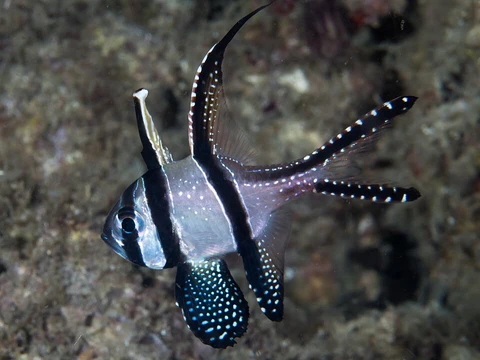
Gonochorism
Two bodies, two seeds, two spaces—gonochorism is the architecture of most marine life.

Gonochorism is the reproductive condition in which individuals of a species are distinctly either male or female, each bearing its own dedicated gamete-producing anatomy. It is the default architecture of sexual reproduction across the animal kingdom and the foundational contrast to hermaphroditism, in which a single individual produces both gamete types. In marine biology the term appears on every taxonomic key, every life-cycle diagram, and every field notebook: the moment a researcher separates a clutch of larvae into 'male-biased' and 'female-biased' morphs, gonochorism is the assumption underpinning the work.
- Term origin
- Greek: gonos (seed) + choros (place/space)
- Definition
- Condition in which male and female individuals are morphologically and functionally distinct
- Contrast
- Hermaphroditism (single individual produces both gamete types)
- Prevalence
- Default condition for the vast majority of animal taxa, including most marine fishes, crustaceans, and mammals
- Key anatomical feature
- Sex-specific gonads (testes vs. ovaries) and often secondary sexual dimorphism
- Taxonomic scope
- Animals (Metazoa); not applicable to most plants or fungi
Lore & Background
The word itself is a small piece of Greek anatomy: *gonos* (seed, offspring) paired with *choros* (a place, a space), together meaning 'separate places for the seed.' That etymology captures the biological reality precisely—two distinct bodies, each housing a different kind of reproductive machinery, each occupying its own 'space' in the life cycle. In a coral-reef fish such as a damselfish or a wrasse, the gonochoric condition is visible to a trained eye: the male may carry a more elongated anal fin, a deeper blue flank, or a courtship head-shape that the female simply does not develop. The two morphs are not a gradient; they are, in the language of the term, two separate *choroi*.
Reader's Guide
Imagine you are watching a pair of marine fish on a reef shelf. The male is doing the work of advertising: he hovers just above the female, his fins spread like a slow fan, his body angled so his lateral stripes catch the current. The female, meanwhile, circles the substrate—sand, a rock, the base of a coral head—her mouth opening and closing as she tests the surface. This is not a single organism splitting its duties; it is two separate bodies, each built for one half of the job.
When the female is ready, she drops her eggs in a tight cluster. The male follows immediately, his ventral region pressed close, releasing milt over the deposit. There is no internal mixing, no shared gonad. The sperm and the egg meet outside the body, in the water column, and that external fertilisation is the hallmark of the gonochoric strategy in most reef fishes.
In crustaceans the picture is starker. A male shrimp carries a pair of specialised claspers—modified legs that lock around the female's abdomen during spawning—while she carries the eggs in a ventral brood pouch. Two bodies, two toolkits, two *choroi*. An observer sees the male's claspers snapping shut, the female's antennae flaring, and then the slow drift of both animals apart as the first translucent eggs begin to pulse with tiny cilia. No single individual performed both roles. The separation is the point.
Did You Know?
- The vast majority of animal species—including most marine fishes, crustaceans, and cetaceans—are gonochoric; hermaphroditism, by contrast, is the exception rather than the rule in the animal kingdom.
- In gonochoric marine species, secondary sexual dimorphism (differences in size, colour, fin shape, or behavioural repertoire between males and females) is the norm and is a primary tool for field identification.
- Because gonochoric species require two individuals to reproduce, their population dynamics are sensitive to sex-ratio shifts—a practical concern in fisheries management and marine conservation.
More in Biology
Elsewhere in Banggai cardinalfish
Spotted an error? Know more?
Reader corrections go straight into our review queue. Suggest an edit · How this site is sourced