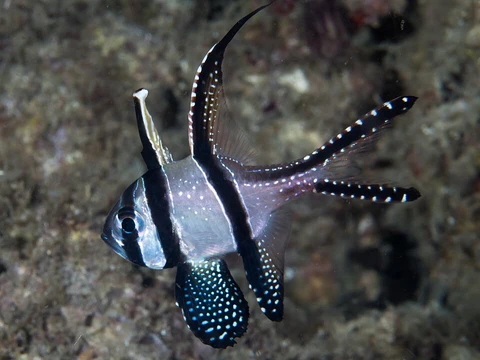
Pterapogon kauderni
The tiniest anemonefish, wearing a single bold white band across a flame-orange body.

Pterapogon kauderni, commonly known as the clown anemonefish, is the smallest species of anemonefish in the family Pomacentridae. Described by Herre in 1935, it is a compact, vividly colored reef fish restricted to the shallow waters of the western Pacific, primarily around the Philippines and Indonesia. Like all anemonefish, it maintains a symbiotic relationship with sea anemones, most notably Heteractis magnifica, whose stinging tentacles it inhabits without harm.
In the aquarium trade, P. kauderni is prized for its small size, bold orange-and-white coloration, and relatively manageable temperament compared to larger Amphiprion species. Its limited geographic range and dependence on specific anemone hosts make it a subject of ongoing interest in both marine conservation biology and the ornamental fish industry.
- Common name
- Clown anemonefish
- Genus
- Pterapogon
- Approximate adult size
- 4–5 cm (smallest anemonefish species)
- Primary anemone host
- Heteractis magnifica
- Distribution
- Western Pacific (Philippines, Indonesia)
- Described by
- Herre, 1935
Lore & Background
Pterapogon kauderni occupies a niche that is, in many ways, the most exposed in the anemonefish guild. Where larger Amphiprion species can range across broad reef slopes and deeper channels, the clown anemonefish is largely confined to shallow lagoons, reef flats, and the immediate vicinity of Heteractis magnifica colonies. This restriction means its population dynamics are tightly coupled to the health of a single host species and to the physical stability of the shallow-water substrate it depends on.
The species is protandrous: all individuals develop as males, and the largest female in a group may transition to male if removed, a reproductive strategy shared across the subfamily Amphiprioninae. Males are noticeably smaller than females, and the size difference is more pronounced in P. kauderni than in many larger congeners, a trait that has made it a useful model in studies of sex-change physiology and social hierarchy.
In the aquarium trade, the clown anemonefish has been collected for decades. Its small size makes it an appealing display fish for nano-reefs, and its bold single white band—contrasting sharply with the orange body—gives it a visual simplicity that larger, multi-banded anemonefish lack. However, because it is tied to a specific anemone and a narrow geographic window, sustained collection pressure can deplete local populations faster than recruitment can replace them, a concern that has prompted calls for captive-bred stock in the ornamental trade.
Reader's Guide
IUCN Red List status: Least Concern (as assessed in available listings). This designation reflects the species' presence across multiple island groups in the Philippines and Indonesia rather than a single isolated population. However, 'Least Concern' does not mean the species is abundant or resilient; it means the known range is broad enough that no single local collapse triggers a global threat category.
The primary pressure is the ornamental aquarium trade. P. kauderni is collected by hand or with small nets from shallow anemone beds, often in the Philippines and Indonesia. Exact annual export volumes for this single species are not consistently reported in CITES or FAO trade databases, but anemonefish as a group represent a significant share of the live-reef-fish export market, with millions of individuals moving through regional hubs each year. Because P. kauderni is the smallest and most visually distinct of the anemonefish, it commands a premium per unit, which can incentivize targeted collection over incidental catch.
The geographic constraint matters. Unlike Amphiprion ocellaris, which spans a wide swath of the Indo-Pacific, the clown anemonefish is concentrated in a relatively narrow band of shallow-water habitat. Loss of Heteractis magnifica colonies—through bleaching, sedimentation, or anemone collection for the trade—directly removes the only suitable microhabitat. Captive breeding of P. kauderni has been demonstrated but remains technically more demanding than for larger anemonefish, so the trade still relies heavily on wild-caught stock. Conservation emphasis therefore falls on protecting anemone beds in key collection areas and promoting captive-bred supply to reduce pressure on the limited wild populations.
Did You Know?
- Pterapogon kauderni is the smallest species of anemonefish, reaching only about 4–5 cm, making it roughly half the size of the familiar clownfish (Amphiprion ocellaris).
- It is one of only two species placed in the separate genus Pterapogon, the other being Pterapogon tricolor (the three-band anemonefish), distinguishing it taxonomically from the larger Amphiprion group.
- The species epithet 'kauderni' honors the Austrian botanist and naturalist Franz Kaudern, who collected specimens in the early 20th century.
- Like all anemonefish, it is a protandrous hermaphrodite: every individual is born male, and the largest fish in a social group can transition to female if the current female is removed.
More in Conservation
Elsewhere in Banggai cardinalfish
Spotted an error? Know more?
Reader corrections go straight into our review queue. Suggest an edit · How this site is sourced