Queen snapper
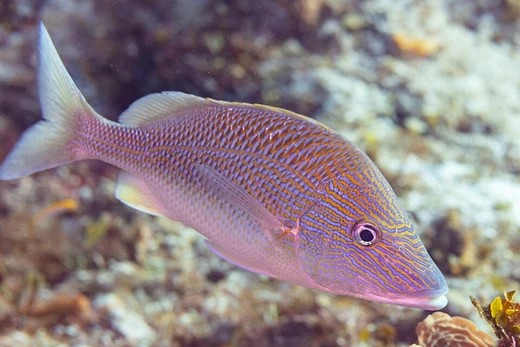
A deepwater snapper with large eyes and a red-pink body.
Last updated

Peter Southwood · CC BY-SA 3.0
The queen snapper (Etelis oculatus) goes by the common names night snapper and brim snapper. It belongs to the ray-finned fish family Lutjanidae. This species stands out because it is the sole member of the genus Etelis that lives outside the Indo-Pacific region, with its home in the western Atlantic Ocean.
Description
This fish has a long, slender, and streamlined body. Its head features a flat area between the eyes, large eyes, and a short snout where the lower jaw sticks out slightly. The jaws contain bands of small, cone-shaped teeth, with an outer row of larger, more widely spaced teeth.
One or two pairs of canine teeth sit at the front of each jaw, and the vomerine teeth form a V-shaped or sometimes triangular patch. The dorsal fin has 10 spines and 11 soft rays, while the anal fin has 3 spines and 8 soft rays; the rearmost ray on each fin is the longest. Both the dorsal and anal fins lack scales.
The tail fin is deeply forked, and its lobes grow longer as the fish ages. The pectoral fins are long and pointed, with either 17 or 19 rays. Medium-sized scales cover the body, and the scale rows on the back run parallel to the lateral line. The largest recorded total length is 100 cm (39 in), though 67 cm (26 in) is more typical.
The back and upper flanks are a reddish deep pink, fading toward the belly. The spiny part of the dorsal fin and the caudal fin are brilliant red, while the other fins are pink. The large eyes are yellow with a red iris.
Distribution
The queen snapper inhabits the warmer waters of the western Atlantic. Its range stretches from North Carolina south along the U.S. Atlantic coast, through the Gulf of Mexico and the Caribbean Sea, down to São Paulo in Brazil. It also appears at Bermuda, as well as Brazil’s Fernando de Noronha and Atol das Rocas Islands.
Habitat and biology
This bathydemersal species lives at depths between 100 and 450 m (330 and 1,480 ft). Adults stay over rocky substrates, feeding mainly on fish and squid. Juveniles are found in mid-water and eat crustaceans. Spawning occurs throughout most of the year, with a peak near the end of the year; spring is the period when these fish are not reproductively active.
Taxonomy
French zoologist Achille Valenciennes first formally described the queen snapper in 1828, naming it Serranus oculatus. The type locality is Martinique.
Scientific classification
- KingdomAnimalia
- PhylumChordata
- ClassActinopterygii
- DivisionTeleostei
- OrderAcanthuriformes
- FamilyLutjanidae
- GenusEtelis
- SpeciesEtelis oculatus
Named by (Valenciennes, 1828)
Close relatives
Other species of Etelis with a Codexery entry.
- Etelis boweni Etelis boweni
- Etelis carbunculus Etelis carbunculus
Sources: Wikipedia taxobox: Queen snapper (CC BY-SA 4.0) · differs from this box at order: WoRMS AphiaID 159789 (CC BY 4.0)
Conservation status
Data Deficient (DD)
Data Deficient: there is not enough information to place this species on the risk scale.
Source: IUCN Red List assessment · GBIF copy of the Red List category
How big is it?
Largest length in the source, 1 m, next to a 1.8 m person.
Diagram: drawn by Codexery, schematic shapes to scale (not a likeness). Length: Wikipedia: Queen snapper
Where the queen snapper has been recorded
Each dot is a place where the species has been observed and reported (121 records, half-degree grid) — not a modelled range. 6 inland records left out (institution coordinates).
Map: drawn by Codexery. Data: GBIF occurrence search (records CC0 / CC BY) · Natural Earth basemap (public domain) · place coordinates: Wikipedia (CC BY-SA 4.0)
Ranked in
More in Snappers
Elsewhere in Snappers and Grunts
Test yourself
Three questions drawn from this entry’s sources. Pick an answer to check it.
Answers checked against the source article
Sources
Compiled from Wikipedia and the sources listed below. Text from Wikipedia is available under CC BY-SA 4.0; this entry is adapted from it.
- Wikipedia: Queen snapper (CC BY-SA 4.0).
- Classification: the source article's taxobox; compare WoRMS, the World Register of Marine Species (CC BY 4.0).
- Conservation status: IUCN Red List assessment.
- Occurrence records: GBIF (CC0 / CC BY). Basemap: Natural Earth (public domain).
- Word definitions: the , each quoted from its Wikipedia article.
Spotted an error? Know more?
Reader corrections go straight into our review queue. Suggest an edit · How this site is sourced