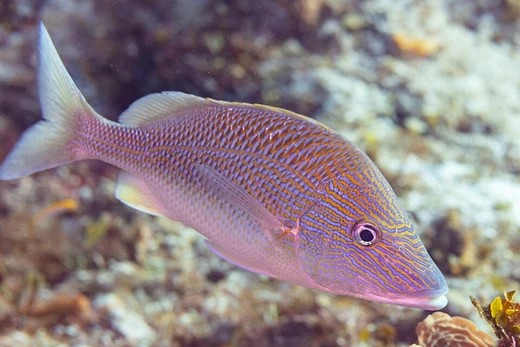
Etelis carbunculus
A reddish snapper of the Indo-Pacific, targeted by fisheries.
Last updated
Etelis carbunculus goes by several common names, including deep-water red snapper, ruby snapper, longtail snapper, and ehu. It belongs to the ray-finned fish family Lutjanidae and lives across the Indo-Pacific region.
Description
This fish has an elongated body, a small head, and large eyes, with a flat area between the eyes. Its mouth reaches back to the middle of the eye, and each jaw holds a single row of conical teeth, with one or two enlarged canine pairs at the front. The vomerine teeth form a slender V-shaped patch.
Compared to related species, its forked tail fin has relatively short lobes. The continuous dorsal fin has a deep notch between its spiny and soft sections, and the last soft ray of both the dorsal and anal fins extends beyond the membrane, longer than the second-to-last ray. The dorsal fin has 10 spines and 11 soft rays; the anal fin has 3 spines and 8 soft rays, and neither fin has scales. The long pectoral fins are nearly as long as the head.
The largest recorded fork length is 127 cm (50 in), though a total length of 65 cm (26 in) is more common. Its overall color is reddish to pinkish, with a whitish belly. The dorsal and tail fins have red margins, and the lower lobe of the tail fin has a white tip.
Distribution
The species has a broad distribution across the Indian and Pacific Oceans. It ranges from the Red Sea south to Mozambique and the Persian Gulf, then across the Indian Ocean into the Pacific. In the Pacific, it extends north to Japan, south to Australia, and east to Hawaii.
It has also been recorded around Manawatāwhi / Three Kings Islands off northern New Zealand. In Australia, it appears from Geraldton in Western Australia east into the Arafura Sea, northeast of Darwin in the Northern Territory, and onto the outer Great Barrier Reef off Queensland, possibly farther south. It also occurs at Lord Howe Island in the Tasman Sea, as well as at Christmas Island and the Cocos (Keeling) Islands.
Habitat and biology
This fish lives over rocky substrates and rocky reefs at depths between 90 and 400 m (300 and 1,310 ft), near the seafloor. It has been reported forming groups. It is a predator, feeding on fish, squid, crustaceans, and zooplankton. In Vanuatu, it breeds year-round, with spawning peaking in November.
Parasites
A monopisthocotylean monogenean from the genus Lagenivaginopseudobenedenia parasitizes E. carbunculus.
Scientific classification
- KingdomAnimalia
- PhylumChordata
- ClassActinopterygii
- DivisionTeleostei
- OrderAcanthuriformes
- FamilyLutjanidae
- GenusEtelis
- SpeciesEtelis carbunculus
Named by Cuvier, 1828
Close relatives
Other species of Etelis with a Codexery entry.
- Etelis boweni Etelis boweni
- Queen snapper Etelis oculatus
Sources: Wikipedia taxobox: Etelis carbunculus (CC BY-SA 4.0) · differs from this box at order: WoRMS AphiaID 212545 (CC BY 4.0)
Conservation status
Least Concern (LC)
- LC▲ this species
- NT
- VU
- EN
- CR
- EW
- EX
Source: IUCN Red List assessment · GBIF copy of the Red List category
How big is it?
Largest length in the source, 1.27 m, next to a 1.8 m person.
Diagram: drawn by Codexery, schematic shapes to scale (not a likeness). Length: Wikipedia: Etelis carbunculus
Where the etelis carbunculus has been recorded
Each dot is a place where the species has been observed and reported (699 records, half-degree grid) — not a modelled range. 11 inland records left out (institution coordinates).
Map: drawn by Codexery. Data: GBIF occurrence search (records CC0 / CC BY) · Natural Earth basemap (public domain) · place coordinates: Wikipedia (CC BY-SA 4.0)
Background
Etelis carbunculus was first formally described in 1828 by French zoologist Georges Cuvier, with the type locality given as Mahé in the Seychelles. It was the only species in the genus Etelis at that time, making it the type species of the genus. The specific name carbunculus means 'ruby red precious stone,' a reference to the fish's reddish color. The species has a wide distribution across the Indian and Pacific Oceans, from the Red Sea and East Africa to Japan, Australia, Hawaii, and New Zealand's Manawatāwhi / Three Kings Islands.
It occurs over rock substrates and rocky reefs at depths between 90 and 400 m, and has been reported forming aggregations. It is a predatory species feeding on fishes, squid, crustaceans, and zooplankton. In Vanuatu, breeding occurs all year round, with spawning peaking in November.
Ranked in
More in Snappers
Elsewhere in Snappers and Grunts
Test yourself
Three questions drawn from this entry’s sources. Pick an answer to check it.
Answers checked against the source article
Sources
Compiled from Wikipedia and the sources listed below. Text from Wikipedia is available under CC BY-SA 4.0; this entry is adapted from it.
- Wikipedia: Etelis carbunculus (CC BY-SA 4.0).
- Classification: the source article's taxobox; compare WoRMS, the World Register of Marine Species (CC BY 4.0).
- Conservation status: IUCN Red List assessment.
- Occurrence records: GBIF (CC0 / CC BY). Basemap: Natural Earth (public domain).
- Word definitions: the , each quoted from its Wikipedia article.
Spotted an error? Know more?
Reader corrections go straight into our review queue. Suggest an edit · How this site is sourced