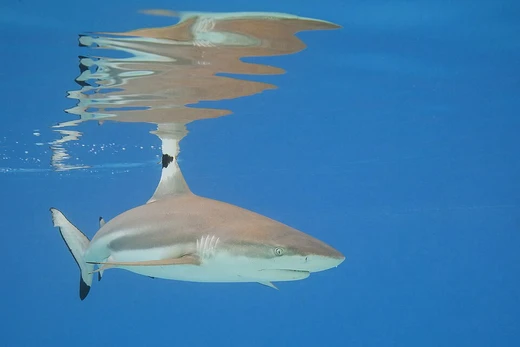
Atlantic sharpnose shark
A small requiem shark of warm, shallow Atlantic waters.

The Atlantic sharpnose shark (Rhizoprionodon terraenovae) belongs to the requiem shark family, Carcharhinidae. It lives in the subtropical northwestern Atlantic Ocean, roughly between 43°N and 18°N latitude. Compared to other sharks, this species is small. Adults typically measure around 91.4 to 99 cm (3.00–3.25 ft), though the maximum recorded length is 110–120 cm (3.6–3.9 ft). In the wild, they can live up to 19 years. Young sharks are easy to spot because their dorsal and caudal fins have black edges.
These sharks prefer warm, shallow coastal waters, often less than 10.1 m (33 ft) deep, though they have been found as deep as 280 m (920 ft). Their range stretches from New Brunswick, Canada, down to the southern Gulf of Mexico. Reports from Brazil are probably cases of mistaken identity with the Brazilian sharpnose shark.
Their diet consists mainly of bony fish, worms, shrimp, crabs, and mollusks. Common fish they eat include menhaden, eels, silversides, wrasses, jacks, toadfish, and filefish.
Newborn pups are 29–37 cm (11–15 in) long. For the first three months, they grow about 5 cm (2.0 in) per month. Growth then slows to 0.9 cm (0.35 in) per month during winter and spring until they reach 60–65 cm (24–26 in). After that, growth picks up to roughly 1.3 cm (0.51 in) per month for about a year. Males become mature at 2–3 years old, when they are 80–85 cm (31–33 in) long. Females mature a bit later, at 2.5–3.5 years, reaching 84–89 cm (33–35 in).
Females are viviparous, giving birth to litters of one to seven pups (usually four to six) after a gestation of 10–11 months. Pups are born at 29–37 cm (11–15 in). Females use marine estuaries in late spring, but breeding happens mostly throughout the year.
In captivity, these sharks are best suited for public aquariums or very experienced private keepers. They are active swimmers that need plenty of space and do best in small schools of at least three. Round or oval tanks or ponds work best. They have been known to live at least four years in captivity.
Quick Facts
- Genus
- Rhizoprionodon
- Species
- terraenovae
Facts from the source article.
Lore & Background
The Atlantic sharpnose shark is a small species compared to other sharks, with a maximum length of about 110–120 cm (3.6–3.9 ft) and an average adult size of about 91.4–99 cm (3.00–3.25 ft). Reports exist of these sharks living up to 19 years in the wild. A distinctive feature is that juveniles have black edges on the dorsal and caudal fins. Atlantic sharpnose sharks can be found as far north as New Brunswick, Canada, to as far south as the southern Gulf of Mexico; reports of specimens from Brazil are likely being confused with the Brazilian sharpnose shark. They prefer warmer, shallow coastal waters, often in waters less than 10.1 m (33 ft) deep, though they have reportedly been found at 280 m (920 ft) deep. The diet mostly consists of bony fish, worms, shrimp, crabs, and mollusks, including menhaden, eels, silversides, wrasses, jacks, toadfish, and filefish.
Reader's Guide
The Atlantic sharpnose shark is a well-documented species in the north-western Atlantic, with its range extending from New Brunswick, Canada, to the southern Gulf of Mexico. Its preference for warm, shallow coastal waters makes it a common inhabitant of nearshore environments, though it can also occur at depths up to 280 m. The species is viviparous, with females giving birth to litters of one to seven pups after a gestation period of 10–11 months. Growth rates vary by age and season: pups grow about 5 cm per month for the first three months, then slow to 0.9 cm per month until reaching 60–65 cm, after which growth increases to about 1.3 cm per month for about a year. Males mature at 2–3 years (80–85 cm), females at 2.5–3.5 years (84–89 cm). In captivity, these sharks are best suited for public aquaria or very experienced private aquarists, as they are highly active swimmers requiring ample space and do best in small schools of at least three sharks in round or oval tanks; they have been reported to live at least 4 years in captivity.
More in Reef Sharks and Rays, Part 2 1-24
Spotted an error? Know more?
Reader corrections go straight into our review queue. Suggest an edit · How this site is sourced