Nihonium
Synthetic, radioactive element in group 13.
Last updated
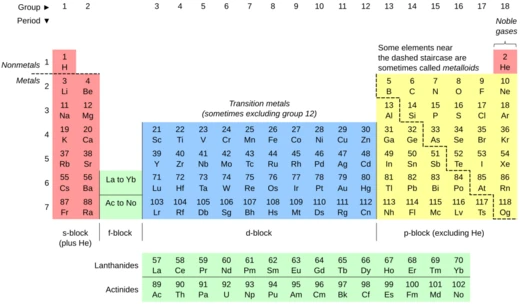
Nihonium is a synthetic, highly radioactive element with the symbol Nh and atomic number 113. Its most stable isotope, nihonium-286, decays in about 10 seconds. On the periodic table, it sits in period 7 and group 13 as a transactinide p-block element.
Quick Facts
- Engvar
- en-GB
Facts from the source article.
History
The syntheses of elements 107 to 112 were conducted at the GSI Helmholtz Centre for Heavy Ion Research in Darmstadt, Germany, from 1981 to 1996 using cold fusion reactions, in which targets made of lead and bismuth are bombarded with heavy ions of period 4 elements. Cold fusion was pioneered by Yuri Oganessian and his team in 1974 at the Joint Institute for Nuclear Research (JINR) in Dubna, Soviet Union.
Yields from cold fusion reactions decreased significantly with increasing atomic number, and the GSI team attempted to synthesise element 113 via cold fusion in 1998 and 2003 by bombarding bismuth-209 with zinc-70; both attempts were unsuccessful. Oganessian and his team at the JINR then turned to the older hot fusion technique, using calcium-48 as a projectile because it is very neutron-rich and doubly magic. In collaboration with the Lawrence Livermore National Laboratory (LLNL) in Livermore, California, they attempted to produce element 114 in 1998 by bombarding a target of plutonium-244 with ions of calcium-48.
Isotopes
Nihonium lacks any stable or naturally occurring isotopes. Scientists have created several radioactive versions in labs by merging two atoms or tracking the decay of even heavier elements. Eight distinct nihonium isotopes have been documented, with masses of 278, 282 through 287, and 290—though the ones at 287 and 290 remain unconfirmed. All of them break down via alpha decay into isotopes of roentgenium.
Some evidence suggests nihonium-284 might also decay through electron capture into copernicium-284, but predictions of its partial half-life differ widely depending on the model used. A spontaneous fission path has also been noted for nihonium-285. Nuclear stability drops sharply after curium, element 96, but the very existence of superheavy elements like nihonium supports the idea that closed nuclear shells at 114 protons and 184 neutrons provide a stabilizing effect, hinting at an island of stability.
Predicted properties
Nihonium is the heaviest element in group 13, sitting below thallium, and opens the 7p series. Because it is incredibly difficult and costly to produce and decays almost instantly, almost nothing has been directly measured about its properties or those of its compounds; most knowledge comes from predictions. Like the other metals in its group (except boron), nihonium is expected to be a metal, but it should behave quite differently from its lighter relatives. The main reason is the spin-orbit interaction, which is very strong in superheavy elements.
This effect stabilizes the 7s and 7p electrons and splits the 7p subshell into two parts. As a result, nihonium’s first ionization energy is predicted to be 7.306 eV, the highest among the group 13 metals. A similar split is expected for the 6d electron levels, raising them close to the 7s energy and potentially allowing for unusual nihonium compounds that have no counterparts among lighter group 13 elements.
Experimental chemistry
Three nihonium isotopes, 284Nh, 285Nh, and 286Nh, survive long enough for chemical study. Between 2010 and 2012, scientists at the JINR tested nihonium’s volatility using 284Nh, produced as a decay product of 288Mc from a 243Am+48Ca reaction. They generated about ten to twenty atoms, but none reached the detectors.
This suggested either nihonium behaves like a noble gas and diffused away, or pure nihonium is not volatile enough to travel through PTFE capillaries. A 2017 experiment at the same lab produced 284Nh and 285Nh using the same reaction but removed quartz surfaces, using only PTFE. Again, no nihonium atoms were detected after chemical separation, indicating unexpectedly strong retention on PTFE.
This result contradicted earlier theory, implying the species in the first experiment was likely nihonium hydroxide, not elemental nihonium. To study elemental nihonium, high-temperature methods like vacuum chromatography may be needed. Bromine gas saturated with boron tribromide has been proposed as a carrier for future experiments, since it oxidises thallium (nihonium’s lighter relative) to thallium(III), offering a way to explore nihonium’s oxidation states, similar to past work on group 5 element bromides like dubnium.
More in Periodic Table & Elements
Sources
Compiled from Wikipedia and the sources listed below. Text from Wikipedia is available under CC BY-SA 4.0; this entry is adapted from it.
- Wikipedia: Nihonium (CC BY-SA 4.0).
- Word definitions: the Codexery glossary, each quoted from its Wikipedia article.
Spotted an error? Know more?
Reader corrections go straight into our review queue. Suggest an edit · How this site is sourced