Nobelium
Synthetic actinide element named after Alfred Nobel.
Last updated
Nobelium is a synthetic chemical element with the symbol No and atomic number 102. It is named after Alfred Nobel, the inventor of dynamite and benefactor of science. A radioactive metal and the tenth transuranium element, it is the second transfermium and the fourteenth member of the actinide series.
Quick Facts
- Atomic number
- 102
- Element category
- actinide
- Named after
- Alfred Nobel
Facts from the source article.
Discovery
The discovery of element 102 was claimed by groups from Sweden, the United Kingdom, the United States, and the Soviet Union. The first complete and incontrovertible report of its detection came in 1966 from the Joint Institute of Nuclear Research at Dubna. The first announcement of the discovery was made in 1957 by physicists from Argonne National Laboratory, Harwell Atomic Energy Research Establishment, and the Nobel Institute for Physics in Sweden.
They bombarded a curium target with carbon-13 ions in half-hour intervals for fifty times and performed ion-exchange chemistry between bombardments. Twelve of the fifty bombardments contained samples emitting (8.5 ± 0.1) MeV alpha particles that eluted earlier than fermium and californium. The reported half-life was 10 minutes, assigned to either 251No or 253No, though the possibility that the alpha particles came from a short-lived mendelevium isotope was not excluded. The team proposed the name nobelium, which IUPAC immediately approved.
In 1958, scientists at Lawrence Berkeley National Laboratory repeated the experiment using the new heavy-ion linear accelerator to bombard a curium target with 13C and 12C ions. They could not confirm the 8.5 MeV activity but detected decays from 250Fm, supposedly the daughter of 254No, with an apparent half-life of about 3 seconds. This assignment was probably wrong, as later Dubna work showed the half-life of 254No is significantly longer.
Characteristics
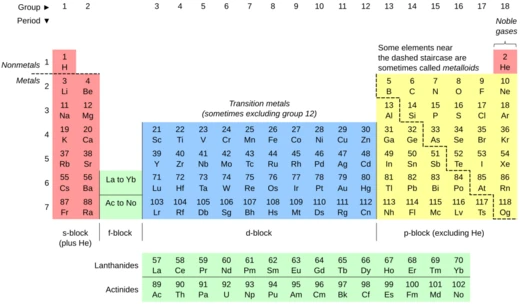
In the periodic table, nobelium is located to the right of mendelevium, to the left of lawrencium, and below ytterbium. Nobelium metal has not been prepared in bulk quantities. The lanthanides and actinides in the metallic state can exist as divalent or trivalent metals.
In 1975, Johansson and Rosengren examined cohesive energies of metallic lanthanides and actinides and concluded that the increased binding energy of the [Rn]5f136d17s2 configuration over the [Rn]5f147s2 configuration for nobelium was not enough to compensate for the energy needed to promote one 5f electron to 6d. Thus einsteinium, fermium, mendelevium, and nobelium were expected to be divalent metals, though this prediction has not yet been confirmed for nobelium. The increasing predominance of the divalent state is attributed to relativistic stabilization of the 5f electrons.
In 1986, nobelium metal was estimated to have an enthalpy of sublimation between 126 kJ/mol, supporting the theory that it would form a divalent metal. Like other divalent late actinides, metallic nobelium should assume a face-centered cubic crystal structure, with a metallic radius of around 197 pm. Its melting point has been predicted to be 800 °C, and its density is predicted to be around 9.9 ± 0.4 g/cm3.
Preparation and purification
Isotopes of nobelium are mostly produced by bombarding actinide targets such as uranium, plutonium, curium, californium, or einsteinium, except for nobelium-262, which is produced as the daughter of lawrencium-262. The commonly used isotope 255No can be produced from bombarding curium-248 or californium-249 with carbon-12; the latter method is more common. Irradiating a 350 μg cm−2 target of californium-249 with three trillion 73 MeV carbon-12 ions per second for ten minutes can produce around 1200 nobelium-255 atoms. Once produced, nobelium-255 can be separated using the recoil momentum of the atoms to bring them onto a thin metal foil in a vacuum, often combined with trapping in a helium gas atmosphere and transport via a capillary tube with potassium chloride aerosols.
The thin layer of nobelium collected on the foil can be removed with dilute acid. Nobelium can then be isolated by exploiting its tendency to form the divalent state: under typical elution conditions using bis-(2-ethylhexyl) phosphoric acid as stationary organic phase and 0.05 M hydrochloric acid as mobile aqueous phase, or using 3 M hydrochloric acid as an eluant from cation-exchange resin columns, nobelium passes through the column while other trivalent actinides remain. If a direct gold foil is used, the gold must be separated using anion-exchange chromatography before isolating nobelium by elution from chromatographic extraction columns using HDEHP.
More in Periodic Table & Elements
Sources
Compiled from Wikipedia and the sources listed below. Text from Wikipedia is available under CC BY-SA 4.0; this entry is adapted from it.
- Wikipedia: Nobelium (CC BY-SA 4.0).
- Word definitions: the Codexery glossary, each quoted from its Wikipedia article.
Spotted an error? Know more?
Reader corrections go straight into our review queue. Suggest an edit · How this site is sourced