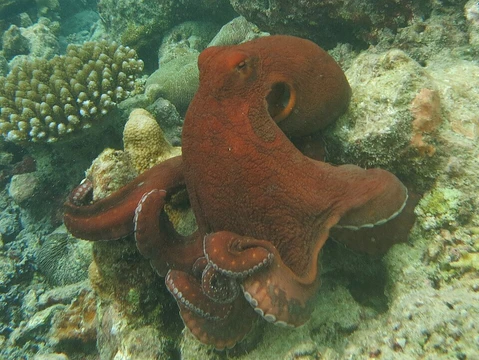
Kelp Forests
The ocean's living cathedral, where the largest octopus on Earth hunts beneath a canopy of swaying kelp.

Kelp forests are temperate marine ecosystems dominated by large brown algae (order Laminariales), most notably Macrocystis pyrifera (giant kelp) in the North Pacific. Forming dense, three-dimensional canopies from the seafloor to near the surface, they are among the most productive and structurally complex habitats on Earth (Wikipedia: Kelp forest; NOAA Ocean Exploration). For the Giant Pacific Octopus (Enteroctopus dofleini), the largest known octopus species, kelp forests constitute a primary foraging, refuge, and reproductive habitat across its North Pacific range (Wikipedia: Enteroctopus dofleini; FAO Species Catalogue).
These forests support extraordinary biodiversity—sea otters, sea urchins, rockfish, sea stars, and hundreds of invertebrate taxa—making them keystone ecosystems whose loss cascades through entire food webs (NOAA; Wikipedia: Kelp forest). The octopus, as an apex invertebrate predator and ecosystem engineer, occupies a central trophic role within this structure.
- Habitat class
- Temperate coastal marine (photic zone, 0–~30 m)
- Dominant canopy species (n. pacific)
- Macrocystis pyrifera (giant kelp)
- Focal octopus species
- Enteroctopus dofleini (Giant Pacific Octopus)
- Global distribution
- Temperate latitudes on all continents except Antarctica
- Canopy growth rate (macrocystis)
- Up to ~30–60 cm per day under optimal conditions (NOAA; Wikipedia: Giant kelp)
- Keystone interaction
- Sea otter → sea urchin → kelp trophic cascade (NOAA; Wikipedia: Sea otter)
Lore & Background
Kelp forests are not static stands of algae but dynamic, fast-growing ecosystems. Macrocystis pyrifera produces new fronds at the surface while its holdfasts anchor to rocky substrate below, creating a vertical architecture that can exceed 25 metres in depth (Wikipedia: Giant kelp; NOAA). This structure partitions light, current, and space into microhabitats: the sunlit canopy, the mid-water frond zone, and the shaded understory over the benthos. Each layer hosts distinct assemblages of fish, invertebrates, and crustose coralline algae (Wikipedia: Kelp forest).
The Giant Pacific Octopus exploits this complexity with remarkable plasticity. It shelters in crevices and under kelp holdfasts during the day, deploys its eight arms to manipulate prey (crabs, mussels, sea urchins) within the frond matrix, and uses the kelp's density as visual and physical cover from larger predators such as sea otters and sharks (Wikipedia: Enteroctopus dofleini; NOAA Fisheries). Its chromatophore-based camouflage blends seamlessly with the brown-green palette of the forest, making it nearly invisible among the swaying stipes.
Ecologically, kelp forests are vulnerable to the 'urchin barren' phenomenon: when sea-otter populations decline (historically from hunting, now from Pfiesteria-related die-offs and predation), urchin populations explode and overgraze kelp, converting a lush forest into a barren urchin-dominated landscape (NOAA; Wikipedia: Urchin barren). The octopus, as a urchin predator, occupies a critical position in this cascade, though its own population is sensitive to hypoxia, warming, and prey availability.
Reader's Guide
North Pacific (Alaska to Baja California): The primary range of Enteroctopus dofleini overlaps the world's most extensive Macrocystis pyrifera forests. The octopus favours the 5–25 m zone over mixed rock and boulder substrate where kelp holdfasts create dense shelter. Summer upwelling brings nutrient-rich water, boosting urchin and crab prey; the octopus shifts to deeper understory in winter as surface temperatures drop (NOAA; Wikipedia: Enteroctopus dofleini).
Northeast Pacific (California Current, Oregon to Baja): Kelp here is dominated by Macrocystis and Egregia. The octopus occupies rocky outcrops and kelp-anchored boulders at 3–20 m. Seasonal upwelling (spring–summer) drives prey availability; the octopus tracks urchin aggregations along the forest floor (NOAA Fisheries; Wikipedia: Kelp forest).
Southern Hemisphere (Tasmania, New Zealand, Chile, South Africa): Laminaria and Durvillaea form the canopy. Octopus vulgaris and local Enteroctopus populations use the same structural niches—crevices, under-holdfast refuges, and the shaded mid-water frond zone—at 2–25 m over rocky substrate (Wikipedia: Kelp forest; FAO Species Catalogue).
Each locale's ecological significance lies in the kelp's role as a nursery and foraging ground: the three-dimensional habitat supports juvenile fish and invertebrate prey that sustain the octopus, while the octopus in turn regulates urchin density, protecting the forest from overgrazing (NOAA; Wikipedia: Urchin barren).
More in Distribution & Habitat
Elsewhere in Big blue octopus
Spotted an error? Know more?
Reader corrections go straight into our review queue. Suggest an edit · How this site is sourced