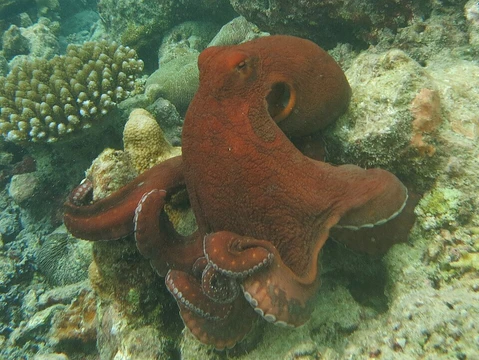
Funnel
One muscular tube, one jet, and the entire ocean opens up.

The funnel (also termed the siphon) is the muscular, tubular opening at the ventral tip of the mantle in all living cephalopods—octopuses, squids, cuttlefishes, and the deep-sea nautilus. It is formed by the fusion of the ventral margins of the mantle wall and serves as the sole exit for water that has passed over the gills inside the mantle cavity. By contracting the mantle adductor muscle, the animal forces a directed jet of water out through the funnel, producing the jet-propulsion that is the primary means of locomotion in these animals.
In octopods (Octopoda) the funnel is a muscular tube physically attached to the posterior of the arm mass, allowing the animal to aim the jet in nearly any direction and to use the arms to assist in steering. In decapodiforms (squids and cuttlefishes) the funnel is a free, separate structure not joined to the arms, and its orientation is controlled by dedicated funnel muscles. This single anatomical element thus unites respiration, locomotion, and in some species, defensive water-expulsion into one compact, highly muscular organ.
- Structure type
- Muscular tube (siphon)
- Taxonomic scope
- Class Cephalopoda (all living orders)
- Primary function
- Directed jet propulsion; expulsion of water from the mantle cavity
- Developmental origin
- Fused ventral margins of the mantle wall
- Octopod attachment
- Joined to the posterior of the arm mass
- Decapod attachment
- Free; not attached to the arms
- Associated muscles
- Mantle adductor (cavity closure) + intrinsic funnel musculature (direction)
Lore & Background
In the soft-bodied octopus, the funnel is not a rigid pipe but a flexible, muscular channel that wraps around the base of the eight arms. The animal can curl the funnel over its body to aim the jet backward for a rapid escape burst, or twist it to the side for a lateral dart. Because the funnel is innervated by the same giant motor neurons that drive the mantle, the jet can be modulated from a slow, continuous pulse for cruising to a violent, single contraction that propels a common octopus (Octopus vulgaris) several body-lengths in a fraction of a second.
In the nautilus, the funnel retains a more ancestral form: a relatively short, broad tube that opens into the chambered shell's aperture. The animal still jets, but the physics are constrained by the rigid phragmocone, and the jet is gentler. In the coleoid squids, the funnel is longer and more constricted, and in some species—such as the glass squid (Cranchiidae)—it is reduced to a narrow slit, reflecting a shift toward passive drifting rather than sustained jetting.
The funnel also plays a role beyond locomotion. In many octopuses and cuttlefishes, a sudden, forceful expulsion of water through the funnel is used to dislodge sediment, startle predators, or clear the gill chamber of debris. In a few species the jet is directed at prey to knock it off a substrate, making the funnel a de facto feeding tool as well as a propulsion organ.
Reader's Guide
FUNNEL (SIPHON)
The funnel is the terminal, muscular tube at the ventral end of the cephalopod mantle. In a common octopus it measures roughly one-third to one-half of the total mantle length; in a large squid it can approach the full length of the mantle cone. It is formed embryologically by the ventral edges of the mantle wall fusing into a single channel.
Function in plain terms: seawater enters the mantle cavity through a separate inhalant opening, flows over the gills for gas exchange, and is expelled out the funnel. The mantle adductor muscle acts as a pump, and the intrinsic muscles of the funnel wall steer the exit jet. The result is jet propulsion—the animal's primary mode of rapid movement.
What makes it remarkable among invertebrates: no other invertebrate group combines a single, highly muscular, directionally steerable tube with a closed mantle cavity to achieve both respiration and locomotion in one organ. The octopus funnel, attached to the arm mass, can be aimed in virtually any direction, giving the animal a vector of thrust that no finned or legged invertebrate can match. In decapods the free funnel is paired with a rigid pen or gladius, adding a hydrodynamic stabiliser that the octopus lacks. Compared to the cilia-driven flow of bivalves or the parapodial paddling of polychaetes, the cephalopod funnel is a high-pressure, high-velocity jet system—orders of magnitude more powerful per unit body mass.
Did You Know?
- In octopods the funnel is physically attached to the arm mass, so the arms can help steer the jet; in squids and cuttlefishes the funnel is a free, separate structure.
- A single full contraction of the mantle can propel an octopus several times its own body length in under a second.
- The nautilus retains a short, broad funnel that opens into the aperture of its chambered shell, a form closer to the ancestral cephalopod condition.
- The funnel is not merely a propulsion organ: in several octopus and cuttlefish species a forceful water jet is used to dislodge prey from rock or to clear sediment from the gill chamber.
More in Anatomy & Physiology
Elsewhere in Big blue octopus
Spotted an error? Know more?
Reader corrections go straight into our review queue. Suggest an edit · How this site is sourced