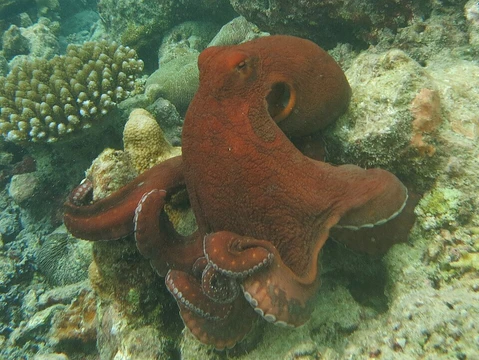
Chromatophore display
A living canvas of pigment, muscle, and nerve that speaks in color before a word is spoken.

Chromatophore display is the rapid, patterned color-change behavior produced by octopuses (and other cephalopods) through the coordinated expansion and contraction of thousands of pigment-bearing skin cells. Each chromatophore is a sac of pigment stretched over a ring of tiny radial muscles; when those muscles contract, the sac flattens and the pigment disperses, and when they relax, the sac bulges and the color concentrates. The result is a living canvas that can shift hue, pattern, and texture in a fraction of a second.
This display serves multiple simultaneous functions: it provides dynamic camouflage against predators and prey, conveys emotional and social signals to conspecifics during courtship, aggression, and territorial encounters, and may even allow an octopus to 'broadcast' different messages to different receivers at the same time. Because the control is distributed across a decentralized neural network rather than a single brain command, chromatophore display is widely cited as one of the most striking demonstrations of cephalopod cognitive and sensory sophistication.
- Subject
- Chromatophore display
- Taxonomic group
- Cephalopoda (Octopoda)
- Primary cell types
- Chromatophores, iridophores, leucophores
- Mechanism
- Radial-muscle contraction of pigment sacs
- Response time
- Milliseconds
- Functions
- Camouflage, communication, emotional signaling
- Neural control
- Distributed (local + central)
Lore & Background
In the layered skin of an octopus, each chromatophore is an independent actuator: a cup of brown, red, yellow, or black pigment held taut by a ring of radially arranged muscle fibers, each fiber innervated by its own motor neuron. Beneath the chromatophore layer sit iridophores—stacked guanine crystals that scatter light to produce structural blues, silvers, and greens—and leucophores, which reflect broad-spectrum white. Together these three cell types give the animal a palette far richer than any single pigment could provide, and the ability to shift from a mottled, sandy texture to a uniform jet-black flash or a rippling wave of iridescent blue in the blink of an eye.
The neural architecture behind the display is as remarkable as the hardware. Motor neurons for the radial muscles branch from a distributed network of ganglia along the mantle and arms, meaning that a local stimulus—pressure, a chemical cue, a shadow passing overhead—can trigger a rapid, reflexive color change before any central processing occurs. At the same time, higher-order signals from the brain can override or layer onto those local responses, producing the complex, sequenced patterns seen during courtship dances or agonistic encounters. This dual control system lets an octopus fine-tune a global 'mood' while still reacting instantaneously to a predator's approach.
Field and laboratory observations show that chromatophore displays are not random. An octopus hiding under a rock may flash a brief, high-contrast pattern to startle a probing fish, then settle into a low-contrast, texture-matched state. During mating, males and females exchange prolonged, wave-like ripples of color along the arms, and the specific sequence and intensity of those ripples appear to carry information about readiness, dominance, and species identity. In territorial disputes, two octopuses may face each other and escalate through a graded series of color shifts—pale to dark, smooth to spiky—before either retreats or a physical confrontation follows. These graded, context-dependent displays are among the clearest behavioral evidence that cephalopods process social and emotional information in ways that go well beyond simple stimulus-response.
Reader's Guide
Camouflage matching: An octopus resting on a sandy or rocky substrate adjusts chromatophore density and iridophore scattering to replicate the local texture and hue. The animal samples the background through its eyes and skin photoreceptors, then drives a distributed muscular response so that the skin becomes optically indistinguishable from the ground. This is not a single 'on/off' switch but a continuous, multi-cellular adjustment, and it can be updated in real time as the animal shifts position.
Startle and threat display: When a predator approaches, the octopus can flash a high-contrast, uniform dark pattern across the mantle and arms in under a second. The sudden increase in apparent size and the sharp color change can startle a fish or crab, buying the octopus a moment to jet away or retreat into a crevice. The display is reflexive in speed but modulated by context: a larger, more confident animal produces a bolder, more sustained flash.
Social and courtship signaling: During mating or territorial encounters, octopuses produce sequenced ripples of color that travel along the arms in directional waves. The pattern, speed, and intensity of these ripples appear to encode information about the animal's state—agitation, readiness, dominance. Two octopuses facing each other may escalate through a graded series of color shifts before one retreats, suggesting a communicative exchange rather than a purely defensive reflex.
Why it matters for cognition: The distributed, multi-layered control of chromatophores—local reflexes overlaid with central modulation—demonstrates a level of sensorimotor integration rarely seen outside vertebrate brains. The same skin can be a passive camouflage, an active threat signal, and a social message simultaneously, and the animal can switch between these modes fluidly. This makes chromatophore display one of the most compelling behavioral windows into cephalopod intelligence.
Did You Know?
- Chromatophore displays can be triggered by local stimuli (a shadow, a chemical cue, mechanical pressure) before any central brain processing occurs, meaning the skin itself acts as a distributed sensory-motor organ.
- During courtship, the specific sequence, direction, and speed of color ripples along the arms appear to carry information about the animal's readiness and dominance status, functioning as a form of visual language.
More in Behavior & Intelligence
Elsewhere in Big blue octopus
Spotted an error? Know more?
Reader corrections go straight into our review queue. Suggest an edit · How this site is sourced