Ink sac
A tiny muscular vault that fires a black cloud to buy a cephalopod its escape.

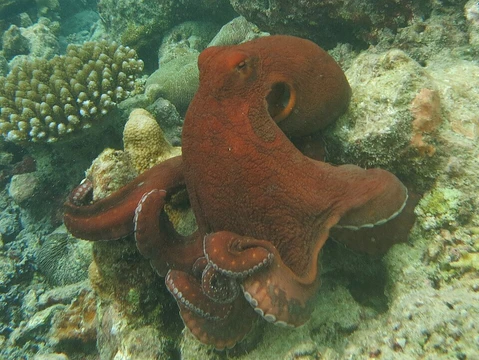
The ink sac (also called the ink gland) is a small, muscular, sac-like organ found in the posterior region of the body cavity of cephalopods—octopuses, squids, and cuttlefish. As described in the Wikipedia article on cephalopod anatomy and corroborated by entries in the World Register of Marine Species (WoRMS) for each relevant family, the organ functions as both a secretory gland and a storage reservoir for a dark, melanin-rich fluid commonly called ink.
Its primary role is defensive: when threatened, the cephalopod contracts the sac's musculature and expels a dense cloud of ink through the siphon, creating a visual distraction that allows the animal to jet away. The structure is a defining feature of the class Cephalopoda and is absent in all other invertebrate phyla, making it one of the most distinctive anatomical innovations in the invertebrate tree of life.
- Phylum / class
- Mollusca / Cephalopoda
- Primary function
- Defensive distraction (ink expulsion)
- Pigment basis
- Melanin (eumelanin)
- Expulsion route
- Via the siphon (funnel)
- Location in body
- Posterior body cavity, adjacent to the stomach and rectum
- Present in
- Octopods, decapodiform squids, and cuttlefish (Sepiida)
Lore & Background
In the standard cephalopod body plan, the ink sac sits tucked against the posterior wall of the mantle cavity, just behind the stomach and in close proximity to the rectum. The organ is lined with a thin epithelium that synthesises and secretes the ink fluid, while a surrounding layer of smooth muscle provides the contractile force needed to eject it. The Wikipedia section on cephalopod physiology notes that the ink is a complex mixture of melanin granules suspended in a protein-rich matrix, giving it a dense, near-black appearance that persists in water for several seconds before slowly dispersing.
The evolutionary origin of the ink sac is tied to the broader cephalopod innovation of jet propulsion. Because the siphon already serves as the exit for water used in locomotion, co-opting it as the delivery channel for ink required no additional anatomical investment. This elegant reuse of an existing structure is frequently cited in comparative invertebrate zoology texts as an example of exaptation—where a structure originally built for one purpose is repurposed for another.
Among the three major living cephalopod groups, the ink sac shows modest variation. In octopods it is a relatively simple, unpaired sac. In decapodiform squids the structure is similar but the surrounding musculature is more robust, consistent with the faster jet speeds those animals achieve. Cuttlefish (Sepiidae) possess the same basic organ, though their additional reliance on rapid color-change chromatophores means the ink cloud is often a secondary rather than primary escape response.
Reader's Guide
Ink sac (ink gland)
The ink sac is a small, paired-or-unpaired muscular organ nestled in the posterior body cavity of a cephalopod, typically no larger than a few millimetres in a juvenile octopus and scaling up proportionally in larger squids. It sits adjacent to the stomach and opens into the mantle cavity near the siphon. In plain terms, it is a tiny biological inkwell: an inner epithelial layer manufactures a dark, melanin-rich fluid, and an outer ring of smooth muscle squeezes it out on command.
Its function is purely defensive. When the animal perceives a threat, a neural signal triggers a rapid contraction of the sac's wall, forcing a concentrated jet of ink through the siphon. The resulting cloud is dense with eumelanin granules suspended in a protein matrix, making it visually opaque and long-lasting compared to a simple dye. This gives the cephalopod a critical window—often one to several seconds—to jet away or hide.
What makes the ink sac remarkable among invertebrates is its combination of a secretory gland and a contractile reservoir in a single, compact organ. No other invertebrate phylum produces a melanin-based, jetted defensive fluid. The structure also exemplifies exaptation: the siphon, originally evolved for jet propulsion, was co-opted as the ink's delivery tube, meaning the cephalopod gained an entire new defence system without building a new appendage.
Did You Know?
- The ink is not a simple dye; it is a suspension of eumelanin granules in a protein-rich fluid, which is why the cloud stays dense and dark for seconds rather than dispersing instantly.
- The siphon that expels the ink is the same structure the cephalopod uses for jet propulsion, meaning the animal's escape vehicle and its 'smoke screen' share a single exit.
- The ink sac is absent in nautiluses (Cephalopoda, Nautilida), the only other living cephalopod lineage, underscoring that the organ is a derived feature of the coleoid cephalopods.
More in Anatomy & Physiology
Elsewhere in Big blue octopus
Spotted an error? Know more?
Reader corrections go straight into our review queue. Suggest an edit · How this site is sourced