Carl Linnaeus
The man who gave every living thing its two-word name.

Carl Linnaeus (23 May 1707 – 10 January 1778), ennobled as Carl von Linné, was a Swedish botanist, zoologist, and physician universally credited as the father of modern taxonomy. He formalised binomial nomenclature—the pairing of a genus name with a specific epithet—and articulated the hierarchical framework (kingdom, class, order, genus, species) that, in revised form, still underpins biological classification. His landmark works, Systema Naturae (first edition 1735; the 10th edition of 1758 is the starting point for zoological nomenclature) and Species Plantarum (1753, the starting point for botanical nomenclature), provided the first comprehensive, consistent naming scheme for the natural world.
Working out of Uppsala University, Linnaeus trained a generation of field naturalists—his "apostles"—who collected specimens across Europe, the Americas, and Asia, feeding an ever-growing catalogue of described species. His system replaced the long, descriptive Latin phrases of earlier authors with a compact, universal two-word label, making cross-referencing, communication, and the very act of naming a living organism practical for the first time.
- Full name
- Carl von Linné
- Born
- 23 May 1707, Råshult, Småland, Sweden
- Died
- 10 January 1778, Uppsala, Sweden
- Primary field
- Taxonomy, Botany, Zoology
- Key publication
- Systema Naturae (1735–1758); Species Plantarum (1753)
- Affiliation
- Uppsala University
- Legacy title
- Father of modern taxonomy / binomial nomenclature
Lore & Background
Linnaeus grew up on a modest farm in the forested province of Småland, where his father, a parish minister, first pointed out the names of plants and animals. A scholarship brought him to Lund and then to Leiden, where the Dutch botanist Jan Frederik Gronovius and the physician Herman Boerhaave shaped his early thinking. In Leiden he published his first edition of Systema Naturae in 1735—a slim volume that would be expanded through ten editions over two decades, each adding new genera, species, and a more rigorous hierarchical logic.
Back in Sweden, Linnaeus was appointed professor of medicine and botany at Uppsala. He ran his household like a small academy: his students, the "apostles," were dispatched to Lapland, the East Indies, South America, and beyond, returning with pressed sheets, dried fish, and insect pins that he carefully slotted into his growing herbarium and cabinet. He is estimated to have described several thousand species in his lifetime, a staggering output for an era before microscopes were routine and before the concept of evolution had been articulated.
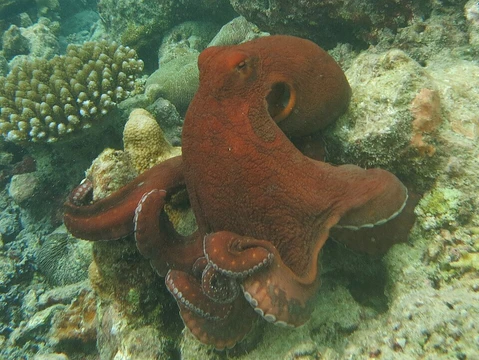
His classification, while brilliant for its time, was static: species were fixed, created kinds, not the mutable populations we now understand. He placed humans, Homo sapiens, alongside the apes in the primate order—a decision that caused lasting controversy among his contemporaries. Yet the architecture he built—genus nested in family nested in order nested in class—proved flexible enough to absorb Darwin, Mendel, and the entire edifice of modern systematics. Every species name you read today, from Octopus cyanea to Homo sapiens, carries his two-word grammar.
Reader's Guide
Kingdom → Class → Order → Genus → Species: Linnaeus's five-rank hierarchy replaced the free-form, multi-clause Latin descriptions ("plantae quae…") of pre-Linnaean authors. The key diagnostic feature is the *genus*: a circumscribed group of closely related species sharing a morphological core, named in the nominative singular (e.g., *Octopus*, *Homo*, *Mentha*). The specific epithet, always a lowercase adjective or noun agreeing with the genus, locks the organism into that genus and distinguishes it from congeners (*O. cyanea* vs. *O. vulgaris*). Together the two words form a unique, language-independent label.
Compared with the earlier system of John Ray, who used longer phrases and a less consistent hierarchy, Linnaeus's innovation was *uniformity*: every organism, from a diatom to a whale, received exactly two words in the same grammatical form. This made cross-referencing across languages and disciplines practical for the first time. The nearest "cousin" to Linnaeus's scheme in the invertebrate world is the older, less formal grouping of naturalists like Gualtieri and Aldrovandi, who sorted animals by habitat or gross morphology but lacked a fixed rank structure. Linnaeus's system sets itself apart by making rank, nomenclature, and diagnosis a single, repeatable protocol—so that a malacologist in Lisbon and a zoologist in Uppsala can name the same cephalopod without meeting.
Did You Know?
- The 10th edition of Systema Naturae (1758) is the internationally recognised starting point for the valid publication of zoological names, while Species Plantarum (1753) serves the same role for botanical nomenclature.
- Linnaeus originally classified humans as Homo sapiens within the primate order alongside the great apes, a placement that provoked considerable theological and social controversy in 18th-century Europe.
- His herbarium at Uppsala, assembled over decades from the collections of his apostles and his own fieldwork, remains one of the oldest and most important botanical reference collections in the world.
More in Taxonomy & Classification
Elsewhere in Big blue octopus
Spotted an error? Know more?
Reader corrections go straight into our review queue. Suggest an edit · How this site is sourced