Ambush predation
The reef's most patient hunter: invisible until the instant it is not.

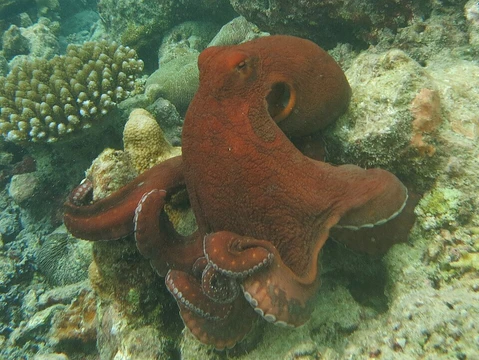
Ambush predation is the primary foraging strategy of octopuses (order Octopoda), the shell-less cephalopods that dominate benthic and reef ecosystems in every ocean. Rather than actively pursuing prey, an octopus exploits its chromatophore-based camouflage and dermal texture control to become functionally invisible against substrate—rock, coral, sand, or seagrass—then strikes with explosive speed when a crab, shrimp, small fish, or mollusc drifts within reach of its eight arms. This sit-and-wait tactic places the octopus among the most efficient invertebrate predators in the marine environment, occupying a trophic niche typically filled by small vertebrate hunters.
Because octopuses are solitary, non-colonial animals with no external shell, ambush predation solves a fundamental problem: how to feed without exposing a soft, vulnerable body to open-water predators. The strategy also conserves metabolic energy, allowing the animal to remain motionless for extended periods while its distributed nervous system continuously monitors the environment through chemoreception on the arm suckers and visual tracking via the large, W-shaped pupils of its eyes.
- Taxonomic group
- Order Octopoda, class Cephalopoda
- Predation mode
- Sit-and-wait / ambush
- Primary prey
- Crustaceans, small fish, bivalves, gastropods
- Camouflage mechanism
- Chromatophores + contractile dermal papillae
- Strike mechanism
- Rapid arm extension assisted by siphon jet propulsion
- Social structure
- Solitary; no colonial or cooperative hunting
- Neural architecture
- Distributed; approximately two-thirds of neurons reside in the arms
Lore & Background
In the benthic world of a coral reef or rocky shore, an octopus in ambush is less an animal than a landscape feature. Its mantle flattens, its arms drape over the substrate, and its chromatophores—each one a tiny muscular sac filled with pigment—mimic the exact mottling of the rock or sand beneath it. Contractile papillae in the dermis add a three-dimensional roughness that breaks up the animal's outline. To a foraging crab or a dashing damselfish, the octopus simply is not there. The only tell is the faint, almost imperceptible pulse of the gills as the animal breathes.
The strike, when it comes, is almost mechanical in its speed. Two or three arms extend in a straight line, suckers clamping the prey's carapace or fins before it can react. The remaining arms coil and restrain. A single rotation of the hard, parrot-like beak (rostrum) injects a mild venom that paralythes the prey, and the octopus drags its meal into a crevice to feed in safety. The entire sequence, from first visual lock to first bite, can occupy well under a second.
What elevates this behaviour above a simple reflex is the cognitive layer that precedes and follows it. Octopuses have been documented selecting different camouflage patterns for different substrates, timing their strikes to a prey's gait, and even carrying a discarded coconut shell as a portable shelter while repositioning to a new ambush site. The distributed nervous system—where each arm carries a local neural ganglion capable of independent sensory processing—allows the animal to coordinate eight limbs in a fluid, multi-directional manipulation that few invertebrate nervous systems of comparable size can match. In the broader study of cephalopod cognition, ambush predation in Octopoda remains one of the most accessible and well-documented windows into how a decentralised brain solves real-time foraging problems.
Reader's Guide
An octopus selects a substrate matching its hunting position—rock face, coral head, or sandy patch—and settles into a low, flattened posture. Using thousands of chromatophores and contractile dermal papillae, it replicates the colour, mottling, and texture of the surface so precisely that prey walking over it register no visual cue. It remains motionless, conserving energy, while its large eyes track movement and its arm suckers sample dissolved chemicals in the water.
When a crustacean or small fish enters arm's reach, the octopus strikes in a fraction of a second. Two or more arms snap forward, suckers lock onto the prey's carapace or fins, and the remaining arms wrap and immobilise it. A bite from the hard beak delivers a mild paralytic venom. The octopus then carries the prey to a sheltered crevice, cracking shells or peeling exoskeleton with its arms before feeding.
What distinguishes this from simple reflex is the planning and flexibility. Documented observations show octopuses selecting different camouflage patterns for different substrates, adjusting strike timing to a prey's gait, and using a discarded shell as portable cover while repositioning. The distributed nervous system lets each arm process local sensory input and coordinate with the central brain, producing multi-limbed manipulation that few invertebrate nervous systems achieve. Ambush predation in Octopoda thus stands as a key case study in cephalopod cognition.
Did You Know?
- Roughly two-thirds of an octopus's neurons are located in its arms rather than in a central brain, giving each limb a degree of independent sensory processing during the strike.
- Octopuses change not only the colour of their skin but its physical texture, using contractile papillae in the dermis to raise bumps, ridges, and spines that match the substrate's three-dimensional surface.
- Individuals of Octopus vulgaris have been documented carrying a discarded coconut shell over their mantle as a portable shelter, a behaviour interpreted as early tool use in an invertebrate.
- Octopus blood is blue rather than red because it carries oxygen with copper-based haemocyanin instead of iron-based haemoglobin, a trait shared with other cephalopods and some crustaceans.
More in Behavior & Intelligence
Elsewhere in Big blue octopus
Spotted an error? Know more?
Reader corrections go straight into our review queue. Suggest an edit · How this site is sourced