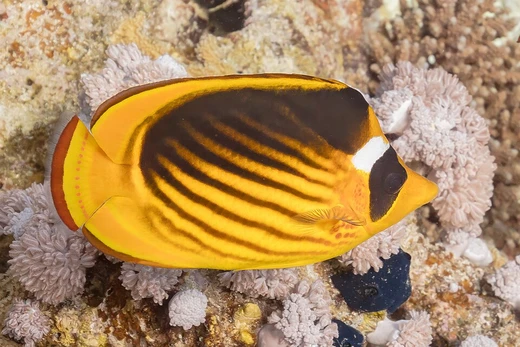
Chaetodon lunula
A tiny crescent of ink on a pale body, haunting the western Indian Ocean's quiet reefs.

Debra Baker · CC BY 4.0
Chaetodon lunula, commonly known as the Moon Butterflyfish, is a small reef-dwelling species in the family Chaetodontidae. First described by Georges Cuvier in 1830, it is restricted to the western Indian Ocean, where it inhabits shallow coral reefs, lagoons, and the upper outer slopes around Madagascar, the Comoros, and Mozambique. Its most striking feature—a dark crescent-shaped marking on the posterior body—gives the species its name and its common name.
As a benthic forager, C. lunula picks small crustaceans, polychaetes, and other invertebrates from the reef substrate and crevices. It typically occurs in pairs or small groups over rubble and coral boulders, playing a modest but ecologically meaningful role in controlling invertebrate populations on the reef floor.
- Common name
- Moon Butterflyfish
- Scientific name
- Chaetodon lunula Cuvier, 1830
- Family
- Chaetodontidae
- Distribution
- Western Indian Ocean (Madagascar, Comoros, Mozambique)
- Typical size
- ≈ 10 cm total length
- Habitat
- Shallow coral reefs, lagoons, outer slopes
Lore & Background
Cuvier's 1830 account in Le Règne Animal placed Chaetodon lunula among the smaller chaetodontids known to European naturalists at the time, and the species name—drawn from the Latin lunula, 'little moon'—immediately flagged the diagnostic dark crescent that sets it apart from its congeners. For nearly two centuries the fish remained a relative curiosity of Malagasy and Mozambican collections, appearing in a handful of aquarium trade records before the modern hobby took an interest in western Indian Ocean endemics.
In the field, the Moon Butterflyfish is a quiet, substrate-oriented fish. Unlike the more open-water, plankton-grazing butterflyfishes of the same genus, C. lunula spends most of its daylight hours hovering just above rubble and broken coral, its long, pointed snout probing crevices for small isopods, amphipods, and polychaete larvae. Pairs are frequently observed, and the species appears to defend a small home territory over a patch of reef structure.
Its restricted range makes it a marker species for the western Indian Ocean biogeographic province. Collectors and marine biologists working around Nosy Be, the Comoros archipelago, and the Bazaruto Channel note that the fish is most abundant in the 2–15 m depth band, favouring areas with mixed live and dead coral rather than open sand flats.
Reader's Guide
Morphology & Diagnosis. Chaetodon lunula is a small butterflyfish reaching roughly 10 cm in total length. The body is laterally compressed, pale yellowish-white to silvery, with a single broad dark vertical bar through the eye (a shared trait across many chaetodontids) and, critically, a dark crescent-shaped blotch on the posterior flank—this lunule is the feature Cuvier (1830) highlighted in the original description in Le Règne Animal.
Distinguishing from congeners. In the western Indian Ocean, C. lunula is sometimes confused with Chaetodon decussatus or C. kleinii, but neither of those species bears the isolated posterior crescent. C. decussatus shows a fine reticulated pattern; C. kleinii has a more elongate body and a different bar pattern. The lunule on C. lunula is unique among regional chaetodontids and is the single most reliable field mark.
Habitat & behaviour. The species favours shallow (2–15 m) reef structures—rubble, broken coral, and the base of live colonies—over open sand. It is a benthic picker, using its elongated maxilla to extract invertebrates from crevices. Pairs are commonly observed, consistent with the territorial, pair-bonded behaviour typical of the genus (see Randall, 1998, for a review of chaetodontid social systems).
Reference: Cuvier, G. (1830). Le Règne Animal, 3rd ed., vol. 3. Paris: F. G. Levrault. Randall, J. E. (1998). A revision of the butterflyfish genus Chaetodon. Bulletin of the Marine Laboratory, 15(1): 1–140.
Did You Know?
- The specific epithet 'lunula' is Latin for 'little moon,' a direct reference to the dark crescent marking on the fish's posterior body.
- Chaetodon lunula is endemic to the western Indian Ocean and has not been recorded in the Indian Ocean east of the Comoros or in the Pacific.
- Cuvier described the species in 1830, making it one of the earlier butterflyfishes formally named in the modern taxonomic era.
- Unlike many larger, open-water butterflyfishes, C. lunula is a benthic forager that spends most of its time probing reef crevices for small invertebrates.
Taxonomy & Classification
The raccoon butterflyfish first entered the scientific record in 1802, when the French naturalist Bernard Germain de Lacépède formally described it under the name Pomacentrus lunula, citing the Indian Ocean as its type locality. Today it sits within the large subgenus Rabdophorus, a grouping so substantial that some taxonomists believe it merits elevation to full genus status. Within that subgenus, its nearest kin is the remarkably similar Red Sea raccoon butterflyfish, C. fasciatus, sometimes called the diagonal butterflyfish. Other close relatives include the black butterflyfish (C. flavirostris), the Philippine butterflyfish (C. adiergastos), and possibly the unusual redtail butterflyfish (C. collare). Despite considerable variation in coloration across this group, the members share a common body plan: a largish, oval silhouette with ascending oblique stripes along the flanks. Nearly every species in the group retains at least a vestigial version of the signature raccoon mask, defined by a pale gap separating the dark crown from the dark eye region.
Physical Description & Coloration
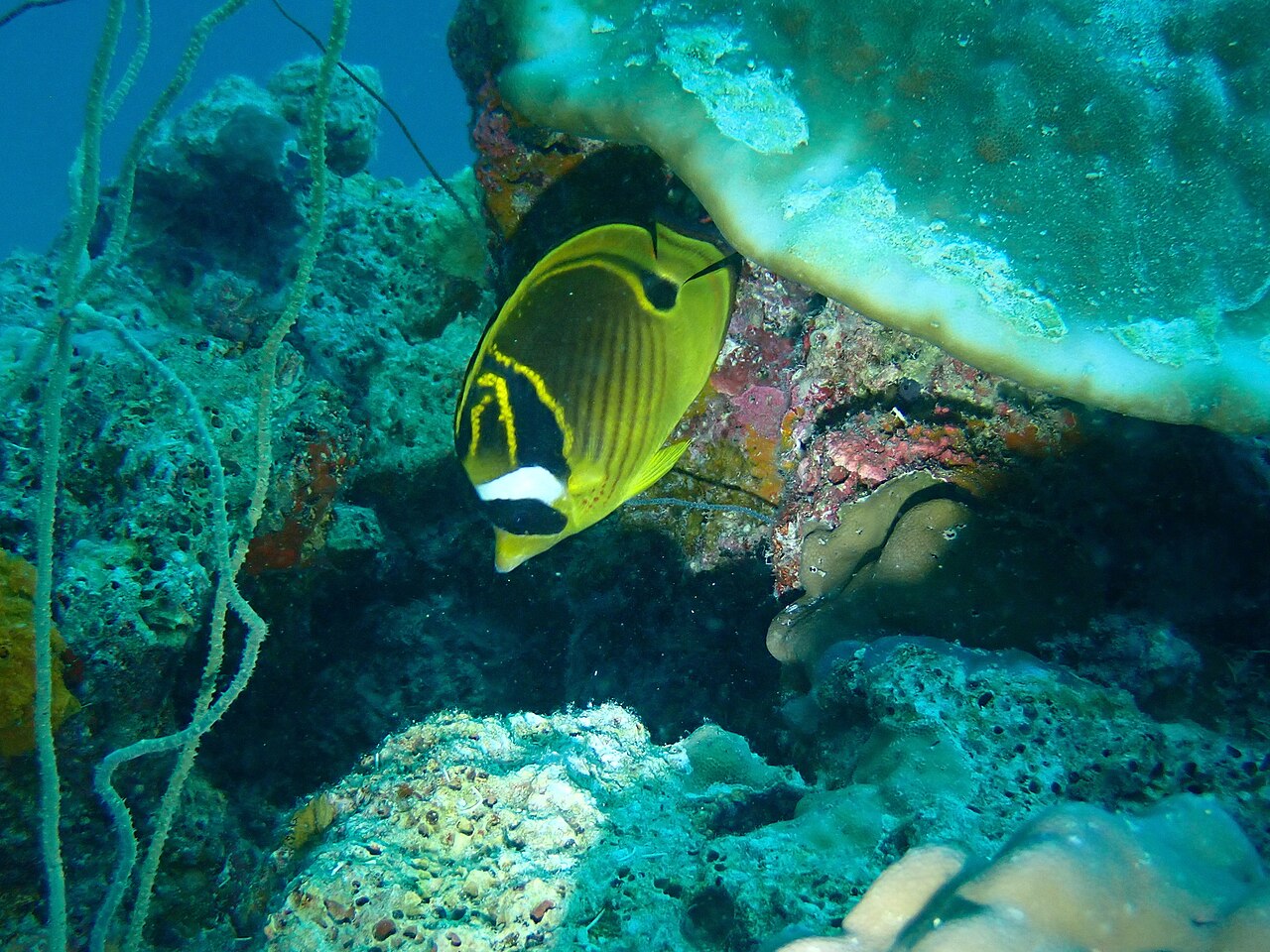
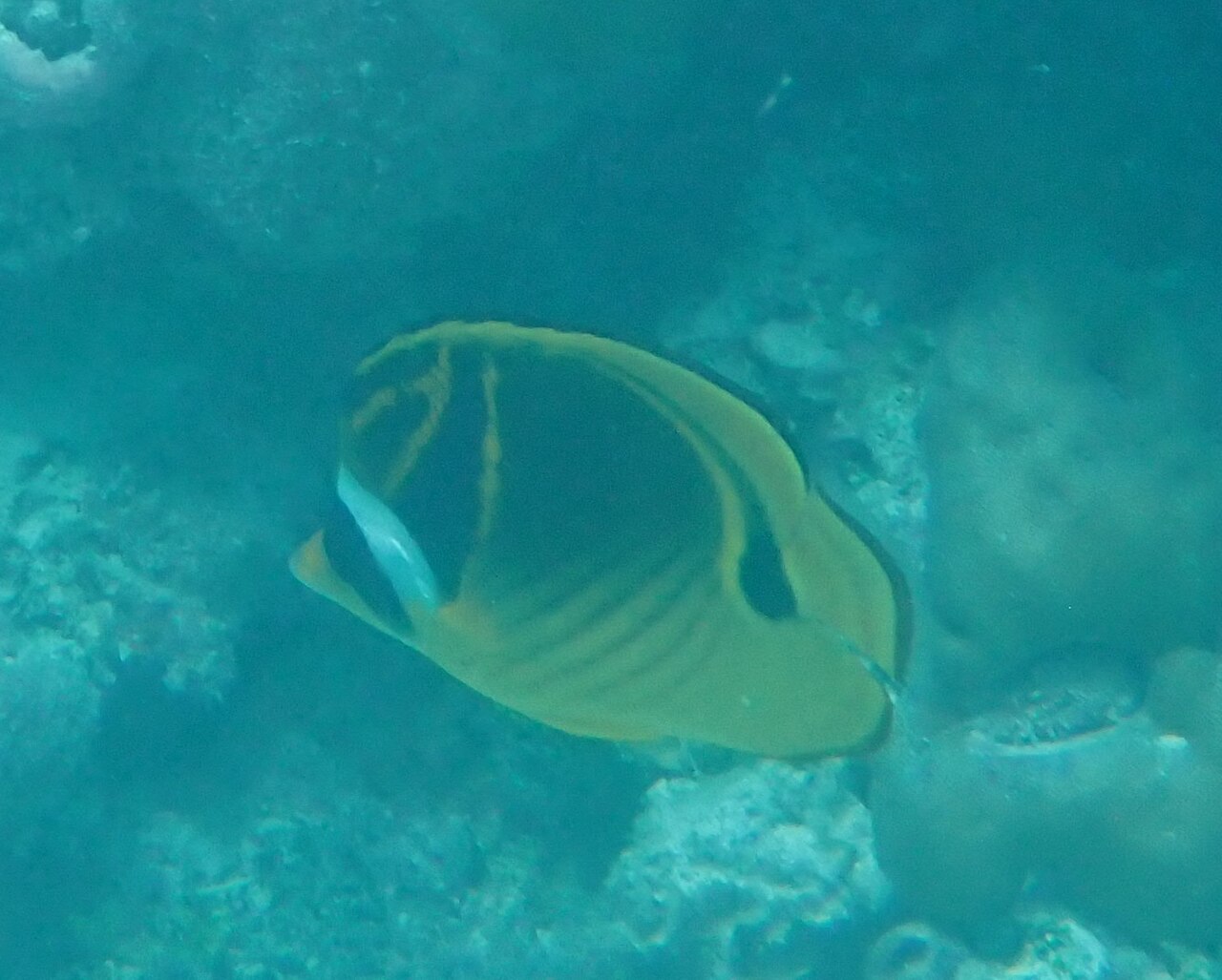
Few reef fish are as immediately recognizable as the raccoon butterflyfish, a name that captures its most striking feature: bold black-and-white banding across the face and eyes that mimics the masked look of a raccoon. Growing to a maximum length of roughly 20 centimeters (nearly 8 inches), it is one of the larger members of its family. The body presents a smooth oval outline, and the flanks are decorated with a series of ascending oblique reddish stripes that give the fish a dynamic, almost geometric appearance. Behind the head, oblique yellow stripes add another layer of color, while a distinct black spot marks the caudal peduncle. Skeletally, the species carries between 10 and 14 dorsal spines and 3 anal spines. The sheer variety of common names it has accumulated—crescent-masked, lunule, halfmoon, moon, redstriped, and simply raccoon coralfish—testifies to how widely this fish is encountered and how many different local traditions have tried to pin down its identity.
Biology, Diet & Distribution
Unlike many of its butterflyfish relatives that are active foragers by day, the raccoon butterflyfish is a nocturnal species, spending its daylight hours in relative quiet and becoming most active after dark. It typically lives in small groups rather than as a solitary individual. Its adult diet is notably varied: nudibranchs and small invertebrates form the bulk of its meals, though it will also graze on algae and coral polyps, making it a mixed-feeding generalist on the reef. Geographically, this fish enjoys one of the broadest ranges of any butterflyfish, stretching across the tropical Indo-Pacific from the coast of East Africa all the way to the Hawaiian and Marquesan islands, and northward to southern Japan. It also appears in the southeast Atlantic off South Africa. In terms of habitat preference, it favors seaward reefs and the shallow reef flats found on lagoon edges, typically at depths exceeding 30 meters.
Life in the Aquarium
For reef aquarists, the raccoon butterflyfish occupies a fascinating middle ground between beneficial and potentially destructive. In a community tank it is generally peaceful, showing no real aggression toward most tankmates, with the notable exceptions of lionfish and triggerfish, which it will target. In captivity, a well-cared-for specimen can live five to seven years. One of its most celebrated roles in the hobby is as a biological control agent: it is a voracious predator of Aiptasia and Majano sea anemones, the notorious nuisance pests that plague reef systems. Depending on the anemone population and the size of the tank, a raccoon butterflyfish can eliminate the infestation within two to six weeks. However, this same appetite for soft tissue means it will eagerly consume any soft corals in the display, potentially causing more aesthetic damage than the anemones it removes. Keepers should also be vigilant for marine ich, caused by the ciliate Cryptocaryon irritans, to which this species is particularly susceptible in the confined conditions of an aquarium.
Gallery
More in Species Profile
Elsewhere in Diagonal butterflyfish
Spotted an error? Know more?
Reader corrections go straight into our review queue. Suggest an edit · How this site is sourced