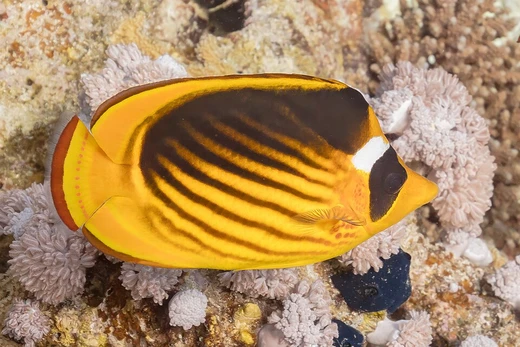
Chaetodon humeralis
A flash of Caribbean yellow anchored by a single black shoulder spot.

Chaetodon humeralis, the humeral butterflyfish, is a small, vividly coloured reef fish in the family Chaetodontidae. First described by Cuvier in 1830, it is a resident of Caribbean and western-Atlantic coral reefs, ranging from the Florida Keys and the Gulf of Mexico southward to the waters off Brazil. Its name derives from the conspicuous black spot on the shoulder (the humeral region) that distinguishes it from other yellow-bodied Atlantic butterflyfishes.
Ecologically, the species is a specialist sponge-feeder, using its elongated, pincer-like teeth to rasp tissue from demosponge surfaces. It is typically encountered in pairs or small, loosely territorial groups over patch reefs and the outer edges of reef flats, where its bright yellow coloration contrasts sharply with the surrounding blue water and brown sponge mats.
- Common name
- Humeral Butterflyfish
- Family
- Chaetodontidae
- Distribution
- Western Atlantic: Florida, Gulf of Mexico, Caribbean Sea, to Brazil
- Maximum length
- ≈ 15 cm (SL)
- Depth range
- 1–30 m
- Primary diet
- Demosponges
- Iucn status
- Least Concern
Lore & Background
The humeral butterflyfish occupies a narrow ecological niche within Caribbean reef communities. Its dentition—elongated, laterally compressed teeth forming a pincer-like arrangement—is a morphological adaptation for extracting sponge tissue, a feeding strategy shared with a handful of other Atlantic chaetodontids but carried to a particularly specialised degree here. Observers on the reefs of Bonaire, Curaçao, and the Florida Keys consistently report individuals hovering just above sponge colonies, inserting their mouths into oscula or surface tissue, a behaviour that can last for minutes at a time.
Socially, the species is dimeric or forms small aggregations of three to five individuals. The pair or group defends a modest feeding territory centred on a preferred sponge patch, driving off intruding conspecifics and, occasionally, other small reef fish. Males and females are visually indistinguishable in life, and courtship displays involve the pair rising together in a slow, spiralling ascent before a simultaneous release of gametes into the water column—a pelagic, broadcast-spawning strategy typical of the family.
In the broader context of Atlantic butterflyfish diversity, C. humeralis sits alongside congeners such as C. ephippium (saddle butterflyfish) and C. interruptus (interrupted butterflyfish). The key to separating them rests on the position and shape of the dark markings: the humeral spot is a single, roughly circular blotch on the pectoral-shoulder region, whereas C. ephippium bears a broad saddle-like bar across the mid-body and C. interruptus shows a broken, ladder-like pattern of dark bars.
Reader's Guide
Colouration & pattern. The body is a uniform, saturated yellow from snout to caudal peduncle. A single, broad black bar runs vertically through the eye, extending slightly above and below the orbit. The diagnostic feature—giving the species its name—is a round to oval black spot on the humeral (shoulder) region, just posterior to the pectoral-fin base. The dorsal and anal fins each carry a narrow black subterminal margin; the caudal fin is unmarked yellow. Cuvier (1830) noted the shoulder spot in his original diagnosis, and Randall (1955) reaffirmed it as the primary character separating C. humeralis from C. ephippium and C. interruptus in western-Atlantic keys.
Size & build. Total length reaches approximately 15 cm (standard length). The body is laterally compressed, disc-shaped in profile, with a moderately arched dorsal profile. The mouth is small and terminal, the teeth elongated and pincer-like—adapted for rasping sponge tissue rather than crushing hard substrates.
Habitat & depth. Found on live-bottom and patch reefs in the western Atlantic from Florida and the Gulf of Mexico to Brazil, typically between 1 and 30 m. It favours areas with dense demosponge cover, often on the outer reef slope or the windward edge of patch reefs where current brings a steady supply of planktonic material to the sponge colonies it feeds on.
Distinguishing from congeners. C. ephippium (saddle butterflyfish) has a broad, dark saddle across the mid-body rather than a discrete shoulder spot. C. interruptus (interrupted butterflyfish) shows multiple broken dark bars. C. humeralis is the only common western-Atlantic yellow chaetodontid with a single, isolated humeral blotch and no mid-body bar. (Randall, 1955; FishBase, Chaetodon humeralis entry.)
Did You Know?
- The species epithet 'humeralis' refers to the black spot on the shoulder (humerus), a feature Cuvier highlighted in the 1830 original description to separate it from other yellow Atlantic butterflyfishes.
- Its pincer-like dentition is a morphological specialisation for rasping demosponge tissue, making it one of the more sponge-dependent butterflyfishes in the western Atlantic.
- Despite its small size, a pair of C. humeralis will actively defend a feeding territory centred on a preferred sponge colony, driving off intruding conspecifics and other small reef fish.
- The species is a pelagic broadcast spawner: the pair rises together in a slow spiral and releases gametes simultaneously into the open water column, a strategy shared across the Chaetodontidae.
More in Species Profile
Elsewhere in Diagonal butterflyfish
Spotted an error? Know more?
Reader corrections go straight into our review queue. Suggest an edit · How this site is sourced