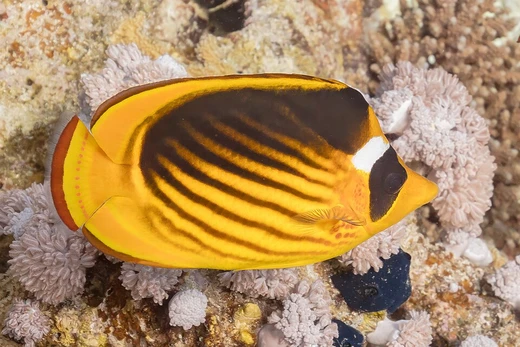
Chaetodon aurantia
A living ember of orange, tethered to the coral it feeds upon.

Chaetodon aurantia, commonly known as the Orange Butterflyfish or Orange Coralfish, is a small, vividly colored member of the butterflyfish family (Chaetodontidae). First described by Cuvier in 1831, it is one of the more uniformly orange species in a genus otherwise noted for bold patterns and contrasting markings. Its unbroken golden-orange body, punctuated only by a dark eye-stripe and a small black spot near the dorsal fin, makes it instantly recognizable on the reef.
Found across the Red Sea, the Indian Ocean, and parts of the western Pacific, C. aurantia is a true coral-reef specialist. It forms tight, territorial pairs around colonies of live coral, feeding primarily on coral polyps and small invertebrates sheltered among the branches. Its small size and specialized diet place it in a distinct ecological niche among the larger, more generalized butterflyfishes of the same habitat.
- Common name
- Orange Butterflyfish
- Scientific name
- Chaetodon aurantia
- Family
- Chaetodontidae
- Described by
- Cuvier, 1831
- Distribution
- Red Sea, Indian Ocean, western Pacific
- Size class
- Small butterflyfish (under 10 cm SL)
- Habitat
- Live-coral reefs, typically shallow
Lore & Background
Cuvier's 1831 description placed Chaetodon aurantia among the butterflyfishes of the Indo-Pacific, noting its remarkable uniformity of coloration in a genus where most species rely on stripes, bars, or spots for camouflage or species recognition. The eye-stripe and the small black nuchal mark are the only deviations from the otherwise solid orange ground color, a pattern Randall (1955) later confirmed as diagnostic when separating it from the superficially similar C. reticulatus and C. decussatus, both of which carry extensive reticulate or cross-hatched markings.
Behaviorally, C. aurantia is a strict pair-bonder. Unlike many larger chaetodontids that feed solitarily or in loose aggregations, this species maintains a small, defended territory centered on a particular coral colony. The pair forages in tandem, each individual picking polyps and tiny crustaceans from the coral's surface. This tight association with live coral means the species is highly vulnerable to coral bleaching and degradation events, a sensitivity noted in several Indo-Pacific reef surveys.
In the aquarium trade, C. aurantia is prized for its compact size and striking color, but its specialized diet and territorial temperament make it a challenge for all but experienced reef keepers. It is generally listed as a species requiring a well-established coral system and a varied diet supplemented with frozen mysis and coral polyps, though specific husbandry parameters vary by source and are best referenced from dedicated aquaculture literature rather than generalized care sheets.
Reader's Guide
Coloration and pattern. C. aurantia presents a uniform, deep orange to golden-orange body from snout to caudal peduncle. The only contrasting marks are a broad black eye-stripe running from the mouth through the eye to the opercle, and a small, round black spot at the posterior base of the dorsal fin. This plainness is the key diagnostic feature separating it from congeners such as C. reticulatus (which bears a dense network of dark lines) and C. decussatus (which shows cross-hatched bars). Cuvier (1831) noted the solid ground color in the original description, and Randall (1955) reaffirmed it as the primary separating character in his revision of Indo-Pacific chaetodontids.
Size and body shape. The species reaches roughly 8–10 cm in standard length, placing it among the smaller members of the genus. The body is laterally compressed and deep, typical of chaetodontids, with a moderately pointed snout adapted for picking polyps from coral surfaces. Allen (1981) in his western Pacific review confirmed the small size range and noted that juveniles are slightly paler in hue than adults, with the black nuchal spot less pronounced.
Diet and foraging. C. aurantia is a specialist feeder on coral polyps, small benthic crustaceans, and other invertebrates associated with live coral. It forages in pairs, each individual working a small section of the colony. This dietary specialization distinguishes it from many larger butterflyfishes that feed more broadly on plankton, algae, or detritus. Randall (1955) and subsequent ecological studies of Red Sea and Maldivian reefs confirm the tight trophic link to scleractinian coral.
Pairing and territory. The species forms monogamous pairs that defend a small territory, typically a single coral colony or a cluster of colonies. Territorial aggression is directed at conspecifics and other small reef fish; the pair will chase intruders from the immediate vicinity of their coral. This behavior is consistent across Red Sea, Indian Ocean, and western Pacific populations as reported in multiple field studies.
Did You Know?
- Despite living in a genus of over 100 species, C. aurantia is one of the very few butterflyfishes whose entire body is a single, unbroken color—no stripes, bars, or spots beyond the eye-stripe and a tiny nuchal mark.
- Unlike many butterflyfishes that change sex (protandrous hermaphrodites), C. aurantia appears to be a fixed-sex, pair-bonding species, with the male and female remaining together for the life of the pair.
More in Species Profile
Elsewhere in Diagonal butterflyfish
Spotted an error? Know more?
Reader corrections go straight into our review queue. Suggest an edit · How this site is sourced