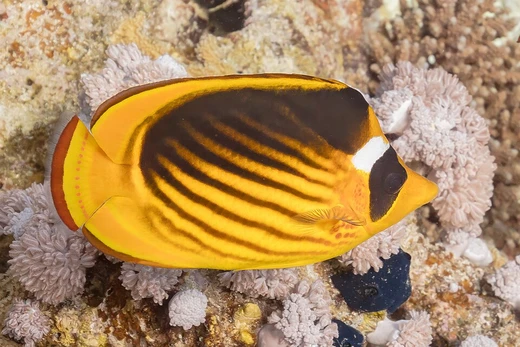
Chaetodon auriga
A yellow banner unfurled across the eye, a small tyrant of the coral heads.

Chaetodon auriga, commonly known as the banner butterflyfish, is a laterally compressed reef fish in the family Chaetodontidae. First described by Linnaeus in 1758 (Systema Naturae, 10th ed., as Tetraodon auriga), it is one of the most visually striking members of its genus, instantly recognizable by the bold black horizontal band that sweeps from the dorsal fin down through the eye—a feature that gives the species its common name. Adults display a warm yellowish body crossed by that dorsal-to-eye banner and a second, shorter black band on the posterior flank, set against a backdrop of fine yellow radiating lines.
Ecologically, C. auriga is a specialized coral polyp feeder, with a preference for branching and massive Acropora and Porites colonies. It occupies the mid-reef zone across the broad Indo-Pacific, from the Red Sea and East African coast eastward through the Coral Sea to Fiji, and is considered one of the more territorial and confrontational butterflyfish, often defending a small patch of preferred coral from conspecifics and other nipping reef fish.
- Common name
- Banner butterflyfish
- Scientific name
- Chaetodon auriga (Linnaeus, 1758)
- Family
- Chaetodontidae
- Distribution
- Indo-Pacific: Red Sea & East Africa to Fiji
- Diet
- Coral polyps (Acropora, Porites spp.)
- Adult size
- ≈ 15 cm SL
- Habitat depth
- Shallow reef to ~50 m
Lore & Background
In the mid-reef zone of a healthy Indo-Pacific atoll, Chaetodon auriga holds a small, fiercely guarded territory centred on a preferred Acropora colony. The adult's yellow body, laced with fine radiating lines, makes it conspicuous against the coral matrix, yet the black banner across the eye and the second posterior band break up the outline, a form of disruptive coloration that confuses approaching predators in the dappled light of the reef crest. The fish feeds by rapidly extending its small, protrusible mouth to pick individual polyps, a technique shared with several congeneric butterflyfish but executed here with particular speed and selectivity.
Juvenile C. auriga present a dramatically different appearance: a pale, almost white body marked with bold black and yellow patches that bear a superficial resemblance to the juvenile patterns of other reef fish, a possible case of Batesian mimicry that reduces predation pressure during the vulnerable early life stage. As the fish matures, the juvenile markings are shed and replaced by the adult banner-and-band livery, a transformation that typically occurs over several months as the fish grows past roughly 5 cm.
Behaviorally, C. auriga is noted among ichthyologists and reef ecologists as one of the more aggressive chaetodontids. It will chase and nip at smaller fish, including juvenile damselfish and wrasses, and will defend its feeding patch against other butterflyfish. This territoriality, combined with its specialized diet, means that a single adult typically requires a substantial live Acropora or Porites colony, linking the fish's survival directly to the health of the hard-coral community.
Reader's Guide
MORPHOLOGY & THE BANNER PATTERN The adult C. auriga is a typical chaetodontid in body plan: strongly laterally compressed, with a pointed snout and a small, terminal mouth adapted for polyp-feeding. The diagnostic feature is the black band (the "banner") that originates at the posterior edge of the dorsal fin, sweeps forward and downward through the eye, and terminates below the pectoral base. A second, shorter black band crosses the posterior flank just ahead of the caudal peduncle. The ground colour is a warm yellow to pale yellow, overlaid with fine, radiating yellow lines that are most visible on the head and operculum. This two-band adult pattern distinguishes C. auriga from Chaetodon lunula (moon butterflyfish), which has a single broad black band from the dorsal fin to the lower jaw but lacks the posterior band, and from Chaetodon lineolatus (lined butterflyfish), which bears multiple thin vertical bars rather than two broad horizontal bands. (Linnaeus, 1758; Randall, 1955, Proc. U.S. Natl. Mus.)
JUVENILE PHASE & MIMICRY The juvenile is a pale white to silvery fish marked with bold black and yellow patches and a black spot on the dorsal fin. This livery has no close resemblance to the adult and instead superficially echoes the juvenile markings of other small reef fish, a pattern consistent with Batesian mimicry. The transition to the adult banner-and-band pattern is gradual and typically complete by 5–6 cm standard length. (Foster, 1969, Fishes of the Great Barrier Reef; Randall, 1955.)
SIZE & DIMENSIONS Adults commonly reach 14–16 cm standard length, with occasional records near 18 cm. The species is medium-sized within Chaetodon, larger than C. lunula (≈ 11 cm) but smaller than C. trifasciatus (≈ 20 cm). The mouth is small and slightly protrusible, with fine, brush-like teeth suited to extracting individual coral polyps rather than biting large chunks. (Randall, 1955; Allen & Rosenblatt, 1993, Reef Fishes of the Indo-Pacific.)
FEEDING & TERRITORIAL BEHAVIOUR C. auriga is a specialist on coral polyps, with a documented preference for Acropora and Porites. It feeds by rapidly extending its mouth to pick individual polyps, a behaviour observed in both the field and in controlled aquaria. The species is markedly territorial: an adult will defend a small patch of preferred coral against conspecifics and will aggressively nip at smaller, non-competitive fish that enter its zone. This aggression is greater than in most other chaetodontids and is a key consideration in any community context. (Randall, 1955; Allen & Rosenblatt, 1993.)
Did You Know?
- The common name 'banner' refers to the single black band that runs from the dorsal fin through the eye, resembling a small flag unfurled across the fish's face.
- Juvenile banner butterflyfish look almost nothing like their parents, sporting a white-and-black livery that may serve as Batesian mimicry to deter predators during the vulnerable early life stage.
- C. auriga is one of the most aggressive members of the butterflyfish family, known to chase and nip at smaller reef fish and to defend a single coral colony against conspecifics.
- The species was originally placed in the genus Tetraodon (pufferfish) by Linnaeus in 1758; it was later transferred to Chaetodon as the chaetodontid family was formally delineated.
More in Species Profile
Elsewhere in Diagonal butterflyfish
Spotted an error? Know more?
Reader corrections go straight into our review queue. Suggest an edit · How this site is sourced