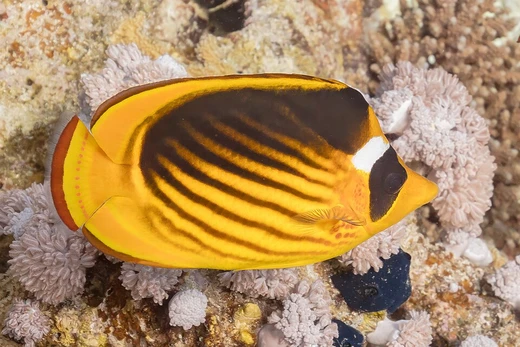
Chaetodon trifascialis
Three black bands, one reef, and a territorial streak that outlasts most of its neighbors.

Chaetodon trifascialis, commonly known as the threeband butterflyfish, is a small reef-dwelling fish in the family Chaetodontidae. Described by Cuvier in 1831, it is a Western Atlantic endemic, ranging from southern Florida and the Bahamas southward through the Caribbean to the coast of Brazil. Its bold pattern of three vertical black bars on a pale cream-white body, combined with a conspicuous black ocellus on the first dorsal fin, makes it one of the most immediately recognizable butterflyfishes in the region.
Ecologically, C. trifascialis occupies a niche as a benthic grazer and invertebrate specialist on shallow coral reefs. Typically encountered in pairs or small loose aggregations, it is territorial over a modest patch of live coral or rubble and feeds on coral polyps, small crustaceans, and other benthic invertebrates. Its presence is often taken as an indicator of healthy, structurally complex reef habitat in the Western Atlantic.
- Common name
- Threeband butterflyfish
- Family
- Chaetodontidae
- Authority
- Cuvier, 1831
- Distribution
- Western Atlantic: Florida & Bahamas to Brazil
- Habitat
- Shallow coral reefs, typically < 20 m
- Max recorded size
- ≈ 17 cm TL
- Diet
- Benthic invertebrates, coral polyps, small crustaceans
Lore & Background
On the windward slopes of Caribbean reefs, the threeband butterflyfish holds a small court of its own. A pair will defend a stretch of branching Acropora or a rubble ledge no larger than a dinner table, chasing off congener butterflyfish and smaller damselfish that venture too close. The male and female are morphologically indistinguishable, and both participate in the defense, darting out in quick, shallow-angle strikes before retreating to the shelter of the coral. Their feeding is methodical: the fish picks at polyp tips, plucks tiny copepods from crevices, and occasionally nips at anemone tentacles, a behavior that places it within the broader anemone-feeding guild of the genus Chaetodon.
The species' range is restricted to the Western Atlantic, a biogeographic pattern consistent with other Caribbean-endemic chaetodontids. It is absent from the Eastern Atlantic and the Indo-Pacific, where the genus is far more diverse. Within its range, C. trifascialis is most abundant on outer-reef slopes and patch reefs where live coral cover exceeds roughly 30 percent, and it is notably scarce on heavily silted or algae-dominated substrates. Seasonal shifts in water temperature and the passage of tropical storms can temporarily displace local populations, but the species re-colonizes suitable habitat within a few tidal cycles.
In the aquarium trade, the threeband butterflyfish is sought after for its clean, high-contrast pattern and relatively compact adult size. However, its territorial temperament and preference for a varied diet of live or frozen invertebrate foods make it a challenging species for beginners. It is generally peaceful toward non-butterflyfish tankmates but will harass other chaetodontids, particularly those with similar body plans such as Chaetodon humeralis or Chaetodon striatus, if housed together in a tank smaller than 400 L.
Reader's Guide
Bar pattern. Three vertical black bars: one through the eye from the dorsal surface to the ventral midline, one from the first dorsal fin down through the pectoral region, and one at the caudal peduncle. This tripartite arrangement is unique within the Western Atlantic Chaetodon. C. humeralis (saddle butterflyfish) replaces the mid-body bar with a broad saddle blotch, and C. striatus (striped butterflyfish) shows horizontal rather than vertical striping. See Cuvier (1831) and Randall (1955) for the original and revised descriptions.
Ocellus. A single round black eyespot on the first dorsal fin, bordered by a thin white ring. This ocellus is absent in C. humeralis and C. striatus and is the single most reliable field mark separating C. trifascialis from its nearest congeners. Hoese & Randall (1980) note it may function as a false-eye deflection against predation.
Size and shape. Adults reach approximately 17 cm total length. The body is laterally compressed, oval in cross-section, with a deeply forked caudal fin in adults and a more rounded tail in juveniles. The mouth is small and terminal, adapted for picking benthic prey rather than filter-feeding.
Colour. Base colour is cream to pale yellow-white. The three bars and the ocellus are jet black. The fins are translucent with faint yellow tinges; the caudal fin carries a narrow black subterminal band in some individuals. Juveniles are paler and the bars are less sharply defined.
Habitat preference. Shallow coral reefs, typically 2–20 m, on live coral, rubble, and mixed substrates. Avoids open sand and heavily algal-covered areas. Pairs or small groups of three to five are the norm; large aggregations are rare.
Did You Know?
- The black ocellus on the first dorsal fin is a false-eye that may misdirect strikes from predatory fish toward the less vital dorsal region rather than the head.
- C. trifascialis is a Western Atlantic endemic; it does not occur in the Eastern Atlantic or the Indo-Pacific, where the genus Chaetodon contains over 100 species.
- Unlike many butterflyfishes that are strictly monogamous, threeband pairs may be observed re-pairing after the loss of a mate, and territorial boundaries can shift seasonally.
- The species was originally described by Georges Cuvier in 1831, making it one of the earlier Caribbean reef fishes to receive a formal scientific name.
More in Species Profile
Elsewhere in Diagonal butterflyfish
Spotted an error? Know more?
Reader corrections go straight into our review queue. Suggest an edit · How this site is sourced